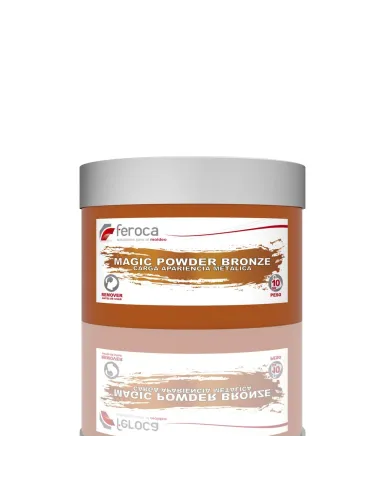
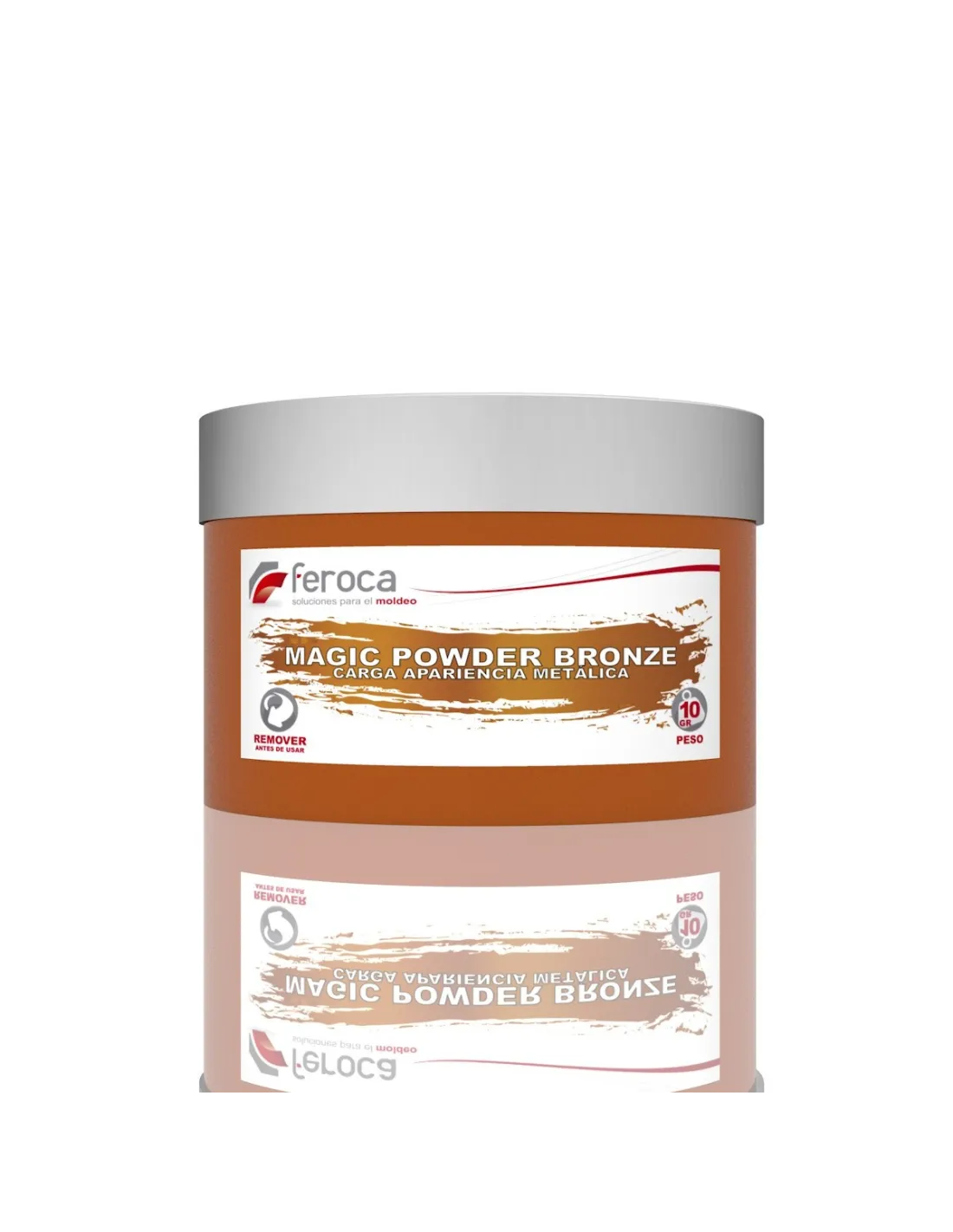
Magic Powder is a synthetic powder filler that lets you add brilliant metallic effects to cast pieces quickly and easily. Compatible with polyester, polyurethane and silicone resins, it achieves bronze, silver, gold and other metal finishes in minutes — without the time and effort required by traditional metallising. UV and water resistant, it is a versatile solution for both series production and prototypes and sculpture.
Technical specifications
| Parameter |
Detail |
| Product type |
Synthetic powder filler with metallic effect |
| Available colours |
Bronze, Flame Red, Gold, Dark Gold, Green, Grey Metal, Silver |
| Presentation (small jar) |
10 g (all colours) |
| Presentation (large jar) |
150–250 g depending on colour |
| UV resistance |
Yes |
| Water resistance |
Yes |
| Compatibility |
Polyester resins, polyurethane resins, silicones and urethane rubbers |
What it is used for
Magic Powder is designed for those who need convincing metallic effects without resorting to lengthy metallising or polishing processes. Its most common applications are:
- Decorative castings in transparent polyester resins with a metallic effect visible throughout the mass.
- Metallic finishes on rigid polyurethane resin parts for industrial prototypes and models.
- Sculptural reproductions that imitate bronze, silver or other metals without the weight or cost of real metal.
- Masks and special effects pieces with tin condensation silicones or urethane rubbers to achieve shiny, metallic surfaces.
- Design prototypes and architectural models requiring a visual metallic finish.
- Decoration and fashion accessories (jewellery, accessories) made in resin.
- Combination with special pigments to multiply colour and finish possibilities.
How to use it
- Prepare the casting system: mix your resin (polyester, polyurethane) or silicone according to the manufacturer's instructions before adding Magic Powder.
- Add Magic Powder: incorporate the powder into the mixed resin. The usual ratio ranges from 5% to 20% by weight of the total mix; adjust the amount to achieve the desired effect intensity.
- Mix carefully: stir slowly and steadily to avoid introducing bubbles and ensure an even distribution of the powder throughout the mass.
- Strain if necessary: for higher-quality finishes on small pieces, you can filter the mixture through a fine-mesh strainer to remove any lumps.
- Pour into the mould: cast in the usual way. To achieve the most intense metallic effect on the surface, orient the mould so the powder tends to settle on the visible face.
- Allow to cure: respect the curing times of the base system (resin or silicone) without modifications.
- Demould and finish: once the piece has cured, you can lightly sand or polish it to enhance the metallic shine on raised areas.
Usage tips
Proportions and colour saturation
Always start with a low proportion (5% by weight) and increase progressively until the desired effect is achieved. At percentages above 20% the powder can affect the flowability of the mix and make casting more difficult. If you need greater opacity without losing flowability, combine Magic Powder with Gel de Sílice AT2 in minimal proportions to adjust rheology without sacrificing the finish.
Combining with pigments and other fillers
Magic Powder works very well mixed with special pigments for resins, allowing you to create unique chromatic effects: a Bronze powder with a warm tone can yield aged copper or brass finishes. You can also combine it with hollow glass microspheres to lighten the piece without losing the metallic surface effect — especially useful in large-volume castings.
Final finish and polishing
For maximum metallic shine, sand the cured piece with fine-grit sandpaper (600–1200) and then apply a finishing wax or varnish. On reliefs and textures, rubbing with a soft cloth and some pressure concentrates the powder on the high points and creates a very realistic aged or patina effect. Store any leftover powder in its original tightly closed container, away from moisture, to preserve its properties.
Frequently asked questions
Can it be used with any type of resin?
Yes. Magic Powder is compatible with the main resin families used in the workshop: polyester, rigid and flexible polyurethane, and also with silicones and urethane rubbers. The only consideration is that the powder does not act as a curing agent or modify curing, so it does not alter the working times or the final result of the base system.
How much powder should be added to get a good effect?
The recommended starting ratio is between 5% and 10% by weight of the total resin mix. For more intense and opaque effects you can go up to 20%, but bear in mind that at higher proportions the mix loses flowability and may be harder to pour into fine-detail moulds.
Do the pieces hold up well outdoors?
Magic Powder has UV and water resistance, making it suitable for decorative pieces used indoors and outdoors with moderate exposure. For applications with intense and continuous sun exposure, it is recommended to apply a UV-protective varnish or lacquer over the finished piece to preserve the metallic finish.
Can different colours be mixed together?
Yes, you can mix different colours of Magic Powder to obtain intermediate tones or unique effects. For example, combining Bronze and Gold produces a very convincing brass finish. It is advisable to test in small quantities before applying the mix to the final production run.
What is the difference between using this powder and conventional metallic paint?
The main difference is that Magic Powder is incorporated into the body of the resin, so the metallic effect is structural rather than superficial. This means that if the piece is scratched or machined, the effect persists. Conventional metallic paint only covers the surface and can chip or wear off with use.
Can it be applied to the mould surface before casting?
Yes. A common technique involves depositing Magic Powder directly onto the mould surface with a dry brush before pouring the resin. This way the powder concentrates on the outer face of the piece, intensifying the surface metallic effect. Make sure the release agent does not interfere with the adhesion of the powder to the mould before casting.
Is a special release agent needed when used with silicones?
When you mix Magic Powder with resin and pour it into a silicone mould, you generally do not need a release agent, as silicone already provides natural release. If the mould is made of polyester, plaster or another porous material, apply the usual release agent before adding the powder or the mix.
How should it be stored correctly?
Store Magic Powder in its original tightly closed container, in a cool, dry place away from sources of moisture. Moisture can cause the powder to clump and make it harder to disperse in the resin. Under suitable conditions, the product has a long shelf life without its properties being affected.
How much product do I need?Calculate the exact amount before buying and avoid wasting material.
Go to the calculator →