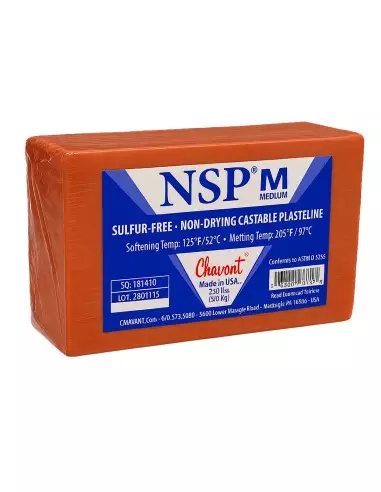
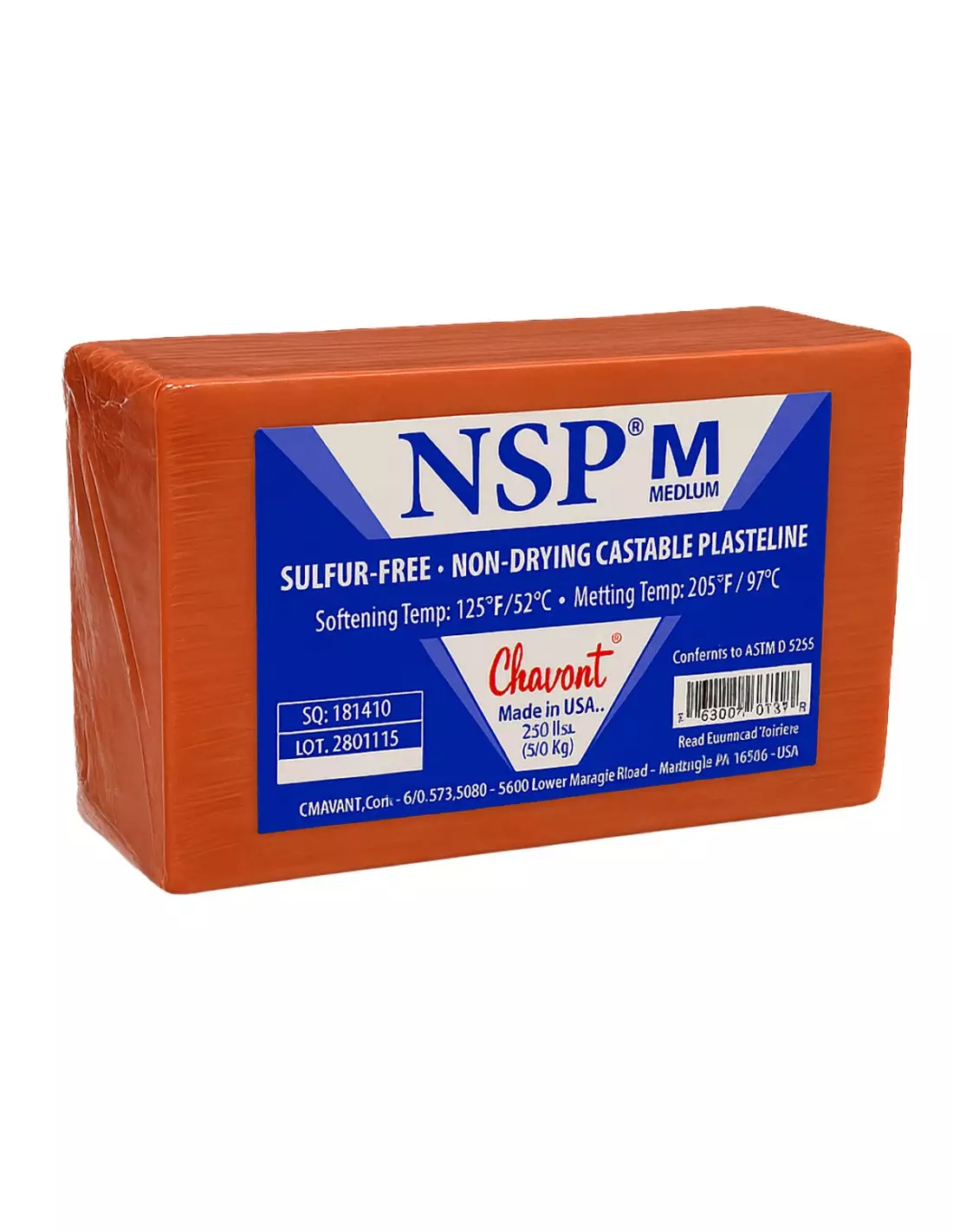
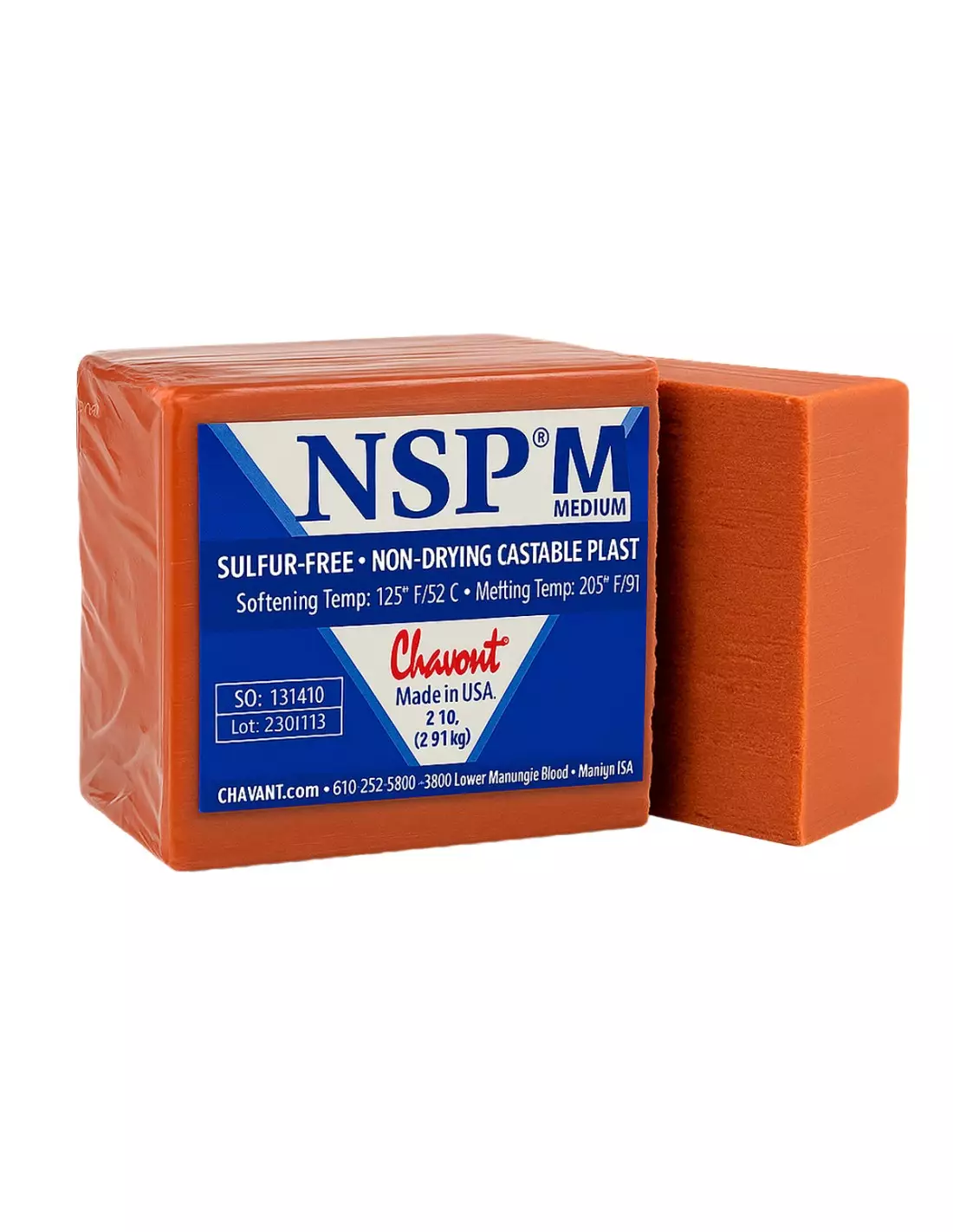
Chavant Medium Brown is a professional medium-hardness clay formulated without sulphur compounds, making it fully compatible with both platinum and tin silicones with no risk of inhibition. With a brown colour that mimics traditional clay, it is the go-to reference for sculptors, special effects technicians and industrial designers who need a precise, stable and reusable modelling material.
Technical specifications
| Property |
Data |
| Presentation |
906 g individually wrapped block |
| Colour |
Brown (clay imitation) |
| Hardness |
Medium |
| Sulphur-free |
Yes — compatible with platinum and tin silicones |
| Softening temperature |
Approx. 85 °C |
| Reusable |
Yes — softens with heat and can be reshaped |
| Toxicity |
Non-toxic, dust-free |
| Machineable |
Yes — milling, carving, extruding and raking |
| Usage level |
Professional, educational, FX, industrial prototyping |
What it is used for
Chavant Medium Brown covers a very wide range of workshop applications. Its medium hardness places it at the optimal point between manual workability and the ability to retain fine detail, making it versatile for both large-format pieces and high-definition work. It is the choice of special effects professionals, industrial prototypers and sculptors who need a predictable material with consistent behaviour.
- Modelling originals for reproduction with silicone or resin moulds
- Clay bed in two-part or double-sided moulds
- Industrial prototyping and product design
- Sculpture for special effects (FX) and animatronics
- Models for 3D scanning or CNC milling
- Fine arts and figurative sculpture
- Direct complement alongside Chavant Hard to combine zones of different hardness within the same piece
How to use it
- Preparation: at room temperature, Chavant Medium has a hardness that allows working with tools and fingers without any pre-heating. If the workshop is cold, briefly warm the block with a hot air dryer or in an oven at low temperature (max. 60–70 °C) until it becomes pliable.
- Building up mass: work in layers. Add volume with large portions and refine with spatulas and loop tools. Chavant Medium does not dry out, so you can pause work and resume it without any additional preparation.
- Fine detail: for high-detail areas, apply localised heat with a thermal pen or a dryer on low power to soften the surface locally without affecting the rest of the sculpture.
- Finishing and texture: use compatible solvents (such as Chavant Sulfur Free Solvent if available) or simply gentle heat to smooth the surface. Wet fingers do not work as they do with clay — use tools.
- Mould bed: spread the clay into a uniform sheet and press the original down to the parting line. Seal the edges with a tool to prevent silicone from seeping underneath.
- Moulding: apply silicone directly onto the clay original. Being sulphur-free, there is no risk of inhibition with either platinum or tin silicones.
- Material recovery: once demoulded, collect the clay, remove any contaminants (dust, fibres) and knead it again. The material is completely reusable.
Usage tips
Temperature: the key to behaviour
The hardness of Chavant Medium changes noticeably with temperature. In cold workshops (below 18 °C) it may be too firm to model comfortably by hand; in warm workshops (above 28 °C) it may lose some definition in very fine details. Keep the workshop at a stable temperature between 20 and 24 °C for the most predictable behaviour. If you need greater firmness for precision details, work with the Chavant Hard variant.
Compatibility with silicones: no restrictions
Containing no sulphur or other known inhibitors, you can use Chavant Medium in direct contact with any platinum silicone in your process without applying a barrier agent. This sets it apart from other industrial or craft clays that do contain sulphur and require prior sealing. If you use it as a mould bed alongside a platinum silicone, simply ensure that no other potentially inhibiting materials (uncured epoxy, latex, cyanoacrylate adhesives) come into contact with the fresh silicone.
Storage and reuse
Store Chavant Medium pieces in a cool place, away from direct sunlight and heat sources. Wrap unused blocks in their original packaging or in cling film to prevent surface dust accumulation, which can show up in fine detail if the material has been left exposed for a long time. The material does not expire if stored correctly; you can amalgamate leftovers from different sessions without any problem.
Frequently asked questions
What is the difference between medium-hardness and high-hardness clay?
Hardness determines the material's resistance to deformation under pressure. A medium-hardness clay like Chavant Medium is more workable at room temperature and allows modelling with fingers and tools with less effort. A high-hardness clay, such as Chavant Hard, retains fine detail better and resists accidental deformation more effectively, but requires more heat to work with. The choice depends on the type of piece and the level of detail required.
Can I use this clay directly with platinum silicones without inhibition?
Yes. Chavant Medium is formulated without sulphur compounds, which are the main inhibiting agents of addition-cure (platinum) silicones. You can place platinum silicone in direct contact with this clay without needing to apply any barrier agent or sealer beforehand. This is precisely the characteristic that makes it a reference material for FX workshops and prototyping studios working with platinum silicones.
How do I heat this clay to soften it?
You can heat it with a hot air dryer on low-to-medium power, in a workshop oven at a temperature no higher than 70–80 °C, or using a heating pad placed under the block. For localised softening during modelling, a dryer is the most precise option. Avoid temperatures above 85–90 °C for extended periods, as the material may become too fluid and lose the worked shape.
Is it possible to mix this clay with other clays in the same range to adjust hardness?
Yes. You can mix Chavant Medium with Chavant Hard to achieve a custom intermediate hardness. Heat both materials separately until they are workable and amalgamate them by kneading thoroughly until you achieve a homogeneous blend. This is a common technique in FX workshops when you want to tailor the material's behaviour to a specific task.
Can this clay be machined on a milling machine or CNC?
Yes. Chavant Medium is machineable: it accepts milling, carving with rotary tools and extruding. For best results in CNC milling, work with the material at room temperature or slightly below to maximise firmness and prevent chips from sticking to the tool. It is an established option in industrial prototyping as an alternative to polyurethane or modelling foam blocks when a reusable material is needed.
How much clay do I need to model a life-size head?
For a solid life-size head you will need between 4 and 6 kg of material, depending on wall thickness and the level of detail of the neck and base. If you work over a foam core or internal Armature, you can considerably reduce consumption, down to just 1.5–2.5 kg for the surface covering. Each Chavant Medium block weighs 906 g, so plan for at least 2–3 blocks for a project of this size over an Armature.
Is it necessary to seal the clay original before pouring silicone?
With Chavant Medium there is no need to apply any sealer or barrier agent before pouring a platinum or tin silicone. Its sulphur-free formulation guarantees there will be no inhibition or problematic adhesion. It is advisable, however, to check that there are no other materials on the piece (paints, adhesives, uncured resins) that could cause problems before proceeding with moulding.
Is this clay suitable for use with children or in educational settings?
Chavant Medium is non-toxic and does not generate dust under normal conditions of use. However, it is a professional workshop material, not a toy. In university-level or vocational training educational settings it is perfectly appropriate. For use with minors, always consult the safety data sheet and ensure adult supervision, especially when heat is used to soften the material.