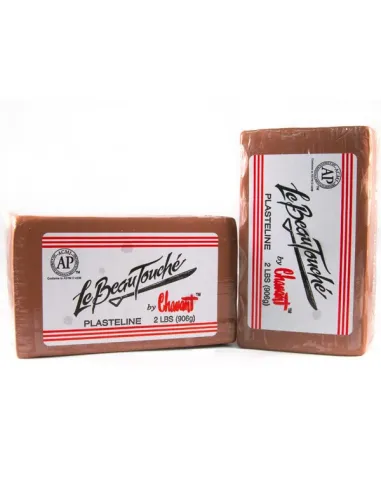
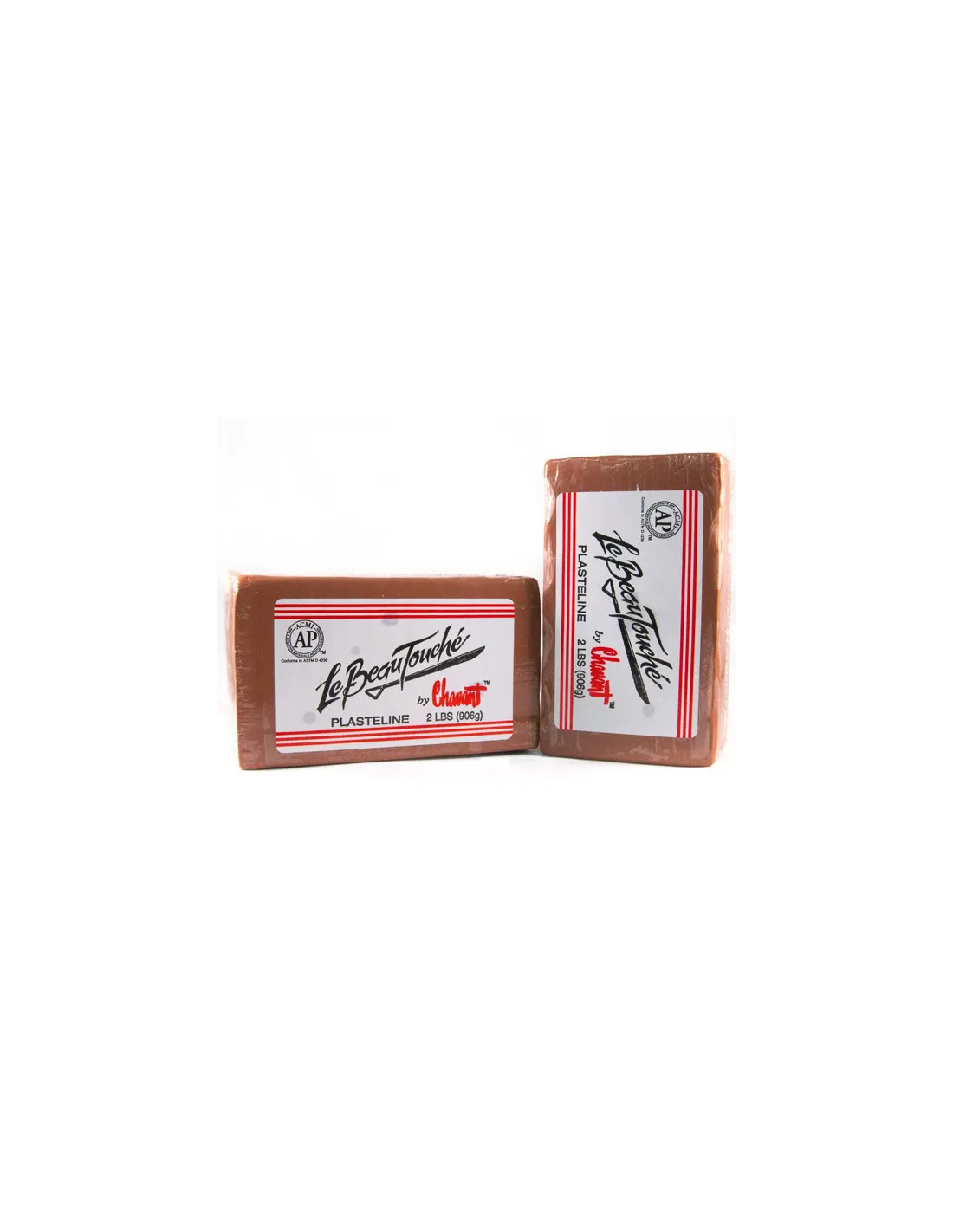
Le Beau Touché is a professional sulphur-free clay designed for sculpting originals and high-detail modelling. Its exceptional heat sensitivity makes it extraordinarily workable with the simple friction of the hands, and its outstanding adhesion allows it to be fixed to any armature or support without prior preparation. It does not dry out, does not crack, and is fully compatible with platinum silicones.
Technical specifications
| Parameter |
Value |
| Format |
906 g block |
| Composition |
Sulphur-free (no sulphides) |
| Recommended working temperature |
Room temperature — maximum 32 °C |
| Heat behaviour |
Very sensitive: softens with the friction of the hands |
| Drying / cracking |
Does not dry out or crack |
| Stability |
No significant changes after heating and cooling cycles |
| Compatibility with platinum silicones |
Yes (sulphur-free formulation) |
| Storage |
Room temperature, no special restrictions |
What it is used for
Le Beau Touché is aimed at artists and professionals who need a soft, high-detail clay that is compatible with platinum silicones for subsequent moulding of the original. It is a standard tool in figurative sculpture studios, special effects, prototype manufacturing and character creation.
- Sculpting originals for subsequent moulding in platinum silicone
- Figurative sculpture: busts, heads, full bodies
- Industrial prototypes and design models
- Special effects and character creation: concept prosthetics, creatures, monsters
- Long-lasting decorative and artistic sculptures
- Filling and correcting ongoing sculptures
- Modelling base over metal armatures, wood or foam
How to use it
- Prepare the armature or support: build the internal structure (wire, foam, wood) that will hold the piece and reduce material consumption.
- Soften the clay: work small portions between the hands until it reaches the desired plasticity. If you need to soften it faster, gently apply heat with a hair dryer on a low setting or leave the block in a warm place (never above 32 °C).
- Add material in layers: apply the clay in successive layers over the armature, pressing firmly to ensure adhesion and avoid internal air bubbles.
- Model the detail: use modelling tools, spatulas and sculpting tools to define surfaces, textures and fine details. Localised heat from a warm metal tool makes smoothing easier.
- Refine and correct: the clay can be removed, added to or redistributed at any time with no time limit. There is no working pressure.
- Prepare for moulding: once the original is finished, seal it if necessary with a suitable Release agent before applying the platinum silicone. Being sulphur-free, Le Beau Touché does not inhibit the cure of the silicone.
Usage tips
Temperature control in the studio
Le Beau Touché is very sensitive to heat, which is an advantage but also a risk if the studio is very warm. Above 28–30 °C the clay loses consistency and can deform under its own weight in large pieces. If you work in summer or in a warm studio, briefly refrigerate the piece to recover firmness before adding fine detail. In winter, the material may feel somewhat stiffer than usual: warm it for a few minutes with a hair dryer before starting.
Tools and surface smoothing
To achieve perfectly smooth surfaces, run a slightly warmed (not hot) metal spatula over the clay with slow, even movements. You can also use mineral solvent (white spirit or similar) on a soft brush to unify the surface, although this may slightly alter the finish on highly detailed pieces. Always test on an inconspicuous area before applying it to the whole sculpture.
Compatibility with silicones and preparation of the original
Being sulphur-free, Le Beau Touché is directly compatible with platinum silicones with no risk of inhibition. Even so, if the piece has exposed metal armature, adhesive residue or any other material of doubtful compatibility, apply a thin layer of Release agent or seal those areas before pouring the silicone. Bear in mind that inhibition can occur through contact with materials other than the clay itself, not just the clay. If you have any doubts about the compatibility of a material, always carry out a cure test with a small amount of silicone on the surface.
Frequently asked questions
Is this clay compatible with platinum silicones?
Yes. Le Beau Touché is formulated without sulphur or sulphides, so it does not inhibit the cure of platinum silicones. You can pour platinum silicone directly over the original without needing to seal it, although it is recommended to check that other materials in contact (armatures, adhesives, foams) are not inhibitors either.
Can this clay be used for finished modelling without making a mould?
Yes. Le Beau Touché does not dry out or crack, so it is perfectly valid for display pieces or models that are not going to be moulded. Bear in mind that being thermoplastic, it is not suitable for outdoor use or environments with high temperatures.
How do you soften it if it is very hard when taken out of storage?
Work small portions between the hands for a few minutes. If you need to soften a larger amount, apply gentle heat with a hair dryer on a low setting or leave the block in a warm environment. Never exceed 32 °C or use a microwave, as excessive heat can alter the material's properties.
How much do I need to model a life-size head?
For a life-size head without an internal armature you may need between 2 and 4 kg depending on the wall thickness. If you use a foam or wire armature to fill the internal volume, one or two 906 g blocks may be enough to add the surface detail. It is recommended to always have spare material on hand.
Can the clay be reused after working with it?
Yes. Le Beau Touché retains its properties after multiple heating and cooling cycles. You can recover offcuts and leftovers, knead them and use them again without any appreciable loss of quality. Avoid contaminating it with dust, dirt or incompatible materials that could transfer to future originals.
Does it accept paint or surface finishes?
Le Beau Touché accepts acrylic and oil paints on its surface, although being a greasy material adhesion may be limited without a prior primer. For pieces intended to be painted as a final finish, apply a coat of spray primer (fixative lacquer or similar) and allow to dry before painting. If the piece is going to be moulded, a surface finish is not necessary.
What is the difference between Le Beau Touché and other professional clays of higher hardness?
Le Beau Touché is a low-to-medium hardness clay, particularly sensitive to body heat, making it very comfortable to work freehand during long sessions. Harder clays, such as Chavant Hard, allow greater precision on very fine details and very hard surfaces, but require more effort or additional heat to work with. The choice depends on your working style and the level of detail required.
Does this clay contain latex or components that could cause allergic reactions?
Le Beau Touché does not contain latex. Its formulation is based on waxes and mineral oils. However, if you have skin sensitivity to greasy or petrochemical-based materials, the use of nitrile gloves is recommended during long working sessions.