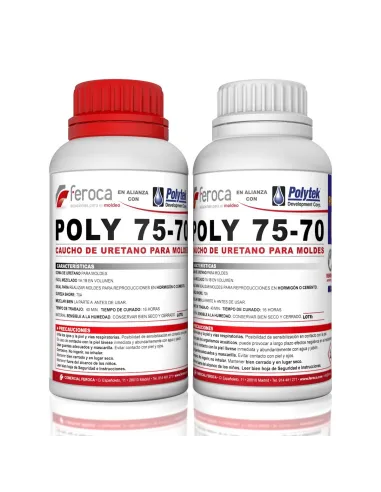
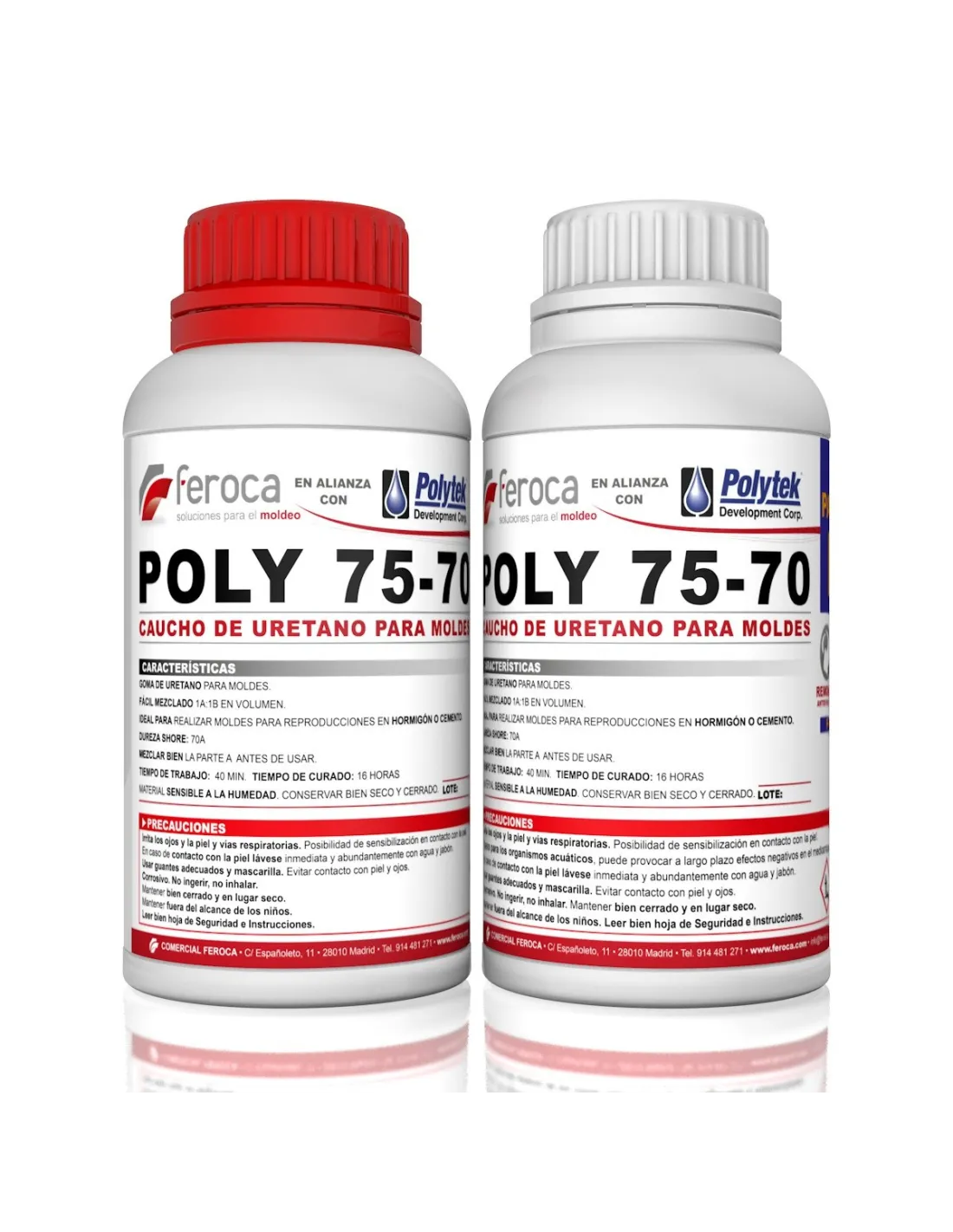
Poly 75-70 is a casting polyurethane rubber with Shore A70 hardness, designed to produce flexible and durable molds with a very high production life. It cures at room temperature with no appreciable shrinkage, using a simple 1:1 mix by weight, with no need for vacuum degassing. It is the standard choice in workshops working with decorative concrete, sculpture and architectural reproduction, thanks to its excellent behaviour with pigments and cementitious materials.
Technical specifications
| Parameter |
Value |
| Material type | Casting polyurethane rubber |
| Application | Casting |
| Mix ratio (by weight) | 100A : 100B |
| Working time | 40 minutes |
| Cure time (demold) | 16 hours |
| Shore Hardness | A70 |
| Color | Brown |
| Vacuum cure required | No |
| Shrinkage | Not appreciable |
What it is used for
Poly 75-70 is optimised for the production of high-run flexible molds, especially when the material being reproduced is pigmented concrete. Its A70 hardness gives it the firmness needed to hold detail in castings of heavy materials without sacrificing the flexibility required for clean demolding. Among its most common applications you will find:
- Molds for casting decorative concrete and pigmented concrete
- Reproduction and restoration of architectural elements (cornices, capitals, moldings)
- Ornamental woodwork and decorative carvings
- Artistic casting and sculpture
- Production of relief candles
- Reproduction of plaster or wax pieces
- Special effects, theming and set decoration
- Medium-run industrial applications and craft molds
How to use it
- Prepare the original: clean the model to be molded and apply a suitable release agent if the material requires it (most concrete mixes and polyurethane resins need a release agent; plaster and wax generally do not).
- Weigh the components: mix Part A and Part B in a 100:100 ratio by weight. Use a precision scale to ensure correct curing.
- Mix: stir each component separately before combining them. Mix A and B for 2–3 minutes with a spatula or low-speed mechanical mixer, scraping the sides and bottom of the container thoroughly. If you want to color the material, add the PolyColor Dyes — special polyurethane-compatible pigments — at this stage.
- Cast: pour the mixture slowly in a thin stream over the lowest point of the mold or molding box to minimise bubble entrapment. No vacuum chamber is required.
- Allow to cure: the material has a working time of 40 minutes. Allow to cure at room temperature for 16 hours before demolding.
- Demold: carefully remove the mold. If you notice areas of increased adhesion, apply release agent before the next casting.
- Post-cure (optional): to maximise mechanical properties, you can post-cure in an oven at a moderate temperature.
Warning: Polyurethane rubbers are moisture-sensitive. Make sure components are kept tightly sealed when not in use and that the model and working environment are dry. Moisture can cause surface bubbles and poor curing. Do not use DC Fluid 50 Silicone Oil or other additives designed for silicones, as they are not compatible with polyurethane systems. Maximum working temperature of the resulting mold: do not exceed 60 °C.
Usage tips
Molds for concrete: the key is the release agent
Although Poly 75-70 has a long service life, polyurethane molds used with concrete always require the application of a release agent before each casting. Without it, the alkaline salts in cement progressively degrade the mold surface and reduce its production life. Apply the release agent in a thin, even coat and allow it to dry before pouring the concrete.
Working temperature and pot life
The 40-minute working time is at standard room temperature (20–25 °C). In summer or in warm workshops the mix may accelerate; in winter it may slow down. If working in cold conditions, warm the components slightly (do not exceed 30 °C) to improve flow and make casting easier. Never mix more material than you can comfortably cast within the working time.
Precise pigmentation with PolyColor Dyes
One of the advantages of Poly 75-70 is its exceptional behaviour with pigments. For uniform tones, add the PolyColor Dyes to Part A before combining it with Part B, and mix thoroughly until a homogeneous color is achieved. This ensures the pigment is perfectly dispersed throughout the entire mold body. Use only pigments formulated for polyurethane; other types may interfere with curing.
Frequently asked questions
Is a vacuum chamber required to eliminate bubbles?
No. Poly 75-70 is formulated for casting without vacuum degassing. Simply pouring the mixture in a slow, thin stream over the lowest point of the mold is enough for bubbles to escape on their own during curing.
How long can I wait between mixing and casting?
You have 40 minutes of working time from when you combine Part A and Part B. After that time, viscosity increases noticeably and casting becomes difficult. Plan the process so you can cast within that window.
Do I need a release agent for all materials?
It depends on the material you are reproducing. Plaster and wax generally do not require a release agent with polyurethane molds. However, concrete mixes and polyurethane resins do require a suitable release agent before each casting to protect the mold and facilitate part removal.
Can I color the rubber before curing?
Yes. You can add PolyColor Dyes to Part A before mixing it with Part B. Always use polyurethane-compatible pigments; other types may inhibit curing or produce color irregularities.
What is the maximum working temperature of the resulting mold?
Polyurethane rubber molds must not exceed 60 °C during use. Above that temperature, mechanical properties degrade and the mold may deform or have its service life shortened.
How many castings can a mold made from this material withstand?
The Poly 75 series is designed for high-volume production. The exact number of castings depends on the material being reproduced, correct use of release agent, and care during demolding. With concrete and a properly applied release agent at each cycle, it is common to obtain dozens of reproductions without significant loss of detail.
Is it compatible with rigid polyurethane resins for making copies?
Yes, Poly 75-70 molds are compatible with rigid polyurethane resins such as Feropur PR55+E55. In this case it is essential to apply release agent before each resin casting to prevent adhesion to the mold.
Can I use silicone additives to reduce viscosity?
No. Additives designed for silicones, such as silicone oils, are not compatible with polyurethane systems and may interfere with curing or alter the mechanical properties of the mold. To improve flow in cold conditions, warm the components slightly before mixing (do not exceed 30 °C).
How much product do I need?Calculate the exact amount before buying and avoid wasting material.
Go to the calculator →