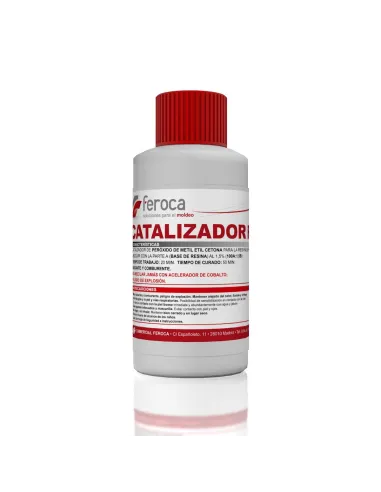
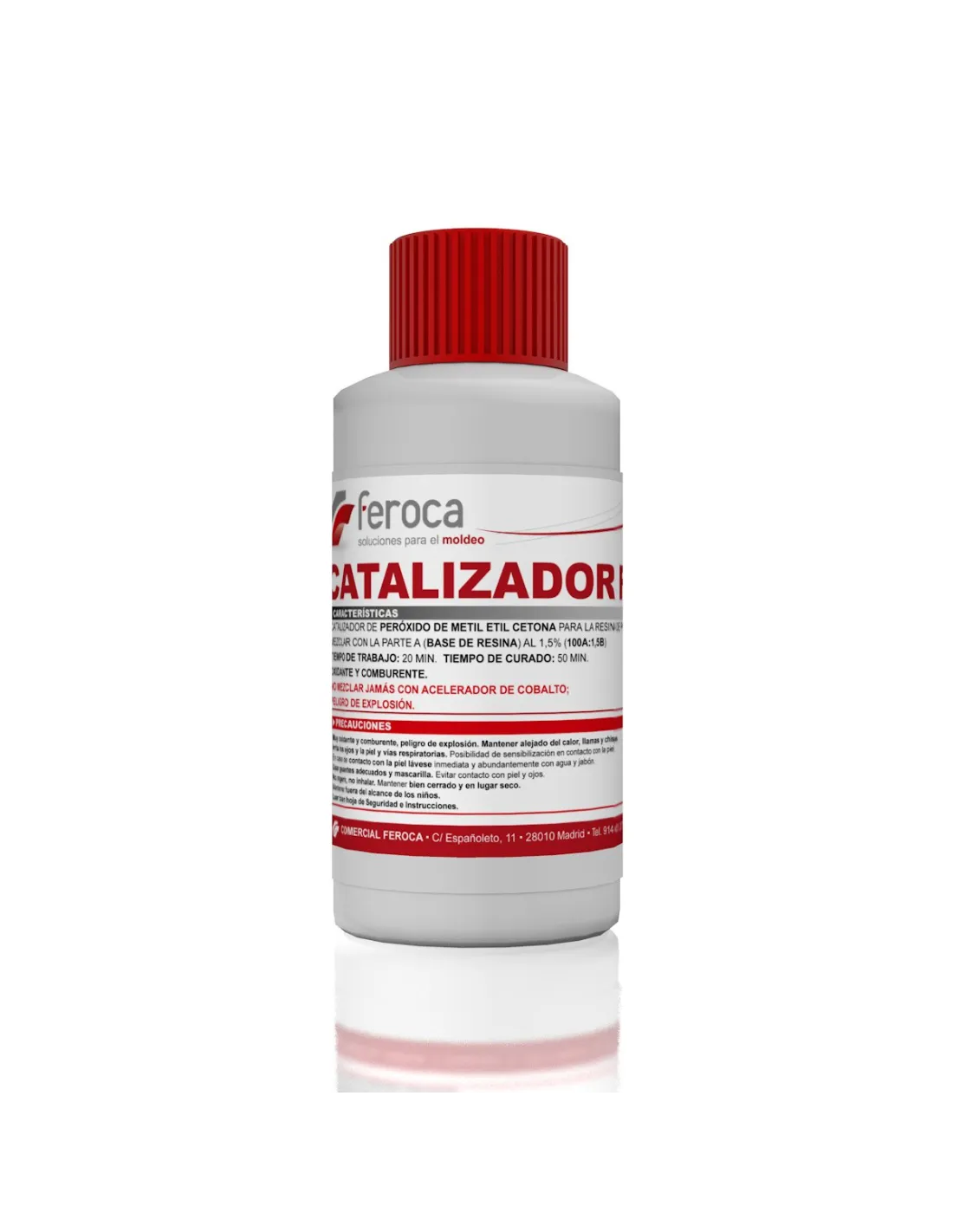
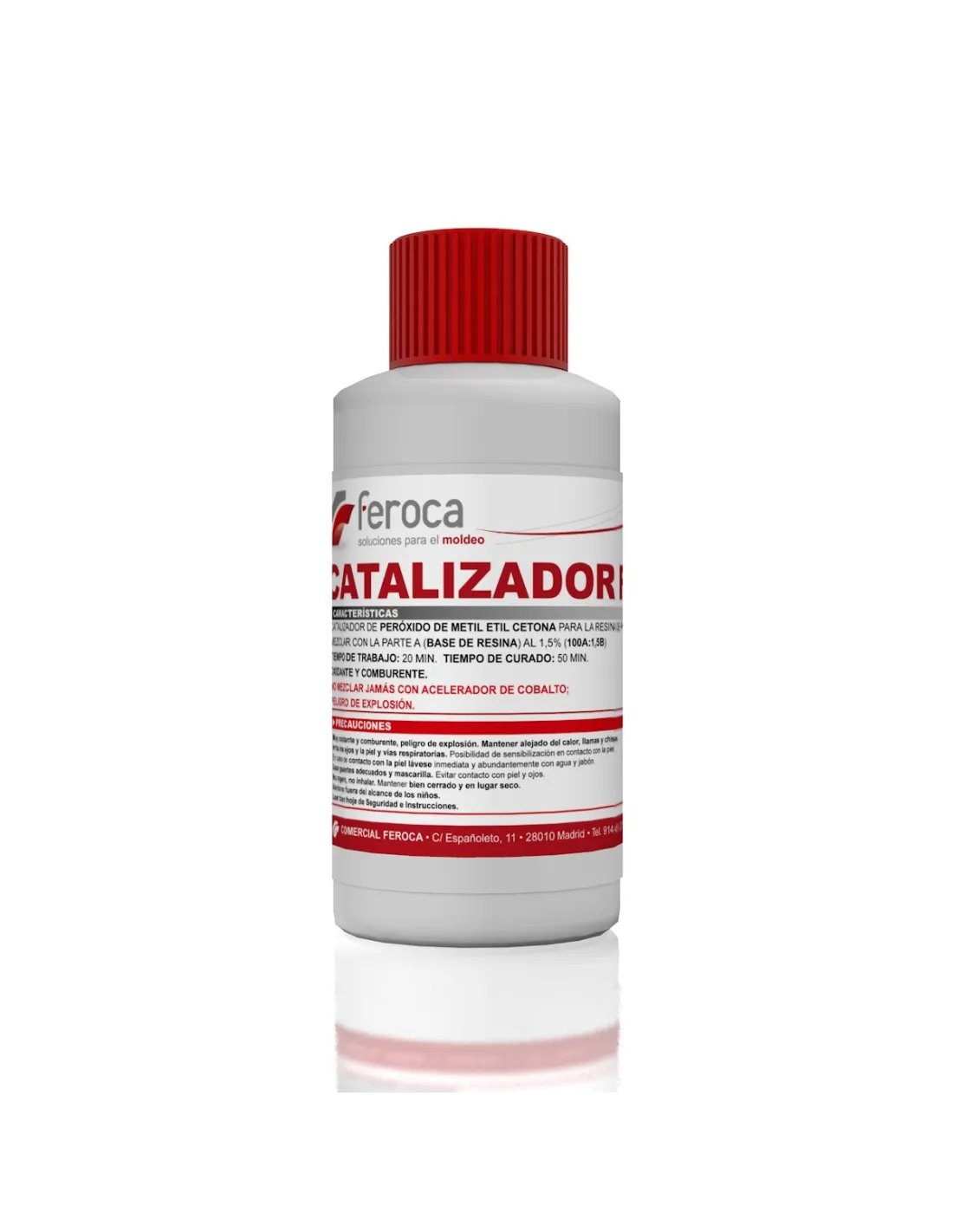
Catalizador F11 is the specific curing initiator for polyester resins: it triggers the polymerisation reaction that transforms liquid resin into a solid. The usage ratio, gel time and resulting exotherm depend on the resin, ambient temperature and casting volume, so it is always worth adjusting before moving to full production.
Technical specifications
| Parameter |
Value |
| Product type |
Peroxide catalyst for polyester resins |
| Compatible families |
Orthophthalic and isophthalic polyester resins, polyester gel coats and top coats |
| Presentation |
Liquid |
| Usage ratio |
Variable depending on resin, temperature and part geometry — refer to the resin label |
What it is used for
Catalizador F11 is the essential component in any process involving polyester resins. Without it, the resin will not cure. It is used in manual lamination with fibreglass as well as in castings, gel coats and repairs, allowing you to control the gel speed by adjusting the dosage.
- Curing polyester resins for fibreglass laminates, such as Ferpol 100 BSX15 DCPD
- Initiating cure in casting resins, such as Ferpol 3501 CV2,5
- Curing transparent resins for inclusions and encapsulations, such as Ferpol 1973 Resina Transparente
- Application in polyester gel coats and top coats
- Repair and reconstruction of polyester parts (boats, swimming pools, bodywork)
- Manufacturing decorative parts, prototypes and polyester moulds
- Simulating water effects, fictional drinks and inclusions for window displays and audiovisual production
How to use it
- Check the technical data sheet or label of the polyester resin you are going to use to find the recommended ratio range.
- Weigh the required amount of resin into a clean, dry container.
- Calculate the amount of Catalizador F11 based on the weight of resin. As a general reference for laminating resins, the typical range is 1 to 2% by weight (approximately 1.5% at normal ambient temperature).
- Add the catalyst to the resin — never the other way around — and mix thoroughly for at least one minute, scraping the sides and bottom of the container.
- Work the mixture before it reaches the gel point. The higher the catalyst ratio and the higher the temperature, the shorter the working time.
- Apply the catalysed resin according to the process: lamination, casting, gel coat application or repair.
- Allow to cure at room temperature. Full cure time varies depending on the resin and workshop conditions.
Safety warning: Catalizador F11 is an organic peroxide. It is a flammable liquid and irritating to skin, eyes and mucous membranes. Always wear nitrile gloves and safety glasses, and work in well-ventilated areas. Do not mix the pure catalyst directly with accelerators (such as cobalt naphthenate): always add them separately to the resin. Direct contact between peroxide and accelerator can cause a violent reaction. Consult the safety data sheet before use.
Usage tips
Adjust the ratio according to temperature
Workshop temperature is the variable that most affects gel time. In summer or at temperatures above 25 °C, reduce the catalyst ratio to avoid premature gelling and excessive exotherms. In winter or below 15 °C, slightly increase the dosage. Never exceed the maximum limit indicated on the resin label: an excess of catalyst does not accelerate cure proportionally and can cause cracking or a poor finish.
Control casting volume to avoid exotherms
In large-volume castings, the polymerisation reaction generates heat. The greater the mass of catalysed resin in a container, the greater the heat build-up (exothermic effect). For thick castings, work in successive layers or reduce the catalyst ratio. Transparent resins such as Ferpol 1973 are particularly sensitive to this phenomenon.
Always run a small test before production
Before catalysing the full amount required, prepare a test mix of around 100–200 g to verify the gel time under the actual conditions of your workshop on that day. This step avoids wasting material and allows you to adjust the dosage safely.
Frequently asked questions
How much catalyst should I add to polyester resin?
The typical ratio for laminating resins ranges from 1 to 2% by weight, with 1.5% being the most common reference at room temperature (20–22 °C). For casting resins or gel coats, always refer to the label of the specific product. Catalizador F11 is dosed based on the weight of resin, not volume, so use a scale for greater accuracy.
What happens if I add too much catalyst?
An excess of Catalizador F11 does not accelerate cure linearly. Above the recommended limit, the resin may gel in an uncontrolled manner, generate excessive heat, develop surface cracks or result in a yellowed finish. Always respect the range indicated in the resin's technical data sheet.
Can I use this catalyst with gel coats and top coats?
Why is my polyester resin not curing or curing very slowly?
The most common causes are: insufficient catalyst ratio, workshop temperature too low (below 15 °C cure slows down drastically), expired or poorly stored catalyst, or insufficient mixing. Check that Catalizador F11 is in good condition, adjust the dosage and make sure to mix thoroughly for at least one minute.
Can polyester resin be used in silicone moulds?
Yes, but with important caveats. Freshly cured polyester resin can inhibit the cure of platinum (addition) silicones if used afterwards in the same mould without sealing it first. Tin (condensation) silicones do not present this problem. If you want to use the silicone mould repeatedly for casting polyester, opt for tin silicones or apply a suitable release agent.
How do I repair a crack in a polyester swimming pool or boat?
Sand the affected area to remove the contaminated surface layer and achieve mechanical adhesion. Clean the area thoroughly. Mix the polyester resin with Catalizador F11 at the indicated ratio and apply with a spatula, incorporating fibreglass if the repair requires structural strength. Once cured, sand and apply a Top Coat Azul Piscinas or the appropriate colour top coat to seal and protect.
How long does polyester resin take to gel?
Gel time depends on the resin, catalyst ratio and temperature. With a standard dosage of 1.5% at 20–22 °C, most laminating resins gel within a range of 15 to 40 minutes. Higher temperature or higher catalyst ratio reduces the time. Always run a prior test under the actual conditions of your workshop.
Can I store already catalysed resin to use later?
No. Once Catalizador F11 has been added, the polymerisation reaction has begun and cannot be stopped. Only prepare the amount you will use in each session. Store uncatalysed resin and catalyst separately, in closed containers, away from heat and direct light.
How much product do I need?Calculate the exact amount before buying and avoid wasting material.
Go to the calculator →