Shopping Cart



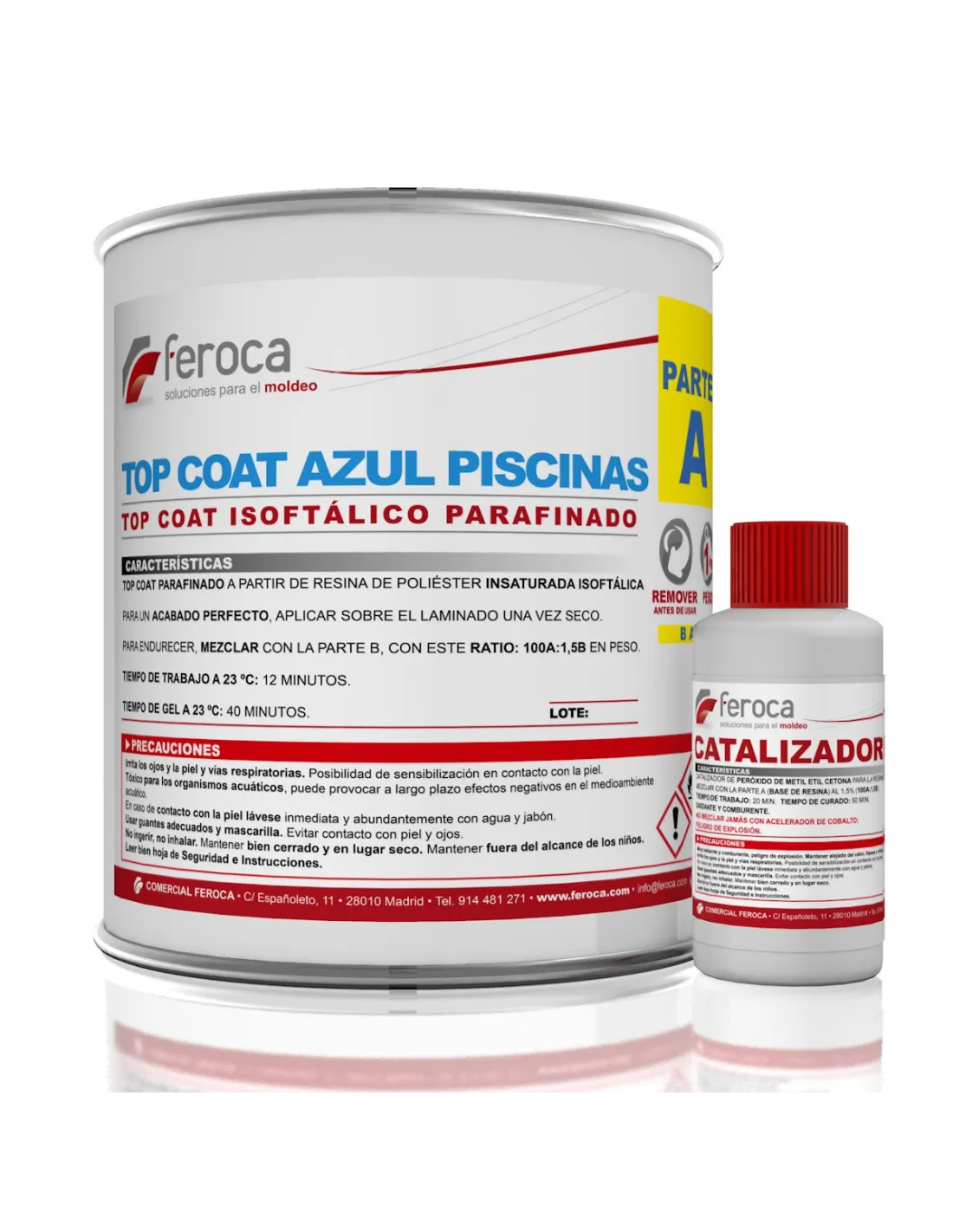
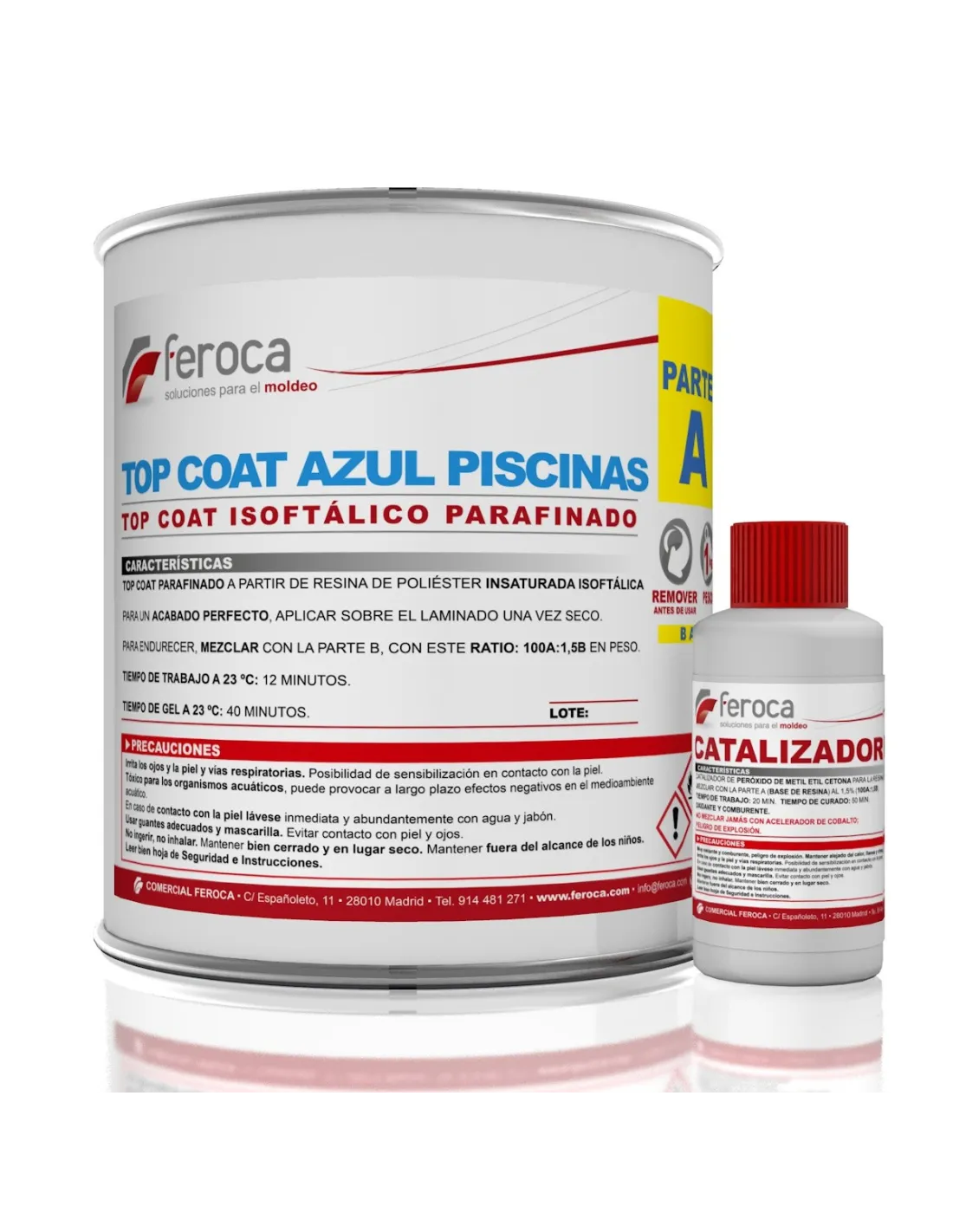
Top Coat Blue Swimming Pools
535015001
Available
€19.50
23,60 € Tax incl.
23,60 € Tax incl.
Neopentyl glycol polyester top coat in pool blue. Coverage 500 g/m². Catalysed at 1.5 % with Catalizador F11.
The Blue Pool Top Coat is a finishing paint based on neopentyl glycol polyester resin, specifically formulated for coating and refinishing fiberglass-laminated pools. Its medium viscosity allows application by brush or roller, with excellent adhesion on polyester laminates and a uniform, glossy, water-resistant finish.
Technical specifications
| Parameter | Value |
|---|---|
| Base | Neopentyl glycol polyester resin |
| Colour | Pool blue |
| Viscosity | Medium (suitable for brush and roller) |
| Recommended catalyst | Catalizador F11 |
| Catalyst percentage | 1.5 % |
| Approximate coverage | 500 g/m² |
| Rest time before filling the pool | 7 days minimum |
| Kit presentation | 1 kg + 25 g catalyst / 5 kg + 100 g catalyst / 25 kg + 500 g catalyst |
| Custom colours (minimum) | 25 kg (RAL range, approx. 1 week lead time) |
What it is used for
This top coat is designed to provide the final finish on fiberglass pools or to refinish aged, porous or colour-faded polyester surfaces. It is also used in any application requiring a glossy, water-resistant surface finish on polyester laminates.
- Final finish on new pools manufactured in fiberglass and polyester
- Renovation and repainting of existing pools with colour or gloss loss
- Localised repair of damaged areas in combination with the Kit de Reparación de Piscinas
- Coating of bathtubs, jacuzzis and tanks manufactured in polyester laminate
- Surface protection of fiberglass parts exposed to water or continuous humidity
How to use it
- Prepare the surface: dry-sand the entire surface with medium-grit sandpaper (80–120) to remove dirt, algae or remnants of degraded old top coat. Clean with acetone to degrease completely.
- Calculate the required quantity: measure the surface in m² and multiply by 500 g to calculate the top coat needed. Include a 10–15 % margin for hard-to-reach areas.
- Catalyse at 1.5 %: mix the top coat with Catalizador F11 at a ratio of 1.5 % by weight (15 g of catalyst per 1,000 g of top coat). A lower percentage will compromise the cure.
- Homogenise the mix: the product is thixotropic; stir vigorously for at least 2 minutes until the catalyst is fully integrated and the colour is uniform.
- Apply the first coat: use a soft-bristle brush or foam roller. Apply a generous, even coat, always working in the same direction.
- Apply a second coat if necessary: once the first coat has gelled (approximately 1–1.5 h under temperate conditions), apply a second coat in a perpendicular direction for better coverage and uniformity.
- Allow to cure: keep the pool empty and undisturbed for a minimum of 7 days before filling with water.
- Verify the cure: soak a cloth in acetone and rub over a small, inconspicuous area. If the cloth comes away clean with no colour transfer, the cure is correct and the pool can be filled.
Warning: This product contains styrene and methyl ethyl ketone peroxide (MEKP) catalyst. Always work in well-ventilated spaces. Use nitrile gloves, safety goggles and a respirator with an organic vapour filter. The catalyst (F11/MEKP) is a strong oxidiser: do not mix it directly with cobalt accelerators without first diluting in resin — risk of ignition. Dispose of waste in accordance with local hazardous waste regulations.
Usage tips
Temperature and environmental conditions
The ideal application temperature is between 18 °C and 25 °C. Below 15 °C the cure slows considerably and may remain incomplete. If the temperature is high (above 30 °C) the working time is shortened: work in small sections or apply early in the morning to avoid premature gelling. Never apply at relative humidity above 80 % or on wet surfaces.
Finishing and polishing
After full cure (7 days), if the surface shows brush marks or any irregularity, you can level it with very fine wet-and-dry sandpaper (400–600) using circular movements. Then buff with polyester polishing compound to restore maximum gloss. This step is especially useful in renovations where the base was not perfectly smooth.
Custom colours and compatibility with other top coats
Pool blue is the standard colour, but if you need another RAL colour you can request it from Feroca with a minimum order of 25 kg (approximate lead time of one week). If the pool already has an existing polyester top coat in good condition (no blistering or delamination), you can apply directly over it after sanding and cleaning. If you prefer a white finish, see the Top Coat Blanco.
Frequently asked questions
How much catalyst do I need to add and what happens if I use less?
The correct ratio is 1.5 % by weight of Catalizador F11 relative to the total top coat. With 1 kg of top coat you need 15 g of catalyst. A lower percentage results in incomplete cure: the surface will remain soft, tacky or will deteriorate on contact with water. Do not reduce the percentage to gain more working time; instead, work in smaller sections.
How long should I wait before filling the pool?
A minimum of 7 days with the pool empty is recommended after the last coat of Blue Pool Top Coat. To confirm the cure is correct, carry out the acetone test: soak a cloth and rub over an inconspicuous area. If the cloth comes away clean with no colour transfer, the cure is complete and the pool can be filled safely.
How many coats do I need to apply?
Generally two coats are sufficient to achieve uniform coverage and the correct thickness. The first coat seals the surface and the second evens out the finish. If the starting surface is very porous or uneven, a third coat may be necessary in the most affected areas.
Can it be applied over a pool with an existing top coat?
Yes, provided the old top coat is well adhered, with no blistering or delaminated areas. Sand the entire surface with 80–120 grit sandpaper to create texture and improve adhesion, clean with acetone to remove any grease or dirt, and apply the Blue Pool Top Coat as if it were a new surface. Areas with structural damage must be repaired first with the Kit de Reparación de Piscinas.
Can I get the top coat in another colour?
Yes. Although pool blue is the standard colour available in stock, Feroca can manufacture the top coat in any RAL colour on request. The minimum quantity for custom colours is 25 kg and the production lead time is approximately one week. If you need white, the Top Coat Blanco is available directly.
How can I polish the surface once cured?
After the 7-day cure, gently sand with fine wet-and-dry sandpaper (400–600) using circular movements to remove brush marks or minor imperfections. Then apply polyester polishing compound with a cloth or polisher to restore the glossy finish.
What tools do I need for application?
To apply the Blue Pool Top Coat you need: a soft-bristle brush or foam roller (for large surfaces), a precision scale to measure the catalyst, a mixing container, 80–120 grit sandpaper for surface preparation and acetone for cleaning and the cure test. Nitrile gloves, safety goggles and a respirator with an organic vapour filter are recommended throughout the process.
Can it be applied in cold weather or high humidity?
It is not recommended. The minimum application temperature is 15 °C; below this, the cure may remain incomplete even if the catalyst percentage is correct. At relative humidity above 80 % the cure is also affected and adhesion problems may arise. If working in borderline conditions is unavoidable, increase the cure time before performing the acetone test.
Video tutorial
Pool Repair · Polyester Resin
No reviews
Tap to zoom