Shopping Cart


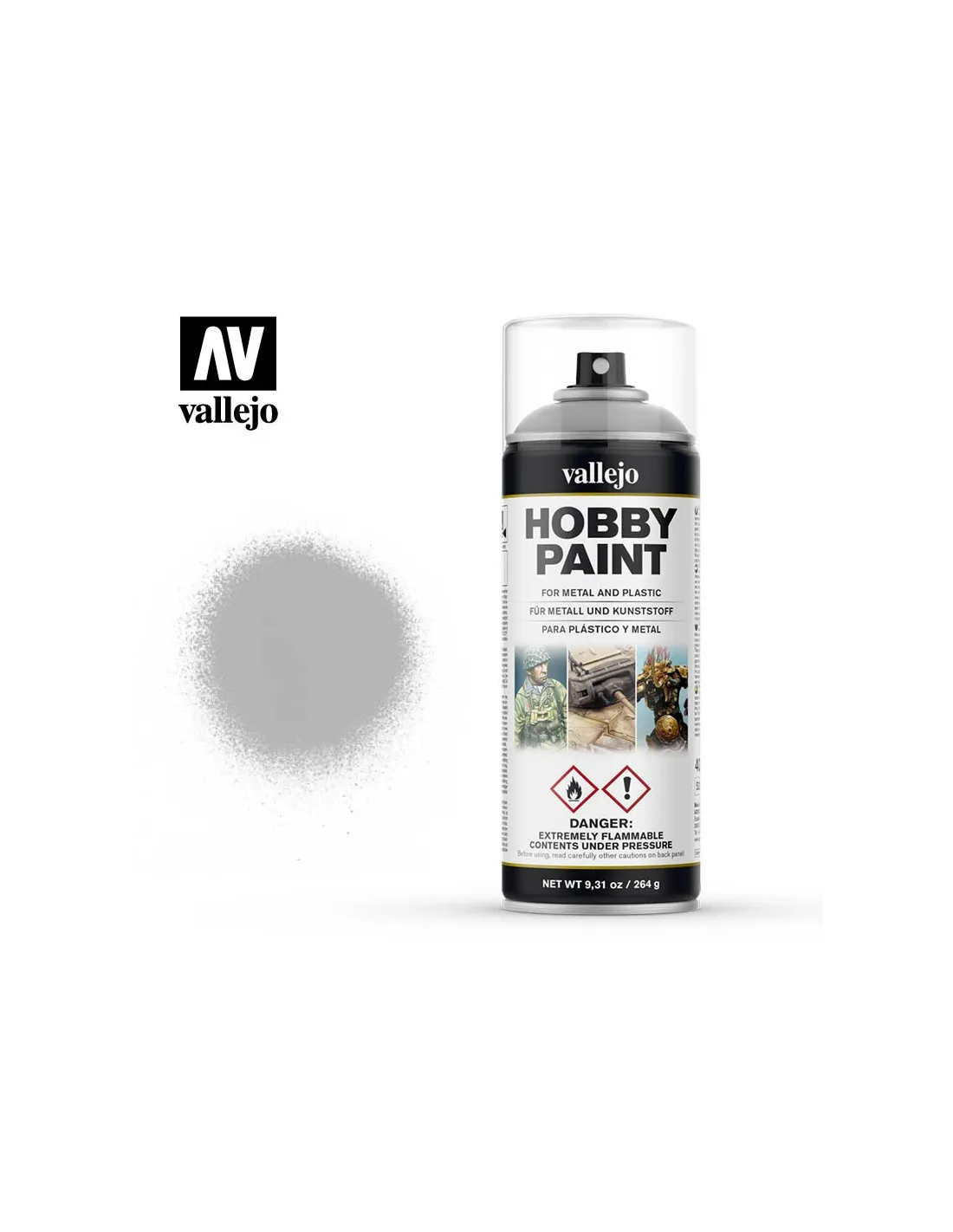
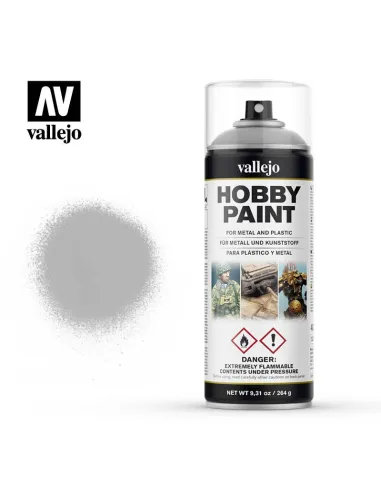
Hobby Spray Paint Vallejo -Printing-
602801100
€10.50
12,71 € Tax incl.
12,71 € Tax incl.
This product cannot be shipped by air. To the Balearic Islands it is sent by sea freight. For deliveries to the Canary Islands, please contact us before ordering.
Vallejo spray primer for metal, plastic and resin. Self-levelling matte finish, 400 ml, 2 nozzles included.
The Vallejo Hobby Spray Paint in primer version is the reference surface preparation base for metal, plastic and resin miniatures and scale models. Its high pigment concentration formula guarantees uniform coverage with a self-levelling matte finish that respects every detail of the model, and significantly improves the adhesion of subsequent acrylic paint layers.
Technical specifications
| Parameter | Value |
|---|---|
| Content per container | 400 ml |
| Finish | Self-levelling matte |
| Available colours | Grey, Black, White |
| Compatible substrates | Metal, plastic, resin |
| Application distance | ~25 cm |
| Time between coats | 5 minutes |
| Included nozzles | 2 (narrow tip and medium tip) |
| Valve pressure | Low pressure |
| Application position | Vertical |
What it is used for
This spray primer is specifically designed to prepare the surface of miniatures and scale model parts before painting. It is especially useful when working with acrylic paints, as it acts as a bonding layer, preventing chipping and evening out the base colour. The three available neutral tones (Grey, Black and White) allow you to modulate the depth of the final shading even before applying the first colour.
- Priming metal miniatures (lead, pewter, brass)
- Preparing plastic parts (ABS, polystyrene, PVC) for acrylic painting
- Pre-sealing 3D printed parts or casting parts in polyurethane resin
- Neutral base for shading techniques (NMM, OSL, zenithal highlight)
- Bonding layer between substrate and detail paints in wargames and scale modelling
- Preparing bases and custom scenic bases before painting with acrylics
How to use it
- Thoroughly clean and degrease the part to be primed. Any traces of grease, dust or Release agent will prevent proper adhesion.
- Select the nozzle according to the task: the narrow tip for fine lines and detail areas, the medium tip for larger surfaces.
- Shake the can vigorously for at least one minute before use.
- Hold the can in a vertical position and apply in quick, thin passes at approximately 25 cm from the part.
- Allow 5 minutes drying time between coats. On parts with heavy relief, apply two thin coats rather than one thick one.
- When finished, invert the can and spray for a few seconds until no more paint comes out of the nozzle. This prevents blockages for next use.
- Once the primer is dry, apply acrylic paint layers with a brush, airbrush or spray according to the desired technique.
Usage tips
Choose the primer colour according to your painting technique
Grey is the most versatile option and the ideal starting point for most colour schemes. Black facilitates natural shading in zenithal techniques or for dark palettes; white maximises the saturation of colours applied on top and is the ideal base for vivid or translucent colours. If you are mixing tones, you can apply the three primers separately in different areas of the same part.
Temperature and humidity affect the result
Always apply in an environment with a temperature between 15 and 30 °C and relative humidity below 70%. In cold or high-humidity conditions, the spray may dry with a grainy or "sandy" effect. If working outdoors, avoid direct wind, which dries the aerosol before it reaches the surface and creates unwanted texture.
Thin coats, always
The temptation to cover in a single pass can ruin the level of detail on the miniature. Apply two or three very thin coats and allow drying between them. A thick coat of primer fills in bas-reliefs and obscures inscriptions, fabric textures or faces, making all the sculpting or 3D printing work pointless. If this happens, lightly sand with fine wet-and-dry sandpaper and re-prime.
Frequently asked questions
Is it necessary to prime before painting a miniature?
Yes, especially on metal and plastic. Without primer, acrylic paint has very little adhesion and peels off with handling during gaming or manipulation. The Vallejo Hobby Spray Paint primer creates a micro-texture that anchors subsequent layers and improves the durability of the final finish.
Can I use this primer on 3D printed resin or mould-cast resin?
Yes. It is one of its most common uses. Before applying it, make sure the resin part is fully cured, clean and free of Release agent or uncured UV layers in the case of photosensitive resins. A light sanding with fine wet-and-dry sandpaper further improves adhesion.
What type of paint is this primer compatible with?
It is optimised for water-based acrylic paints, which are the most common in scale modelling and wargames. It is also compatible with enamels applied by brush, although in that case it is advisable to wait for the primer to dry completely (30-60 minutes) before applying enamels to prevent the solvent from lifting them.
Can I dilute this spray primer to use it with an airbrush?
This product is specifically formulated for spray application and is not designed for airbrush use. If you need an airbrush-compatible primer, look for bottle versions in the same range or use a water-dilutable liquid acrylic primer.
How many parts does a 400 ml can cover?
It depends on the size of the figures and the number of coats applied. For 28-32 mm scale miniatures, a 400 ml can can easily cover between 50 and 150 infantry figures, or a smaller number of vehicles and large models. Applying thin coats maximises the yield of the can.
What do I do if the nozzle gets blocked?
If you have followed the procedure of inverting the can when finished, blockage is unlikely. If it does happen, remove the nozzle, soak it in warm water for a few minutes and remove the dried paint residue with a needle or fine toothpick. Dry it thoroughly before replacing it. Remember that the can includes two interchangeable nozzles.
Does the part need to be sanded before priming?
On metal and smooth plastic it is not essential, but on resin parts or 3D prints with visible layer lines a pass with 400-600 grit wet-and-dry sandpaper is recommended before priming. This removes irregularities and ensures a more uniform surface for subsequent painting.
Can I apply this primer directly on untreated metal?
Yes, it is compatible with metals commonly used in scale modelling (lead alloys, pewter, brass). It is essential to clean the part with soap and water or isopropyl alcohol to remove traces of grease from handling or the manufacturing process before applying the primer. Otherwise, adhesion will be compromised.
Video tutorial
5 · Tutorial: how to paint miniatures
No reviews
Tap to zoom