Shopping Cart



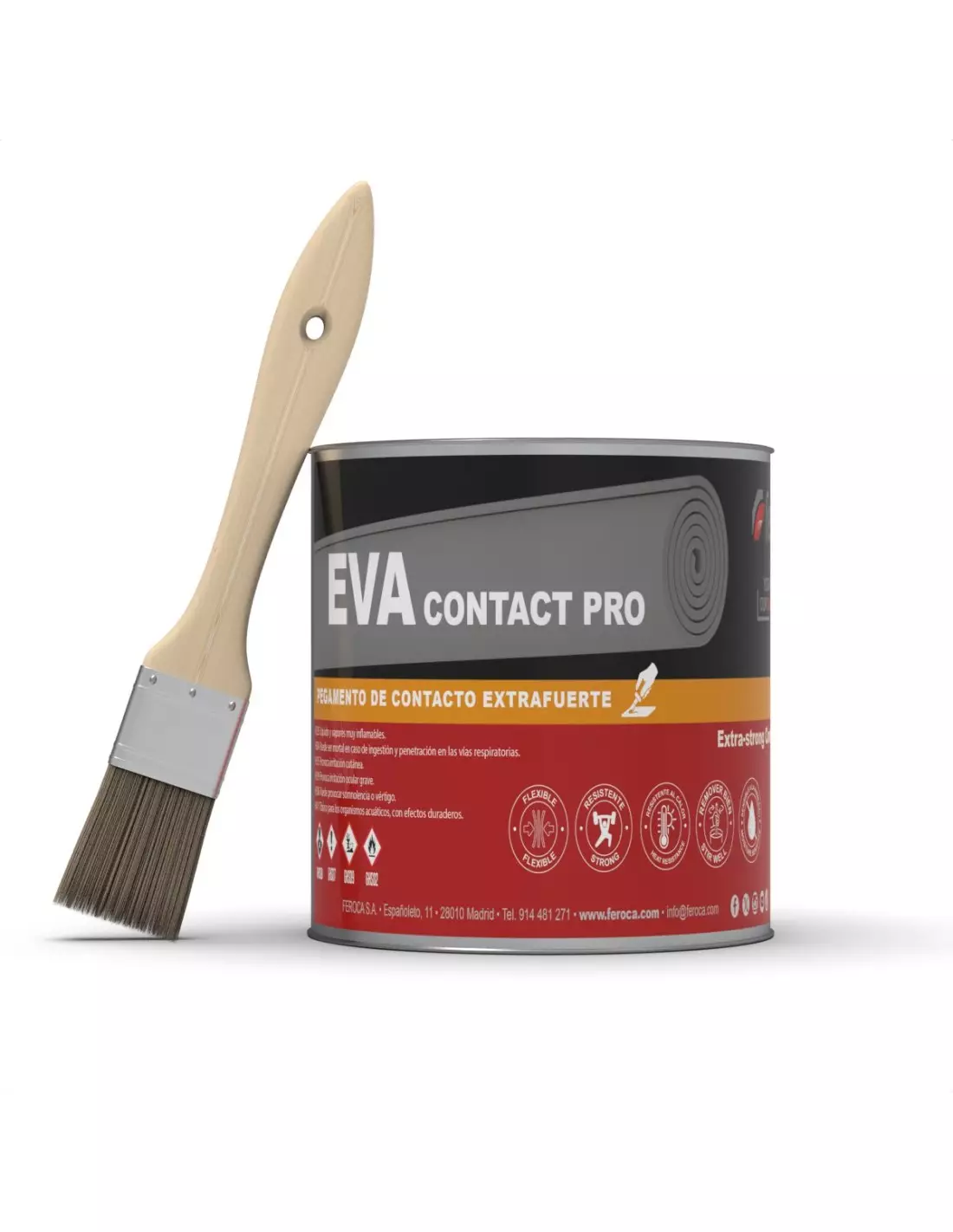
EVA Contact Pro - Contact Adhesive
406300200
€6.50
7,87 € Tax incl.
7,87 € Tax incl.
Professional contact adhesive for high-density EVA foam. Toluene-free, elastic after drying and heat-resistant up to 100 °C.
EVA Contact Pro is a professional contact adhesive specifically formulated to bond high-density EVA foam quickly and securely. Its toluene-free formula provides an extra-strong, flexible, heat-resistant bond up to 100 °C, making it ideal for demanding workshop projects as well as crafts, cosplay and set design.
Technical specifications
| Property | Value |
|---|---|
| Type | Contact adhesive |
| Primary application | High-density EVA foam |
| Colour | Translucent yellow |
| Flexibility after cure | Elastic and flexible |
| Heat resistance | Up to 100 °C |
| Open time before bonding | 15–25 minutes |
| Working window | Up to 60 minutes |
| Full cure | 48 hours |
| Toluene-free | Yes |
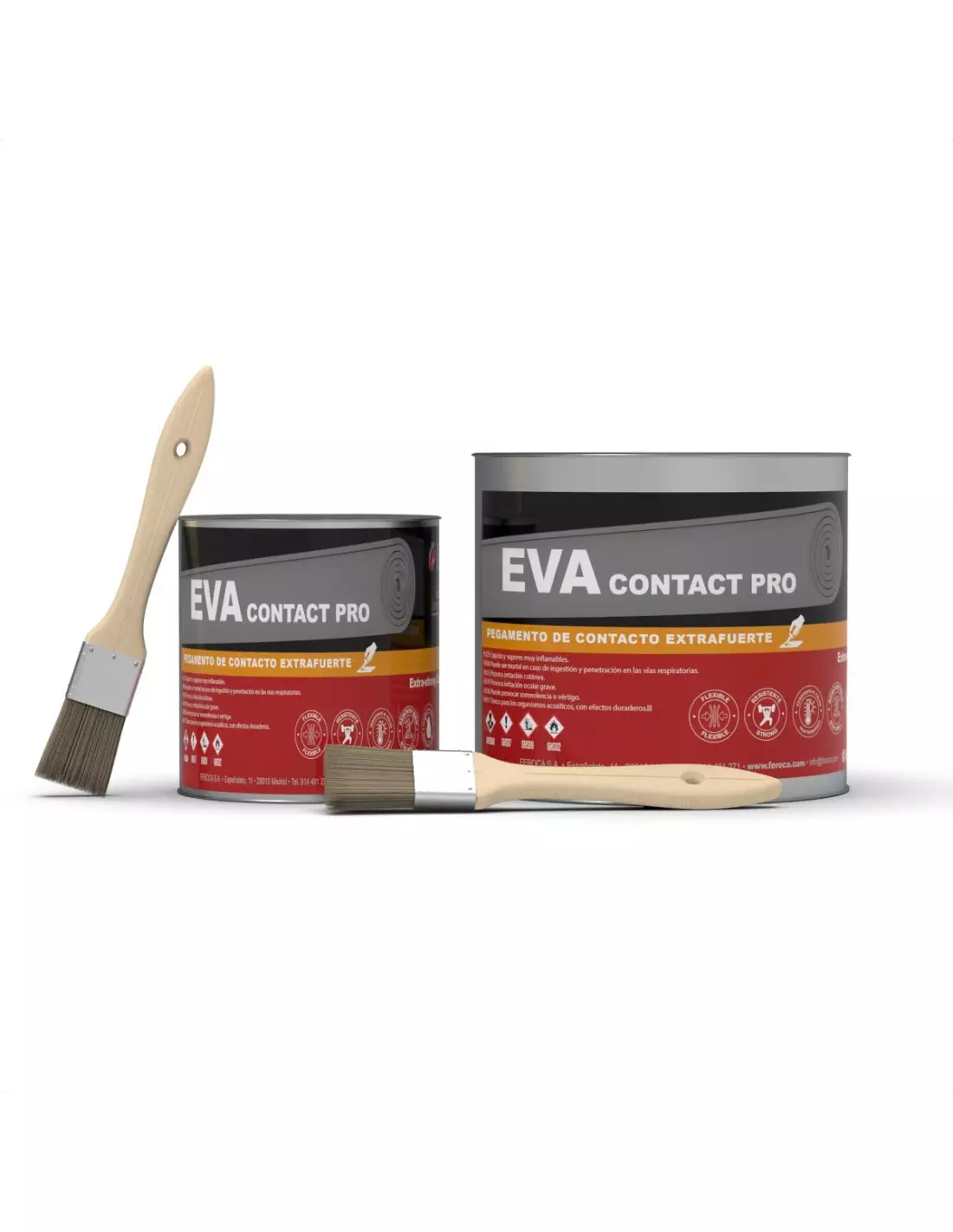
| Available formats | Multiple (brush included in both formats) |
What it is used for
EVA Contact Pro is designed for any professional or advanced hobbyist who regularly works with high-density EVA foam and needs clean, long-lasting bonds that can withstand mechanical deformation and heat. Its main uses include:
- Bonding 5 mm EVA foam and 10 mm EVA foam pieces for cosplay armatures, helmets and accessories
- Assembling panels, sets and props for stage design and theatre
- Manufacturing EVA foam protectors, insoles and sports accessories
- Bonding EVA to wood, cardboard, leather and other porous or semi-rigid substrates
- Craft and modelling projects where flexibility at the final joint is required
- Any application where the piece will be subjected to heat from a heat gun or heat stripper during the forming process
How to use it
- Prepare the surfaces. Make sure both faces are clean, dry and free of dust, grease or residue from other adhesives.
- Apply the adhesive to both surfaces. Using the included brush or a flat brush, spread a thin, even coat of EVA Contact Pro onto each of the two faces to be bonded.
- Allow the solvent to evaporate. Wait 15 to 25 minutes. The adhesive should be tacky (slightly sticky to the touch but not transferring to your finger) before joining the pieces.
- Make use of the working window. You have up to 60 minutes from that point to position and bond the pieces. Take your time: good positioning avoids rework.
- Join and press. Bring the surfaces into contact with precision and apply firm, even pressure across the entire bonded area. A rubber roller makes the job easier on large areas.
- Allow to cure. For maximum bond strength, let the joint rest for 48 hours before subjecting it to mechanical stress or intense heat.
Caution: EVA Contact Pro contains organic solvents. Always use it in a well-ventilated space. Avoid prolonged inhalation of vapours and direct contact with skin and eyes. Keep away from heat sources and flames during application. Consult the safety data sheet before first use.
Usage tips
Thin coat, stronger bond
The usual temptation is to apply a large amount, thinking that more adhesive means more grip. With contact adhesives the opposite is true: an excessive coat slows solvent evaporation, creates bubbles in the joint and reduces final strength. Apply the thinnest coat possible that evenly covers the entire surface.
Ambient temperature and humidity
The 15–25 minute open time is calculated for standard conditions (20–25 °C, moderate relative humidity). In cold or high-humidity conditions the solvent evaporates more slowly: you may need to wait up to 30–35 minutes. In dry heat or with an air current, the process speeds up. Always check the tack before bonding — not the clock.
Compatibility with heat gun and thermoforming
One of the advantages of EVA Contact Pro is its resistance up to 100 °C, making it compatible with the standard EVA foam forming process using a heat gun or heat stripper. However, apply heat with continuous movements and do not stop the gun over the joint: prolonged direct focus on a single point can weaken the bond.
Frequently asked questions
Can I use this adhesive on surfaces other than EVA foam?
Yes. EVA Contact Pro also bonds wood, leather, cardboard and other porous or semi-rigid materials. On very smooth or non-porous surfaces (such as engineering plastics or metals) adhesion may be lower; in those cases it is advisable to do a test first and, if necessary, lightly sand the surface to increase mechanical keying.
How long does it take to set and when can I start working the piece?
The bond is functional within a few minutes of pressing the pieces together, but full cure is reached at 48 hours. For light handling you can work with it earlier, but avoid subjecting the joint to intense flexion or heat until it has fully cured.
Can it be used with a heat gun without the joint opening?
Yes, provided the cure is complete. EVA Contact Pro withstands up to 100 °C, a temperature sufficient for standard EVA foam forming. Apply heat with a continuous movement and do not concentrate the airflow directly on the bond line for extended periods.
Does the adhesive need to be applied to both surfaces or just one?
Always to both surfaces. That is how a contact adhesive works: the bond forms when two tacky layers meet each other. If you apply the product to only one face, adhesion will be much lower.
What do I do if the pieces end up misaligned when joining them?
Once the two tacky layers touch, the bond is practically irreversible. That is why careful positioning before contact is essential. If you need to correct, you can try to separate the pieces by applying moderate heat with a heat gun to soften the adhesive, although this is not always possible without damaging the material.
Is this adhesive compatible with paints and surface finishes?
Yes. Once cured, EVA Contact Pro is compatible with the usual finishes applied over EVA foam: acrylic paints, flexible lacquers and foam-specific finishing products. Always wait for full cure (48 hours) before applying any finishing coat over the joint.
What is the difference between this adhesive and a cyanoacrylate for bonding EVA?
Cyanoacrylate adhesives such as Ciano Normal or Ciano Denso set in seconds and are ideal for spot repairs or small bonds, but they create a rigid, brittle joint that can come apart when the EVA foam is flexed. EVA Contact Pro is formulated to create flexible, elastic bonds suited to pieces that will be heat-formed or subjected to flexion during use.
How do I clean adhesive residue from tools and surfaces?
While the adhesive is still fresh, clean with a cloth soaked in a suitable solvent (consult the product safety data sheet). Once cured, removal is mechanical: peel or scrape carefully. Avoid solvent contact with already-bonded EVA foam, as it may attack the material.
No reviews
Tap to zoom