Shopping Cart


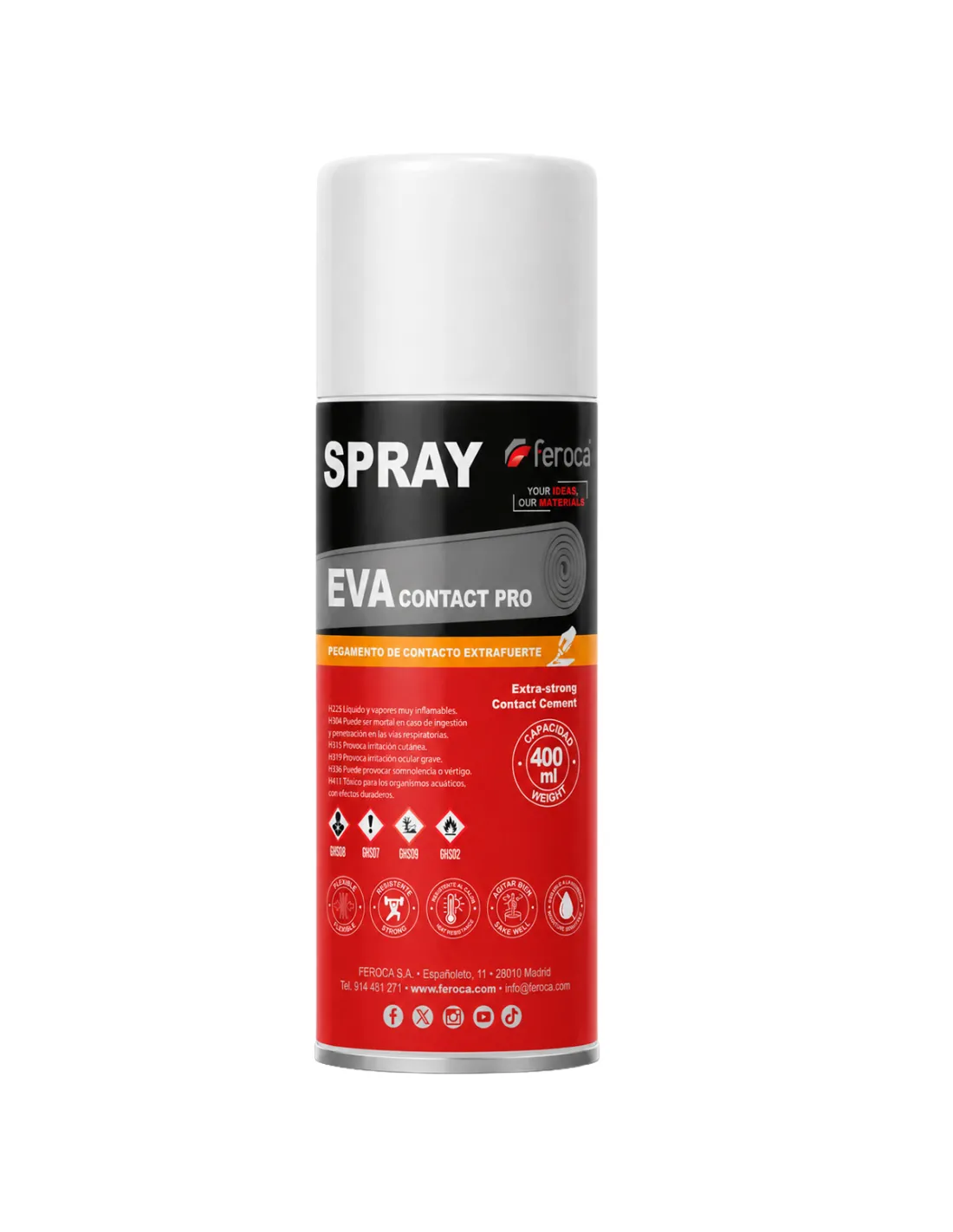
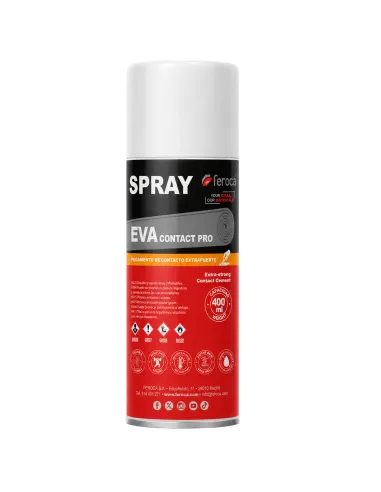
Eva Contact Pro SPRAY 400 ml
406090000
€12.00
14,52 € Tax incl.
14,52 € Tax incl.
This product cannot be shipped by air. To the Balearic Islands it is sent by sea freight. For deliveries to the Canary Islands, please contact us before ordering.
Eva Contact Pro SPRAY is the permanent spray adhesive based on synthetic rubber for foam rubber, textiles, paper, cork and fibreglass. 400 ml.
The Eva Contact Pro SPRAY is a permanent solvent-based adhesive formulated with resin-modified synthetic rubber. It offers the same bonding characteristics as a contact adhesive but in aerosol format, allowing large surfaces to be covered uniformly and quickly without the need to spread with a spatula or roller.
Technical specifications
| Parameter | Value |
|---|---|
| Colour | Transparent |
| Base | Solvent / resin-modified synthetic rubber |
| Adhesion type | Permanent (equivalent to contact adhesive) |
| Setting time | 20 – 30 minutes |
| Full cure | 24 hours |
| Presentation | 400 ml aerosol |
What it is used for
Eva Contact Pro SPRAY is designed for laminating large surfaces or bonding soft materials where uniform pressure is key. The aerosol format makes it especially practical when working with large or irregularly shaped pieces, eliminating spatula marks and ensuring homogeneous coverage. It is particularly suitable for:
- Foam rubber, latex foam and polyurethane foams
- Textiles, non-woven fabrics, felt and carpeting
- Paper, cardboard and graphic materials
- Leather, cork and laminates
- Fibreglass, veneers and tiles
- Photography studios, print shops and model-making workshops
How to use it
- Shake the can: shake the spray well before use to homogenise the contents and ensure uniform application.
- Prepare the surfaces: make sure both faces are clean, dry and free of dust, grease or dirt that could reduce adhesion.
- Apply the adhesive: spray from a distance of 20–30 cm onto one or both surfaces, keeping the can in constant motion to avoid build-up.
- Respect the open time: allow the solvent to evaporate for 2 to 5 minutes before joining the pieces. This step is essential to activate the contact bond.
- Join the surfaces: bring the pieces together and press with your hand or a roller to ensure uniform contact across the entire surface.
- Setting and cure time: initial setting occurs within 20–30 minutes; full cure and maximum strength are reached after 24 hours.
- Ventilation and safety: always work in a well-ventilated area. The propellant and solvent are flammable; keep the product away from flames, sparks and heat sources.
Caution: flammable aerosol product. Use exclusively outdoors or in premises with forced ventilation. Keep away from flames, sparks and heat sources. Do not pierce or incinerate the container. Solvent vapours can be harmful in enclosed spaces; use respiratory protection if ventilation is insufficient. Keep out of reach of children.
Usage tips
Spray distance and speed determine coating quality
The optimal spraying distance is 20 to 30 cm. If you get too close, the adhesive pools and takes longer to dry, potentially creating an uneven bond. If you move too far away, the layer becomes too thin and discontinuous, compromising adhesion. Keep the can in constant motion and make parallel passes with 30% overlap to achieve homogeneous coverage. On very large surfaces, work in sections so that the solvent evaporation time is uniform across the entire piece before joining.
Open time is the key to contact bonding
Unlike other adhesives, contact spray adhesives require the solvent to partially evaporate before joining the pieces. If you join too soon, the adhesive is still wet and the bond will be weak. If you wait too long, the surface will lose tack and the pieces will not adhere properly. Under normal conditions (20 °C, moderate humidity), 2 to 5 minutes is the right range. In warm, dry environments the solvent evaporates faster; in cold or humid conditions it may need a little more time. Touch the surface with the back of your finger: it should feel tacky but not transfer adhesive.
Foam rubber and soft foams: uniform pressure to avoid bubbles
When laminating foam rubber or latex foam, bonding pressure is just as important as the adhesion itself. Apply adhesive to both surfaces to maximise joint strength, respect the open time and, when joining, press progressively from one end to the other to expel trapped air. A rubber roller is the ideal tool for applying uniform pressure without deforming the foam. Avoid bending or stretching the foam during bonding, as when it relaxes it can create internal stresses that weaken the joint before the cure is complete.
Frequently asked questions
Is it the same as a contact adhesive?
In terms of chemistry and bond strength, yes: both are solvent-based synthetic rubber adhesives that activate on contact. The difference is in application: the spray covers large surfaces far more uniformly and with less preparation time, without the need for a spatula or roller to spread the adhesive.
Can it be used with foam rubber and latex foam?
Yes. This is one of its main uses. Eva Contact Pro SPRAY is compatible with polyurethane foam rubber and latex foam, materials very commonly used in upholstery, cosplay and special effects. It is recommended to apply to both surfaces and respect the open time before joining to achieve maximum strength.
Is the bond reversible or permanent?
The bond is permanent. Once cured, separating the pieces normally means tearing the material or the adhesive layer without recovering the surfaces intact. For applications requiring future disassembly, a specific repositionable formula must be used.
What is the correct application distance?
Between 20 and 30 cm is the optimal distance for an even coat. At shorter distances the adhesive pools and slows drying, potentially compromising the bond. At greater distances the layer is too thin and may not cover uniformly, reducing adhesion strength.
Should it be applied to both surfaces or just one?
For porous or absorbent materials such as foam rubber, latex foam, felt or cork, it is recommended to apply to both surfaces for maximum strength. On non-porous materials such as metal, plastic or glass, applying to one side may be sufficient, although applying to both always improves adhesion.
Does it work on vertical surfaces or complex shapes?
Yes, the aerosol format makes application easy on vertical, curved or irregularly shaped surfaces where spreading with a spatula would be difficult. Keep the can approximately vertical during spraying to prevent propellant from escaping without adhesive, especially when the can is nearly empty.
Can I use it indoors?
Only if the space has forced ventilation or cross-airflow. Solvent vapours and propellant are flammable and can accumulate in enclosed spaces reaching dangerous concentrations. Ideally, work outdoors or in workshops with local extraction. Never use the spray near flames, sparks, electrical heating elements or any ignition source.
How long does the can last once first used?
The 400 ml can is a hermetically sealed pressurised container: as long as propellant remains and the can has not been damaged, the product keeps in the same condition as a new one. Store at temperatures between 5 and 35 °C, away from heat sources and direct light. If after shaking the spray does not come out evenly or the pressure has dropped noticeably, the propellant may be exhausted even if adhesive remains inside.
No reviews
Tap to zoom