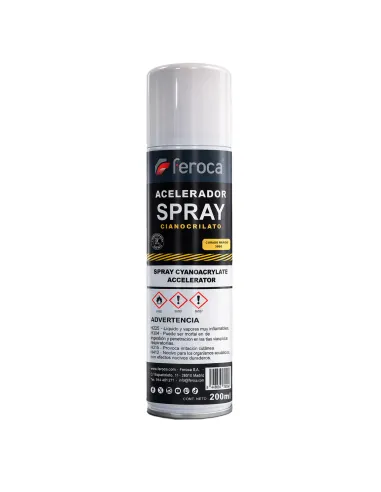
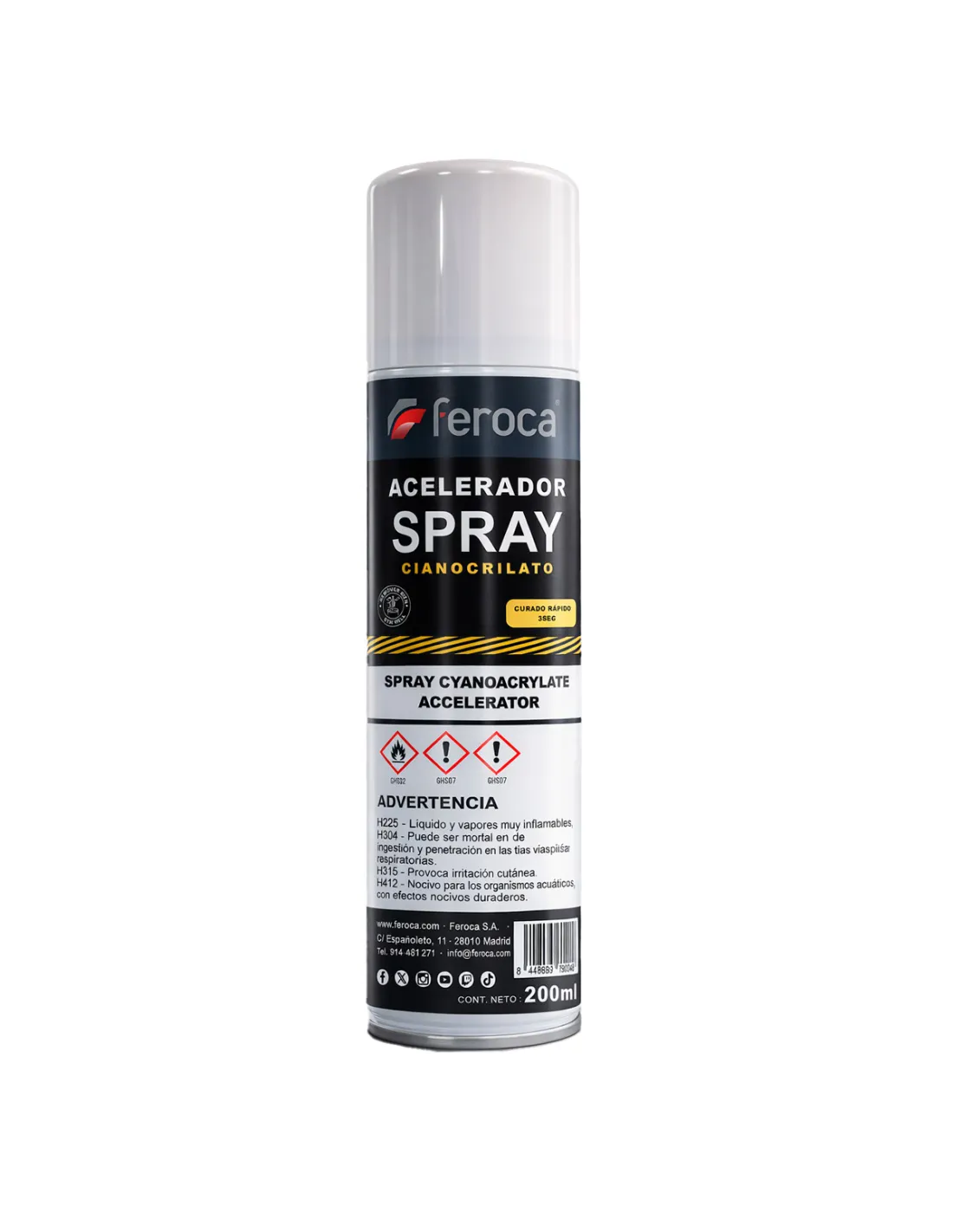
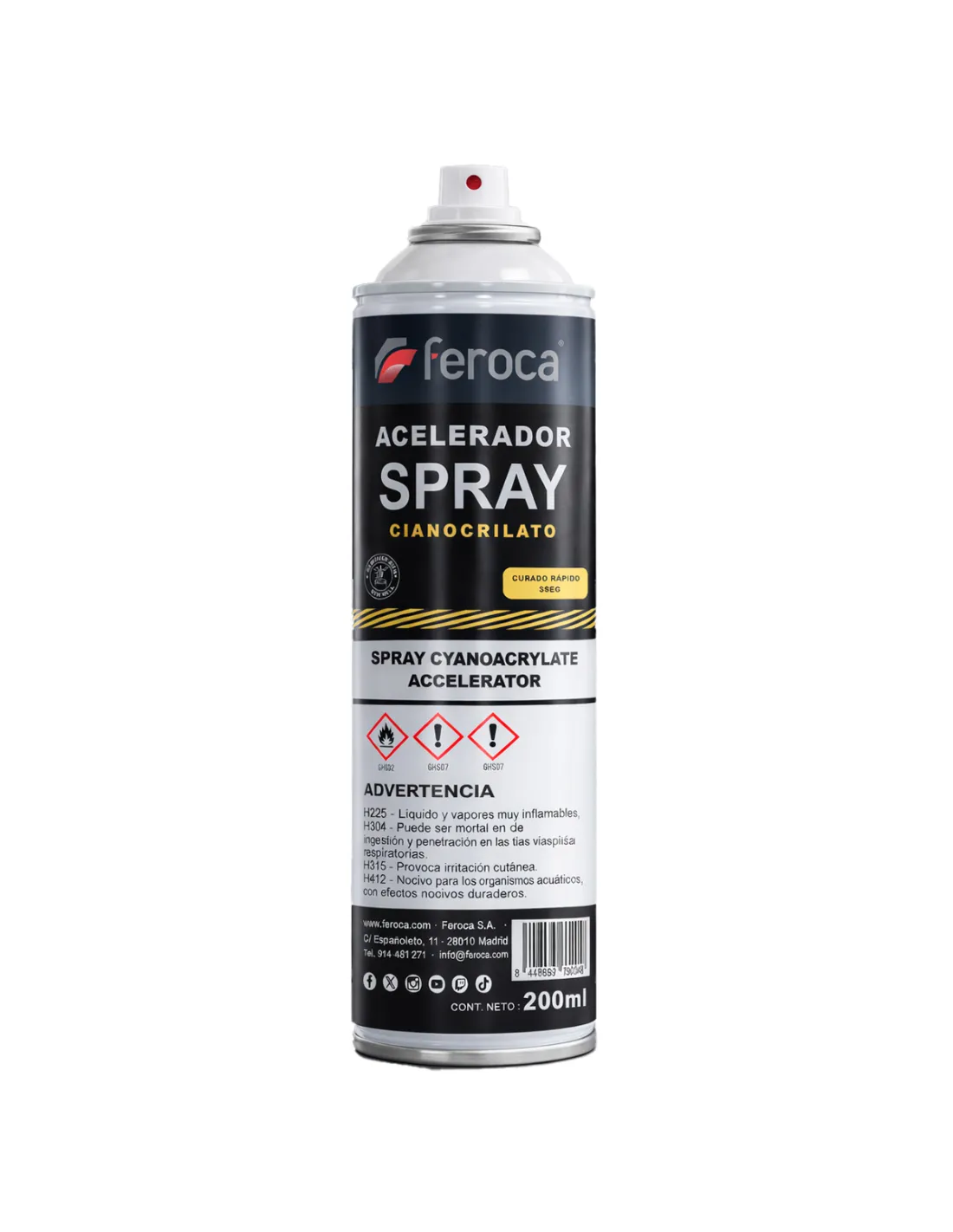
The Cyanoacrylate Accelerator Spray is the essential companion for working with cyanoacrylate adhesives when you need a truly instant bond. Apply it to one surface before applying the cyanoacrylate to the other, and both parts bond the moment they make contact — no waiting. Ideal in the workshop for speeding up curing on difficult parts, production assemblies or repairs where time matters.
Technical specifications
| Parameter |
Value |
| Format |
Spray (aerosol can) |
| Type |
Cure accelerator for cyanoacrylate adhesives |
| Application |
Direct spray onto the surface |
| Bond time after application |
Instant on contact with cyanoacrylate |
| Compatibility |
All cyanoacrylate adhesives |
| Storage |
Cool, dry place away from direct sunlight |
What it's used for
The accelerator spray is designed to reduce cyanoacrylate setting time to zero, which is especially useful when working with parts you can't hold in position for long, porous surfaces, or when you need production throughput. It is also very effective combined with Ciano Denso, which due to its viscosity cures somewhat more slowly and benefits from the accelerator to compensate.
- Rapid assembly of parts in resin, polyurethane or composite
- Instant bonding of parts in foam, cork, wood or leather
- Emergency repairs in special effects and prosthetics workshops
- Bonding small parts that cannot be held under prolonged pressure
- Combination with Ciano Denso to speed up its slower cure
- Series production where cycle time is critical
- Sealing and bonding porous materials that absorb the adhesive
How to use it
- Prepare the surfaces: make sure both surfaces to be bonded are clean, dry and free of dust or grease.
- Shake the spray: shake the accelerator spray can before use.
- Apply the accelerator: spray the accelerator onto one of the two surfaces to be bonded, from a distance of approximately 15–20 cm.
- Wait for evaporation: wait a few seconds for the accelerator's solvent to evaporate completely. The surface loses its wet sheen when it is ready.
- Apply the cyanoacrylate: apply a small amount of cyanoacrylate — Ciano Normal, Ciano Muy Líquido or Ciano Denso — to the other surface.
- Join the parts: bring both surfaces together with precise positioning, as the grip is virtually immediate.
- Apply pressure: apply firm pressure for 5–10 seconds to secure the bond.
Caution: the spray contains volatile and flammable solvents. Always use in well-ventilated spaces, away from flames or heat sources. Avoid contact with eyes and skin. Cyanoacrylate can bond fingers instantly: if this happens, do not force separation. The accelerator also speeds up setting if cyanoacrylate spills onto skin, so work with nitrile gloves whenever possible.
Usage tips
Use just the right amount of accelerator
Less is more. Too much accelerator can leave a whitish residue at the joint and in some cases weaken the bond. A light, even mist is sufficient. If you see too much liquid remaining on the surface, wait longer for it to evaporate before joining.
Pair it with the right cyanoacrylate for the material
For very porous materials (foam, untreated wood, cork), Ciano Denso penetrates less and leaves more material at the joint; the accelerator compensates for its slower cure. For smooth, non-porous surfaces, Ciano Muy Líquido with accelerator gives very clean and strong bonds.
Storage and shelf life
Store the spray upright, in a cool place away from direct light. Heat and humidity degrade the accelerator over time. If the spray begins to dispense with low pressure or unevenly, it is a sign that the can is nearly empty: it is best not to force it and to replace it to ensure consistent results.
Frequently asked questions
Is it mandatory to use the accelerator with cyanoacrylate adhesives?
It is not mandatory. Cyanoacrylates cure on their own by reacting with ambient moisture. The cyanoacrylate accelerator spray is used when you need an instant bond or when working with very dry or low-reactivity surfaces where natural curing would be too slow.
Can I apply the accelerator and the cyanoacrylate to the same surface?
No. The accelerator and the cyanoacrylate must be applied to different surfaces. If you mix them on the same side before joining, the cyanoacrylate will set before you can position the parts and the bond will be poor or non-existent.
How long do I have to join the parts after applying the accelerator?
The accelerator remains active for several minutes once the solvent has evaporated. However, the optimum is to bond within the first 1–2 minutes after evaporation to take full advantage of its effectiveness.
What materials does the accelerator work with?
The cyanoacrylate accelerator spray is compatible with all materials that accept cyanoacrylate adhesives: metals, plastics (ABS, PVC, polystyrene), cured resins, wood, ceramics, leather, rubber and rigid foams. Always test on a hidden area if the material is delicate, as the spray's solvent may affect some soft plastics or paints.
Does the accelerator leave marks or stains on the part?
If applied in excess or not allowed to evaporate properly, a whitish residue may remain around the joint. By applying a minimal amount and waiting for complete evaporation, the result is clean with no visible marks.
Can the accelerator be used with any type of cyanoacrylate?
What do I do if I've bonded my fingers together?
Do not force separation. Soak the area in warm soapy water, or use pure acetone to dissolve the cyanoacrylate. Work with gentle movements and patience. If the skin is compromised or there is pain, consult a doctor.
Where can I buy regular cyanoacrylate?
You can find Feroca's Ciano Normal directly in our online store. We also stock a very liquid and a dense version depending on your needs.