Shopping Cart


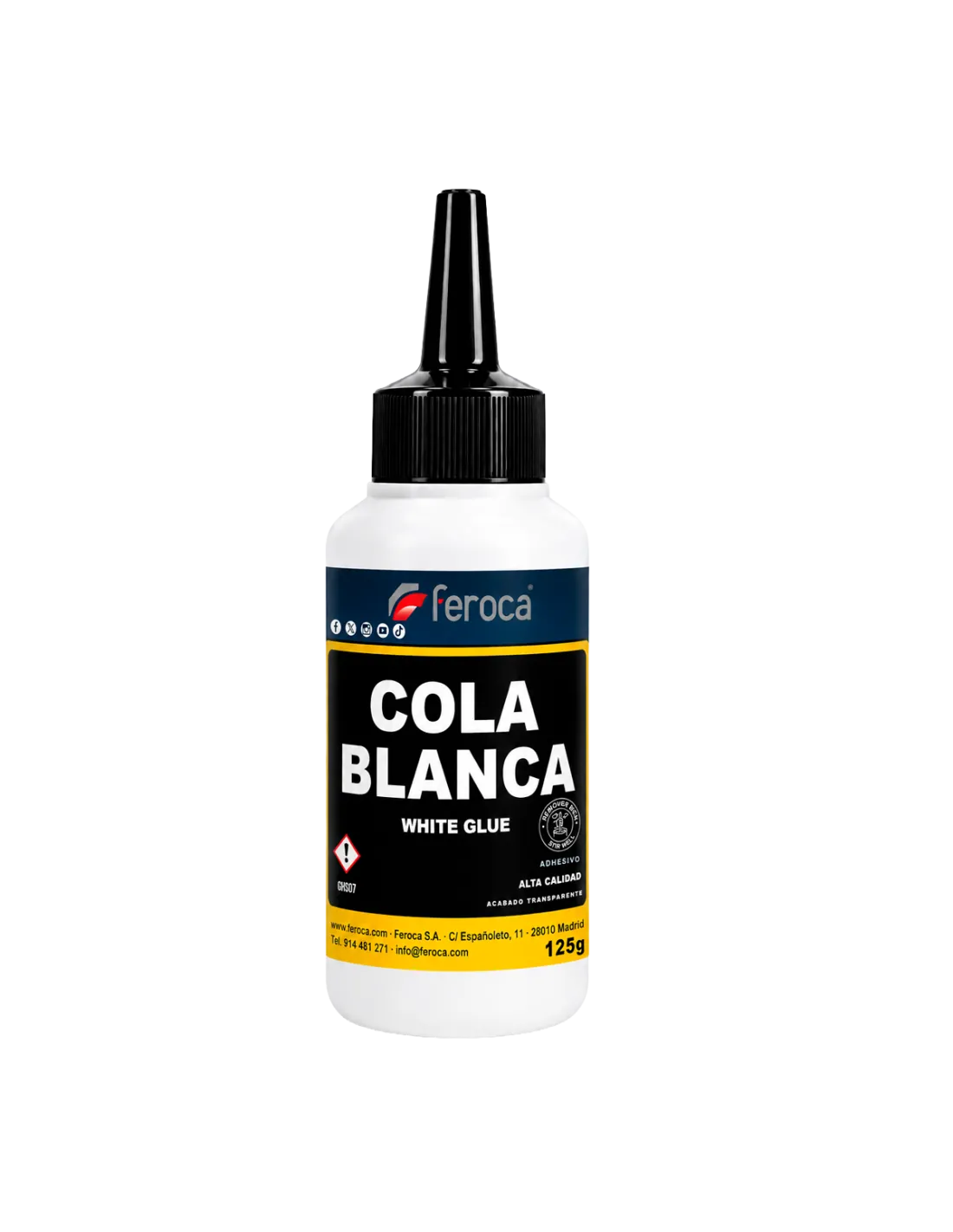
White Glue D2 125 grams
406091000
€4.00
4,84 € Tax incl.
4,84 € Tax incl.
White PVA emulsion adhesive with D2 moisture resistance (EN 204). For wood, cardboard and craft projects. 125 g bottle with twist nozzle.
Cola Blanca D2 is a polyvinyl acetate (PVA) adhesive emulsion with moisture resistance certified to EN 204 class D2. With a fluid consistency and relatively fast drying time, it is the go-to adhesive for bonding wood, cardboard and porous materials in workshops, schools and crafts.
Technical specifications
| Parameter | Value |
|---|---|
| Type | Polyvinyl acetate (PVA) emulsion |
| Colour | White |
| Viscosity | Medium (fluid) |
| Moisture resistance | D2 per EN 204 standard |
| Packaging | Twist nozzle with airtight closure |
| Available sizes | 125 g |
What it is used for
Cola Blanca D2 is designed for bonding porous materials in applications where the joint may be exposed to moderate ambient moisture. Its D2 classification ensures the bond retains its properties under normal indoor humidity conditions.
- Carpentry and joinery: bonding boards, mouldings and solid wood pieces
- Cardboard industry: gluing and laminating cardboard and paperboard
- Lithographic industry: bookbinding and assembly
- Crafts: collage, school projects, cardboard modelling
- Ceramics and porous materials in general
How to use it
- Prepare the surfaces: they must be clean, dry and free of dust and grease. For wood, make sure the moisture content of the material does not exceed 12%.
- Apply the glue: spread an even layer with a brush, spatula or directly with the twist nozzle onto one or both surfaces.
- Join and press: bring the pieces together and apply pressure using clamps or presses. Greater pressure produces a stronger bond.
- Waiting time: initial bonding occurs within 20–30 minutes. For maximum strength, allow at least 24 hours to cure before loading the joint.
- Clean up excess: remove residue with a damp cloth before it dries. Once dry, the glue is harder to remove.
Usage tips
Working temperature
Always apply and join pieces above 10 °C. At lower temperatures the emulsion may coagulate and lose its properties. The optimum working range is 15–25 °C. In very cold environments, slightly pre-warm the pieces before gluing.
Pressure and clamping time
Clamping time varies depending on wood type and ambient temperature. 20 to 60 minutes under pressure guarantees a good initial bond. Do not remove clamps before the glue has lost its milky appearance: that loss of translucency indicates that setting has progressed sufficiently.
Dilution and tool cleaning
You can dilute the PVA white glue with water to adjust viscosity. Tools are cleaned with water immediately after use. Once dry, the glue is not water-soluble: remove it mechanically by sanding or scraping.
Frequently asked questions
What does the D2 classification mean for wood adhesives?
The EN 204 standard classifies wood adhesives into four classes: D1 (dry interior), D2 (interior with occasional ambient moisture), D3 (exterior with moderate exposure) and D4 (exterior with immersion). A D2 glue retains its properties when the joint is occasionally exposed to ambient moisture, but is not suitable for direct outdoor use or areas in contact with water.
Can it be used on wood for outdoor applications?
No. The D2 classification covers indoor ambient moisture, not direct water exposure or outdoor use. For outdoor applications or damp areas, you need a glue with a D3 or D4 classification.
Is white glue suitable for bonding foam or EVA?
PVA white glue is not the best option for foams and EVA: its water-based formula can hinder adhesion on non-porous surfaces and drying time is too long for these materials. For EVA foam, a specific contact adhesive is the most suitable option.
How do I remove dried white glue from a surface?
Once dry, PVA glue forms a flexible film that can be removed mechanically by scraping or sanding. On wood you intend to paint or varnish, remove all residue because the finish will not penetrate properly where cured glue is present.
Can I dilute white glue with water?
Yes. You can dilute it with water to adjust viscosity. A 50% dilution is common for priming porous surfaces, consolidating fragile materials or using it as a matte varnish in crafts. The more diluted it is, the lower the adhesive strength of the bond.
How long does it retain its properties in the container?
Stored in a cool, dry place with the container tightly closed, it retains its properties for at least 12 months. If it has thickened excessively or has lumps, stir well and check that it returns to its normal consistency before use.
No reviews
Tap to zoom