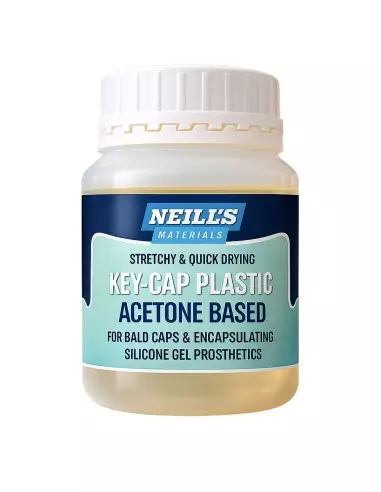
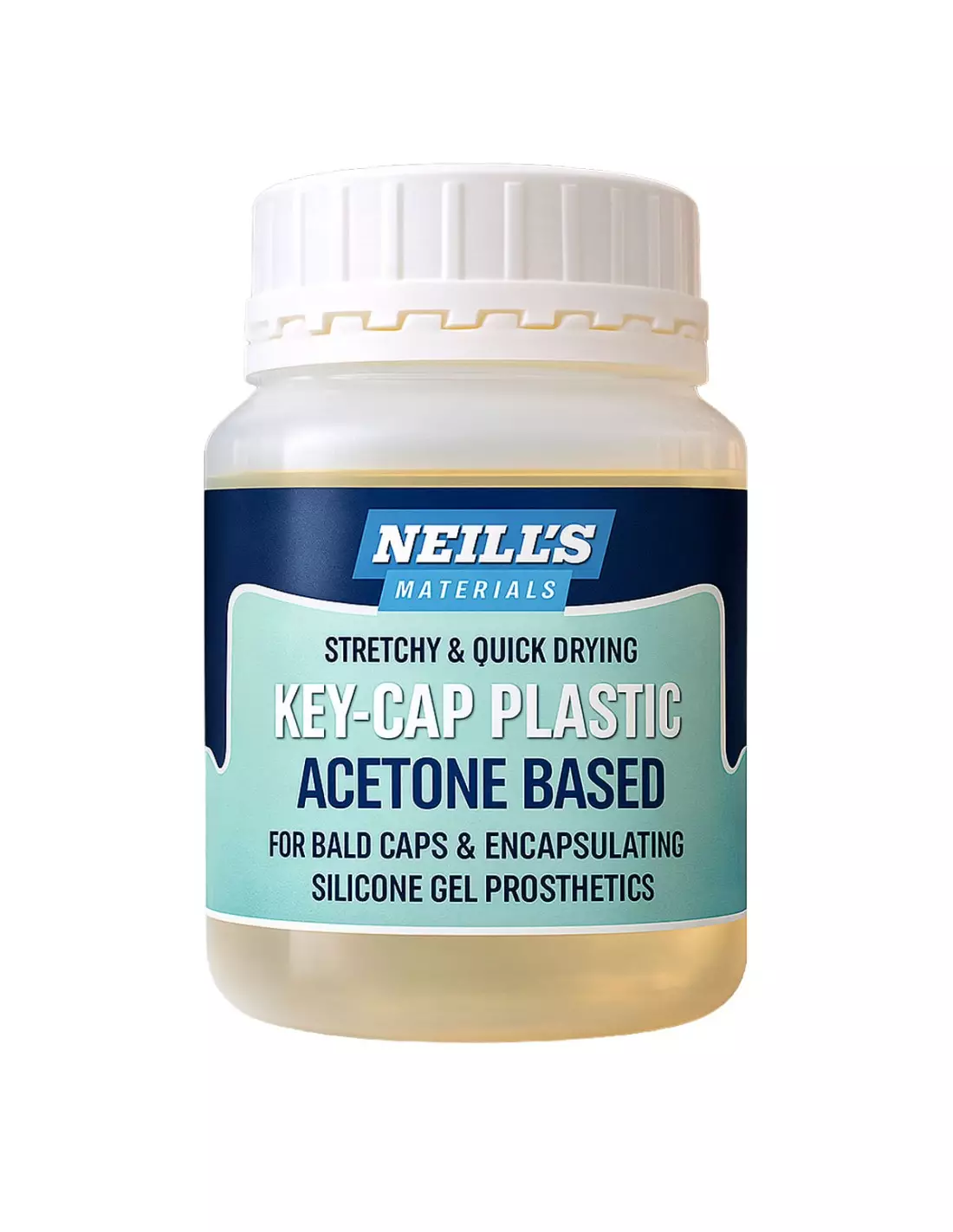
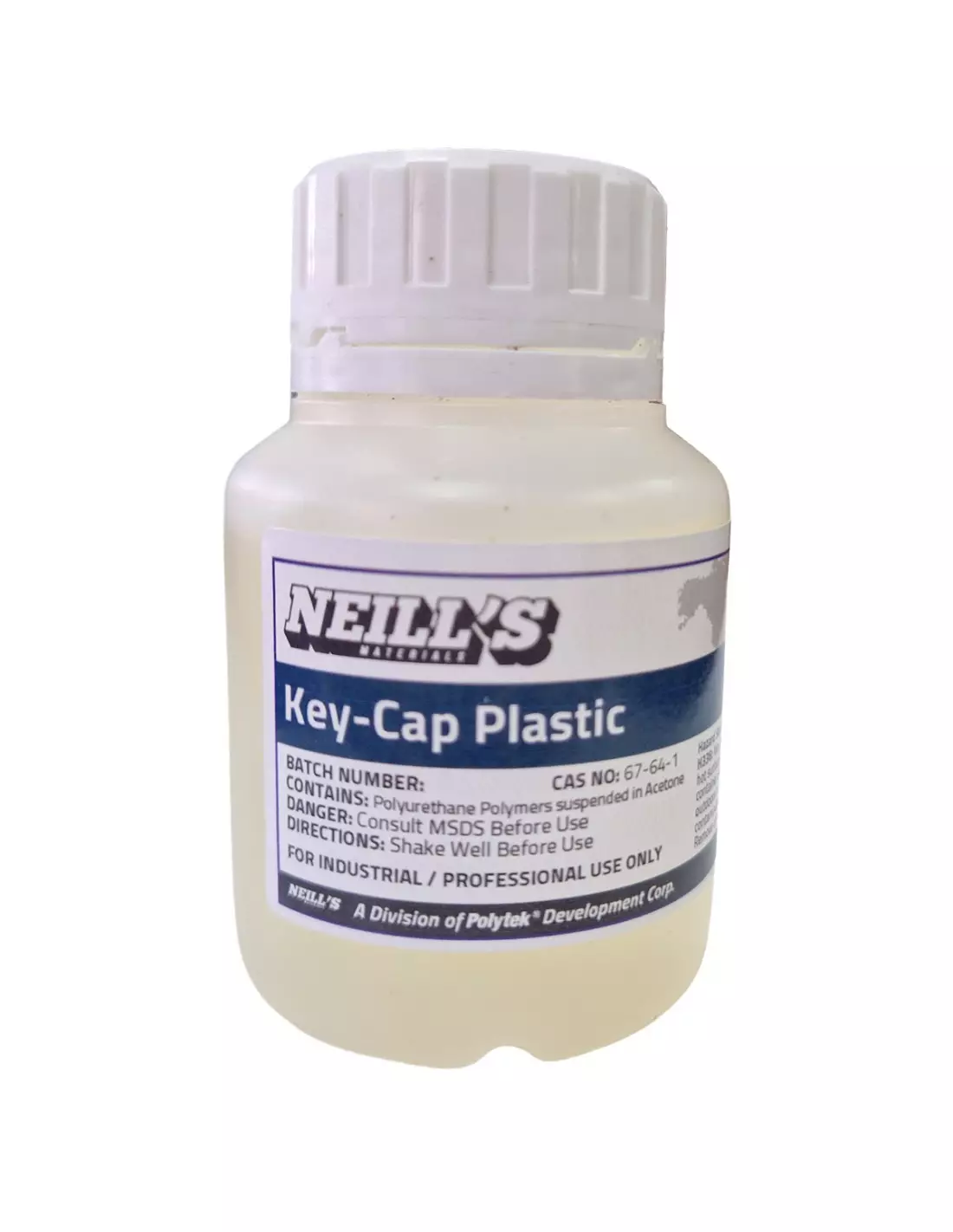
Key-Cap Plastic is the acetone-based encapsulant developed by Neill Gorton, designed to encapsulate silicone gel prosthetics and to manufacture high-quality bald caps. Its edges dissolve with acetone, allowing an imperceptible finish on the skin and seamless integration into any special effects look.
Technical specifications
| Property |
Detail |
| Base |
Acetone |
| Main uses |
Encapsulant for silicone gel prosthetics / Bald Cap manufacturing |
| Thinner |
Acetone |
| Application method |
Brush, spatula or spraying (diluted) |
| Edge blending |
Acetone |
| Skin use |
Yes, direct application on skin in FX makeup |
What it's used for
Key-Cap Plastic is a versatile material in the field of special effects makeup (SFX). Its primary function is to protect and encapsulate the interior of silicone gel prosthetics, while also acting as an artificial skin for bald cap manufacturing. By thinning it with acetone you can adjust its viscosity for brush application or spray it in very thin layers.
- Encapsulation of silicone gel prosthetics for professional FX makeup.
- Bald cap manufacturing for theatrical characterisation, film and television.
- Creation of ultra-thin, flexible artificial skins.
- Spraying of bald caps by diluting with acetone to achieve uniform layers.
- Integration and blending of prosthetic edges onto the actor's skin.
How to use it
- Prepare your work area. Work in a well-ventilated space; acetone is volatile and flammable. Keep heat sources and flames away.
- Adjust the viscosity. If you need a thinner layer or are going to spray, dilute Key-Cap with pure acetone AC-1 until you achieve the desired fluidity.
- Apply the first layer. To encapsulate a prosthetic, spread Key-Cap with a brush over the silicone gel surface in the mould. Allow to dry completely before continuing.
- Add successive layers. Repeat the process until you achieve the desired thickness and strength. More layers means greater durability but reduced transparency.
- For bald caps. Apply layers over a head mould (bald cap form). Allow each layer to dry before adding the next. Carefully remove once the final layer is dry.
- Blend the edges. Once the prosthetic or bald cap is placed on the skin, apply acetone to the edges with a fine brush to blend them into the skin and make the transition invisible.
- Paint and characterise. Once the encapsulant is dry, you can apply FX makeup paints and pigments to achieve the final finish.
Caution — Acetone-based product: Key-Cap Plastic contains acetone, a volatile and flammable solvent. Always work in spaces with good ventilation. Avoid prolonged skin contact and contact with eyes. Use nitrile gloves, safety goggles and a respirator with organic vapour filter. Keep away from heat sources, sparks and open flames. Consult the safety data sheet before use.
Usage tips
Controlling thickness and transparency
The more layers you apply, the greater the mechanical strength of the prosthetic or bald cap, but opacity will also increase. For areas requiring maximum translucency (eyelids, thin facial zones), limit yourself to 2–3 heavily diluted layers. For bald caps that need to withstand more handling, 4–6 layers give a better result.
Spraying for uniform finishes
If you are going to spray the encapsulant, dilute Key-Cap with pure acetone until you achieve a water-like consistency. Test the mixture on paper before applying to the mould. Spraying allows very uniform layers and avoids brush marks, ideal for high-quality bald caps.
Perfect edge integration
The key advantage of Key-Cap over other encapsulants is precisely that its edges dissolve with acetone, allowing near-invisible integration. Apply acetone to the edges with a very fine brush, progressively working from the outside towards the interior of the prosthetic. Work quickly but precisely: acetone evaporates fast. If you need to adhere the prosthetic to the actor's skin, combine with a specific adhesive such as PROTAC or Telesis 8.
Frequently asked questions
What is the difference between an acetone-based encapsulant and an isopropyl alcohol-based one?
The main difference lies in the solvent used and the properties of the resulting film. Acetone-based encapsulants like Key-Cap offer very clean and fast edge blending, ideal for integrating prosthetics on set. isopropyl alcohol (IPA)-based encapsulants like Super-Cap have a slightly longer working time and may be preferable in certain workflows or when you want to avoid acetone use. The choice depends on technique and the artist's preferences.
Can the encapsulant be pigmented before application?
Yes. Key-Cap accepts solvent-compatible pigments. Adding colour directly to the encapsulant allows you to create an artificial skin with a built-in base tone, simplifying the subsequent characterisation process. However, for detailed effects it is always preferable to paint on top once dry.
How many layers are needed to encapsulate a prosthetic?
It depends on the final use and desired thickness. In general, between 3 and 6 layers is standard for silicone gel prosthetics. For bald caps intended for theatrical use or long-duration wear, a minimum of 4–5 fully dried layers is recommended. Each layer must be completely dry before applying the next to avoid the solvent trapping bubbles.
How is the encapsulated prosthetic removed from the skin at the end of the day?
Removal depends on the adhesive used to fix the prosthetic. If you used Telesis 8, the recommended solvent is Telesis 8 Thinner. If you used PROTAC, follow the product's specific instructions. Never pull the prosthetic off abruptly to avoid damaging the actor's skin or the prosthetic itself.
Can it be used directly on the actor's skin?
Key-Cap Plastic is a standard product in professional FX makeup and is used in contact with skin as part of prosthetics and bald caps. However, it is the artist's responsibility to always perform a prior skin tolerance test on each actor. The acetone content means the product evaporates quickly, but prolonged contact with sensitive skin should be avoided.
What thinner should I use and in what ratio?
The thinner is pure acetone (AC-1). There is no fixed ratio: dilute to taste depending on the application. For brush application in thick layers, use little dilution. For spraying or very thin layers, dilute until you achieve an almost watery consistency. It is best to test on paper or a test surface before applying to the final work.
What is the difference between Key-Cap Plastic and Key-Cap Beads?
Key-Cap Beads is the same encapsulant in solid bead format. This allows the artist to prepare the solution at the exact concentration needed by dissolving the beads in acetone. Key-Cap Plastic comes in liquid format ready to use or dilute. The base formula is the same; the difference is the presentation format and flexibility in preparation.
What materials do I need to make a complete FX prosthetic?
For a complete FX prosthetic you will need a makeup-grade platinum silicone for the prosthetic core, Key-Cap Plastic as the encapsulant, a body adhesive such as PROTAC or Telesis 8 for fixation, compatible pigments and paints for characterisation, and acetone for thinning and blending edges. Moulds, modelling tools, gloves and respiratory protection are also essential.