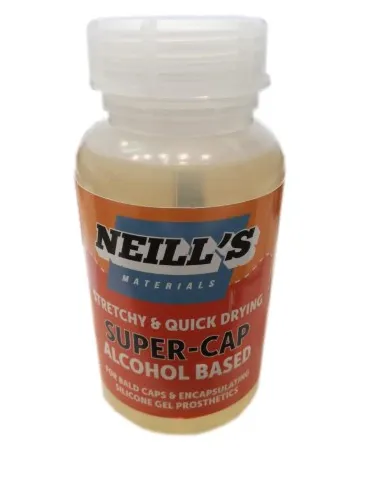
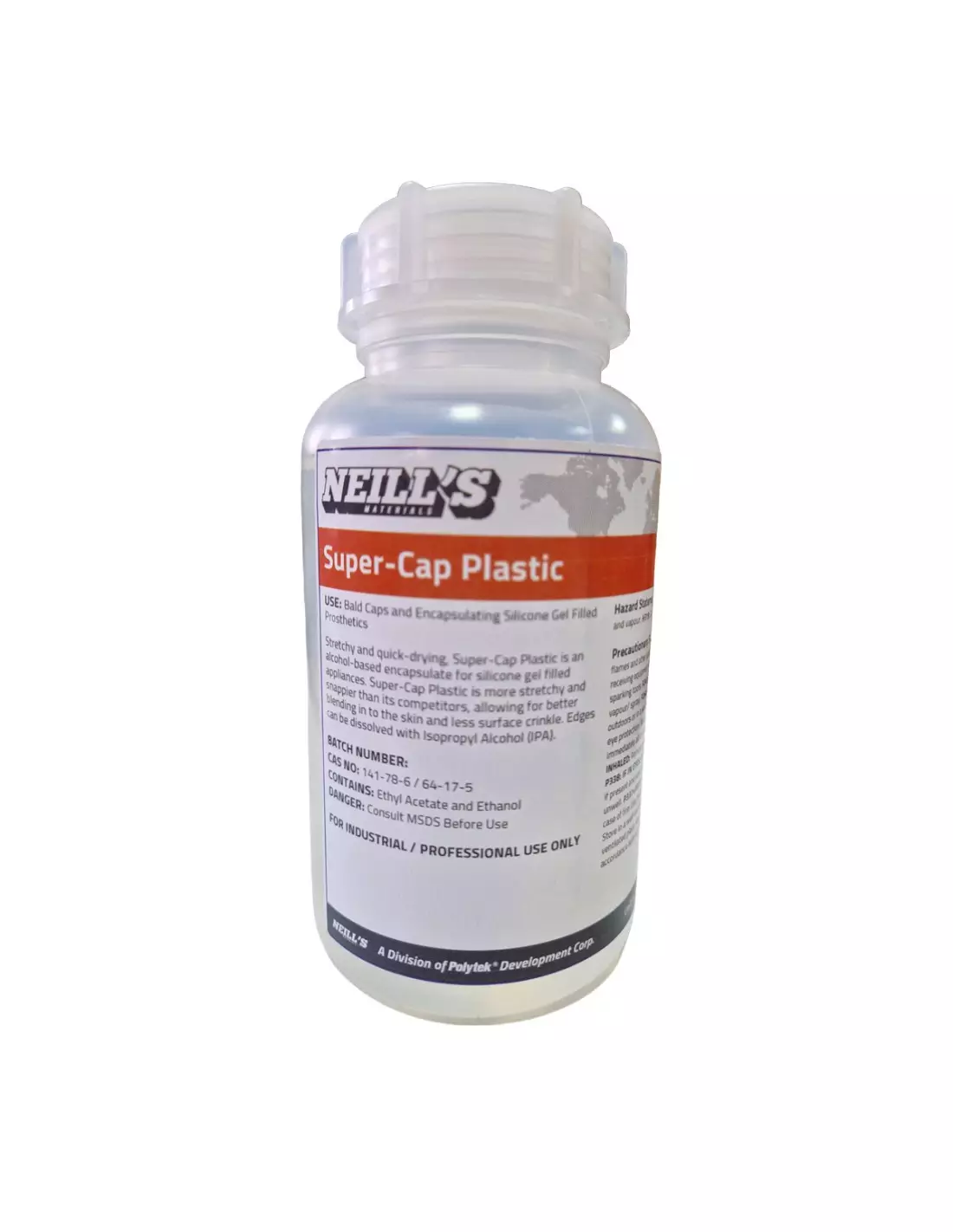
Super-Cap is an isopropyl alcohol (IPA)-based encapsulant designed specifically for silicone gel prosthetics in special effects. Its high elasticity allows natural placement on skin with minimal surface wrinkling, and its absolute transparency makes both mould work and the application of alcohol-activated makeup directly onto the prosthetic straightforward.
Technical specifications
| Base |
Isopropyl Alcohol (IPA) |
| Appearance |
Transparent (does not blush on contact with water) |
| Elasticity |
High — suitable for flexible silicone gel prosthetics |
| Thinner |
99.9% Isopropyl Alcohol — ratio 5:1 (5 parts IPA : 1 part Super-Cap) |
| Edge solvent |
Isopropyl Alcohol (IPA) |
| Compatibility |
Alcohol-activated makeup (Key Color palettes and similar) |
| Applications |
Prosthetic encapsulant, Bald Cap |
| Release agent required |
Petroleum-based (e.g. Eject-it #33) |
| Cure speed |
Slower than acetone-based encapsulants |
What it is used for
Super-Cap is the go-to encapsulant for FX makeup professionals working with silicone prosthetics. Its IPA base makes it compatible with the entire standard studio workflow: pre-painting with alcohol-activated makeup, edge blending with the same solvent, and airbrushing. It is also used to make bald caps thanks to its flexibility and transparency.
- Encapsulation of platinum silicone gel prosthetics
- Bald Cap fabrication for FX and theatre
- Sealing prosthetic edges prior to on-skin application
- Pre-painting prosthetics with alcohol-activated makeup for permanent colour adhesion
- Airbrushing onto prosthetics (diluted in IPA)
How to use it
- Prepare the mould: apply a petroleum-based release agent (such as Eject-it #33) to the mould surface. Super-Cap bonds more strongly than acetone-based encapsulants, so this step is essential.
- Apply the first coat: brush Super-Cap directly from the container, or if preferred, thin it with 99.9% Isopropyl Alcohol at a 5:1 ratio (5 parts IPA to 1 part Super-Cap) for airbrushing. Allow to dry completely.
- Paint in colour (optional): before pouring the silicone gel, you can paint the prosthetic with alcohol-activated makeup over the dry Super-Cap coat. The colour will bond permanently to the prosthetic.
- Apply additional coats: add as many coats as needed to achieve the desired thickness, allowing each one to dry fully before the next.
- Pour the silicone gel: once the encapsulant is dry, pour your platinum silicone (PlatSil Gel or equivalent) over the Super-Cap layer.
- Demould: once the gel has cured, demould carefully. If residue remains in the mould, clean with IPA 99.9%.
- Blend the edges: dissolve and feather the prosthetic edges with isopropyl alcohol to achieve an invisible transition on skin.
- Apply the prosthetic: use a skin-specific adhesive such as PROTAC or Telesis 8 to secure the prosthetic to the performer.
Usage tips
Release agent: do not skip this step
Unlike acetone-based encapsulants, Super-Cap tends to adhere more strongly to mould surfaces. Always apply a petroleum-based release agent before applying the encapsulant. Skipping this step risks damaging the prosthetic when demoulding or leaving residue that is difficult to remove.
Thinning for airbrush
To airbrush Super-Cap, thin it with 99.9% Isopropyl Alcohol at a 5:1 ratio (five parts IPA to one part Super-Cap). This dilution ensures the right viscosity without compromising the final film's properties. Use high-purity IPA (99.9%) to avoid residues that could affect the finish.
Advantage over acetone-based encapsulants
If you need to work in a poorly ventilated environment or want more working time, Super-Cap is preferable to acetone-based encapsulants such as Key-Cap Plastic. IPA is a less aggressive solvent, which also gives you more control when blending edges. If drying speed is the priority, acetone-based encapsulants are faster.
Frequently asked questions
What is the difference between an IPA-based and an acetone-based encapsulant?
The main difference is evaporation speed and solvent aggressiveness. Acetone-based encapsulants (such as Key-Cap Plastic) dry faster, speeding up the process but leaving less working time. Super-Cap, being IPA-based, dries slightly slower, allows more controlled work, and is compatible with alcohol-activated makeup. Additionally, Super-Cap edges are dissolved with the same IPA, simplifying the material chain in the studio.
Can I paint the prosthetic before encapsulating it?
Yes, and this is one of Super-Cap's main advantages. Being IPA-based, you can paint directly onto the dry encapsulant coat with alcohol-activated makeup. The pigment bonds permanently to the prosthetic, ensuring lasting colour that will not lift during shooting or performance.
What adhesive should I use to attach the encapsulated prosthetic to skin?
For silicone prosthetics encapsulated with Super-Cap you can use PROTAC (acrylic adhesive for FX makeup) or Telesis 8 (silicone adhesive). The choice depends on the type of prosthetic and the intended wear time. Telesis 8 is particularly well suited for silicone prosthetics due to its chemical compatibility.
Can it be used to make bald caps?
Yes. Super-Cap can be used to make bald caps thanks to its high elasticity and transparency. The process is similar to prosthetic encapsulation: coats are applied over a previously released head mould, allowing each coat to dry before the next.
How do I clean brushes and the airbrush?
Super-Cap dissolves with Isopropyl Alcohol, making tool clean-up straightforward: simply wash brushes and the airbrush with IPA 99.9% immediately after use. If the product has already dried on the tool, a longer soak may be required.
Does it blush or turn opaque on contact with water?
No. One of Super-Cap's advantages over other encapsulants is that it does not blush on contact with water. This makes it easy to float pieces out of the mould in water and simplifies general clean-up of the workspace.
How many coats should I apply?
The number of coats depends on the desired thickness and the type of prosthetic. Generally, 2 to 4 coats are recommended for standard prosthetics, allowing each to dry completely before the next. For Bald Caps, more coats may be needed to achieve sufficient strength. If applying by airbrush at the 5:1 dilution, a few extra coats may be needed as the film will be thinner.
What ventilation do I need when working with this product?
Although IPA is less aggressive than acetone, isopropyl alcohol vapours in enclosed spaces can cause respiratory irritation. Always work in a well-ventilated area or with local extraction. If using an airbrush to spray, an organic vapour respirator mask is also recommended.