
Shopping Cart
- Feroca
- Mold Making Silicones
- 0 likes
- 190 views
- 0 comments
When you go to buy silicone for your first mould, the first question is almost always the same: tin or platinum? Both are used to make flexible moulds, both copy detail very well and, in many projects, either of them would work. But there are situations where choosing the wrong one costs you the mould, the original or the whole project. In this guide we won't repeat the chemistry: we give you a practical way to decide, with the questions you need to ask yourself before buying and the specific silicone we recommend for each case.
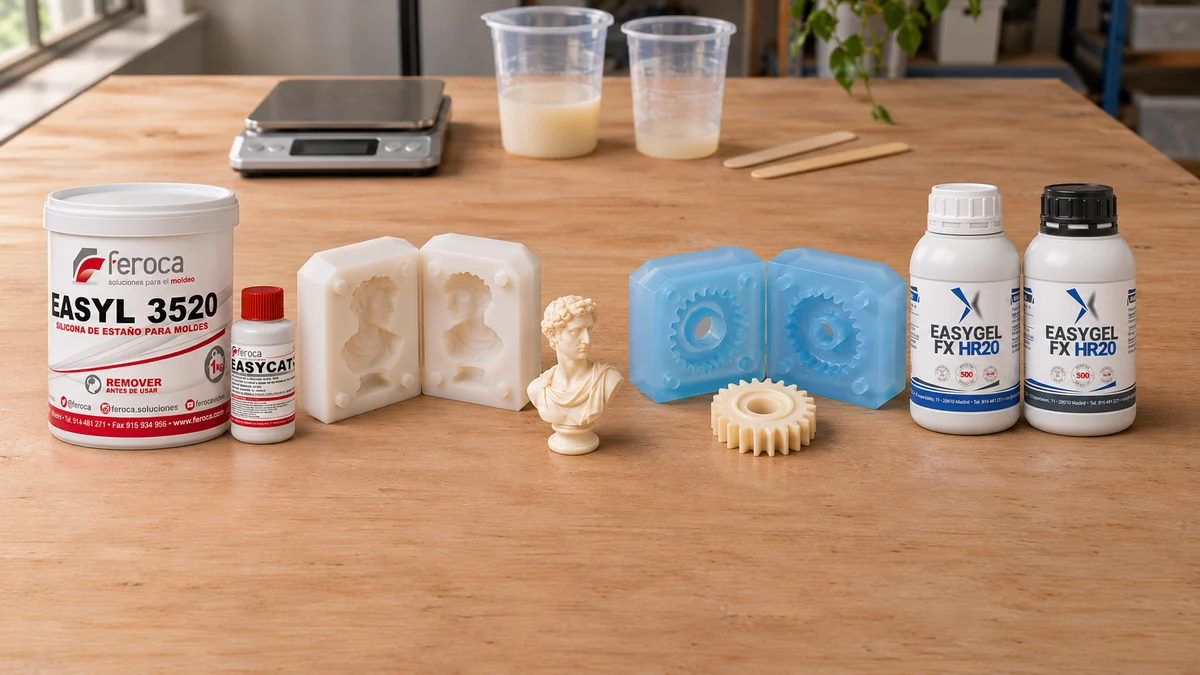
The short answer
- Tin-cure silicone for most workshop moulds: resin, plaster, wax, soap, decoration and cosplay, especially if you don't know what the original is made of or you're on a tight budget.
- Platinum silicone when the mould will touch food or skin, when parts have to be dimensionally accurate and fit together, or when you'll pull many copies from the same mould.
What really changes between them
If you want the full explanation of how each system cures, you'll find it in our complete guide to mould-making silicone. To decide, these five practical differences are enough:
- How it's mixed. Tin-cure silicone uses very little catalyst: 100 parts base to 5 parts catalyst, always by weight. Platinum silicone is mixed in equal parts, 1:1, by weight or by volume.
- How much it shrinks. Tin-cure silicone shrinks slightly as it cures: up to 0.3% for EASYL 3520 and between 0.2 and 0.5% for Silastic 3481. Platinum silicone, less than 0.1%.
- What ruins it. Tin-cure silicone cures on almost any material. Platinum silicone can be inhibited: if it touches certain substances, it stays tacky and doesn't cure.
- How long the mould lasts. A platinum mould withstands more castings than a tin-cure mould made with the same care.
- What it costs. Tin-cure silicone is cheaper.
Seven questions before you buy
Answer them in this order. As soon as one gives you a clear answer, you have your silicone.
1. Will the mould be in contact with food or skin?
If the answer is yes, there's no choice: platinum, and a product designed for that use. For food (chocolate, ice, baking) you need a food-grade silicone such as Easyl 925-FDA or Easyl 940-FDA, and you must post-cure it in an air-circulating oven at 180-200 °C (1-2 hours for thin walls, 3-4 hours for thick walls) before first use. For moulds taken on the body, a lifecasting silicone such as KEY-FORM. Industrial tin-cure silicones, such as Silastic, must not be used either with food or on skin.
2. Do you know what the original is made of?
Platinum silicone is inhibited by latex, clays and plasticines that contain sulphur, tin-cure silicone itself, freshly cast polyester, epoxy that isn't fully cured, urethane rubbers, some paints and some unsealed metals. If your original is made of one of these materials, or you don't know what it is (an old figure, a painted piece, something you've been lent), the safe option is tin-cure. If you still need platinum, do the test we explain below first.
3. Do the parts need to be dimensionally accurate or fit together?
For a decorative figure, 0.3% shrinkage is invisible. For parts that have to fit together (the two halves of a housing, a replacement part, a prop that gets screwed together) or for long parts, where that percentage already shows up in millimetres, choose platinum.
4. How many copies will you pull from the mould?
For a handful of copies, a one-off or a test, tin-cure is more than enough. If you're going to produce in series, or the mould has to last you months of use, platinum withstands more castings and the extra cost is spread over many more parts. Mould life also depends on the material you pour, the release agent and your working pace: if you pour resin castings back to back without letting the mould cool, it suffers more whatever the silicone.
5. What are you going to cast in it?
Plaster, wax, soap and polyurethane, polyester and epoxy resins can be cast without problems in both types. There are two special cases:
- Low-melting-point metals (pewter, tin, bismuth alloys): here you need a specific tin-cure silicone, MetalCast, Shore A50, whose moulds withstand up to 300 °C.
- Moulds that will be exposed to heat without reaching molten metal, such as baking or post-curing parts: platinum silicones such as EASYPLAT MOLD-40, which works between −50 and 200 °C.
6. How much silicone will you mix each time?
Hardly anyone asks this question, and it matters. With tin-cure silicone, for 100 g of base you add only 5 g of catalyst: a 1 g mistake is already a 20% deviation. With small batches you absolutely need a precision scale. Platinum silicone, being 1:1, is much more forgiving of measuring errors and can even be dosed by volume. If you're going to make small moulds and don't have a scale, platinum makes things easier.
7. What's your budget?
If none of the previous questions has led you to platinum, choose tin-cure: you'll make the same mould for less money.
Which silicone to choose for your project
| Your project | System | We recommend |
|---|---|---|
| Your first mould: figures, resin, plaster, wax or soap | Tin | EASYL 3520 (Shore A20, 20 min working time, demould in 4-5 h) |
| Many castings of polyurethane, polyester or epoxy resin | Tin | Silastic 3481 (Shore A21, high chemical resistance to resins) |
| Candles or parts that need a very flexible mould | Tin | Silastic 3483 (Shore A13) |
| Block mould that has to be cut to remove the original | Tin or platinum | EASYCLEAR (translucent tin-cure) or EasyPlat ACQUA (transparent platinum): you can see the original and cut precisely |
| Brush-on mould over a large or vertical piece | Tin | EASYL Brushable (self-thixotropic, doesn't sag) |
| Original made of plasticine, latex or a material you don't know | Tin | EASYL 3520: it doesn't get inhibited |
| Parts that have to fit together or be dimensionally exact | Platinum | EASYPLAT MOLD-40 (Shore A40, shrinkage < 0.1%) |
| High-definition mould with lots of undercuts | Platinum | PlatSil 73-15 (Shore A15, translucent) |
| You need the mould ready quickly | Platinum | PlatSil 73-20 (Shore A22, cures in 1 hour; only 5 min working time) |
| Moulds for chocolate, ice or baking | Food-grade platinum | Easyl 925-FDA (Shore A25) or Easyl 940-FDA (Shore A40) |
| Pewter, tin or low-melting-point metals | Tin | MetalCast (Shore A50, up to 300 °C) |
If you're torn between two hardnesses, the Shore hardness scale helps you see how each one behaves, and with the material calculator you'll know how much silicone you need for your mould box. You'll find every product in the tin-cure silicones and platinum silicones categories.
Common mistakes when choosing (and when switching between them)
| Mistake | What happens | How to avoid it |
|---|---|---|
| Making the mould in tin-cure silicone to cast platinum silicone parts in it | Platinum silicone doesn't cure in contact with tin-cure silicone | If you're going to cast platinum parts (prosthetics, soft replicas), the mould can't be tin-cure |
| Using the same cups, spatulas or brushes for both | Tin-cure residues contaminate the platinum mix and inhibit it | Keep separate, labelled tools, or use different mixing cups for each system |
| Adding the tin-cure catalyst by eye | With only 5% catalyst, a small error changes the cure | Always weigh base and catalyst on a precision scale |
| Using the fast catalyst for your first moulds | Less time for air to escape and, according to the Silastic data sheet, faster mould wear | Start with the standard catalyst, which gives up to 90 minutes of working time |
| Choosing platinum "just in case" without checking the original | Tacky silicone where it touches the original and a ruined mould | Answer question 2 first and, if in doubt, do the test |
| Using an industrial tin-cure silicone for food moulds | It isn't food grade | Only FDA silicones, with their post-cure. You'll find the process in our food-safe silicone guide |
Unsure about platinum? Do a test
Before pouring the whole kit over an original you're not sure about, mix a small amount of platinum silicone and apply it to an inconspicuous area of the original, or to a scrap of the same material. Let it cure for the time stated on the data sheet. If it's dry to the touch and peels off cleanly, you can go ahead. If it has stayed tacky where it made contact, the material inhibits it: seal the original or switch to a tin-cure silicone.
And if what's holding you back is that you need to brush the mould on, that's no reason to decide either way: Thixo Additive works with both tin-cure and platinum silicones, and thickens either of them so it doesn't sag on vertical surfaces.
Made up your mind? You may be interested in how to make a two-part pour silicone mould.
Frequently asked questions
Which silicone is best for getting started with mould making?
For most first moulds, a medium-hardness tin-cure silicone such as EASYL 3520: it's affordable, it isn't inhibited by the original and it gives you 20 minutes of working time to mix and pour calmly. All you need is a precision scale to weigh the catalyst.
Can you cast platinum silicone in a tin-cure silicone mould?
No. Platinum silicone is inhibited in contact with tin-cure silicone and doesn't cure. If you're going to cast platinum silicone parts, such as prosthetics or soft replicas, make the mould with a compatible material.
Is platinum silicone worth it for resin moulds?
If you're going to pull many copies or the parts have to be dimensionally accurate, yes: it shrinks less than 0.1% and the mould lasts longer. For a few copies or decorative pieces, a tin-cure silicone with good resistance to resins, such as Silastic 3481, is more than enough.
Why does tin-cure silicone need a precision scale?
Because it's mixed with 5% catalyst by weight: for 100 g of base you only add 5 g. With such a small amount, any measuring error is proportionally large. Platinum silicone is mixed 1:1 and can be dosed by weight or by volume.
Which silicone should I use for chocolate or ice moulds?
Only food-grade platinum silicone, such as Easyl 925-FDA or Easyl 940-FDA. After curing for 24 hours, post-cure the mould in an air-circulating oven at 180-200 °C (1-2 hours for thin walls, 3-4 hours for thick walls) and wash it before first use.
Which silicone withstands the highest temperature?
For low-melting-point metal moulds, the tin-cure silicone MetalCast, whose moulds withstand up to 300 °C. For moulds that go in the oven without reaching molten metal, platinum silicones such as EASYPLAT MOLD-40, which works up to 200 °C.
Comments (0)