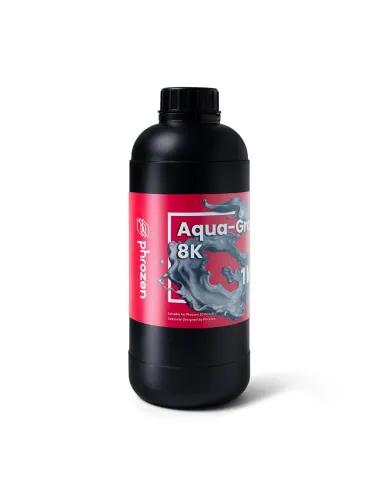
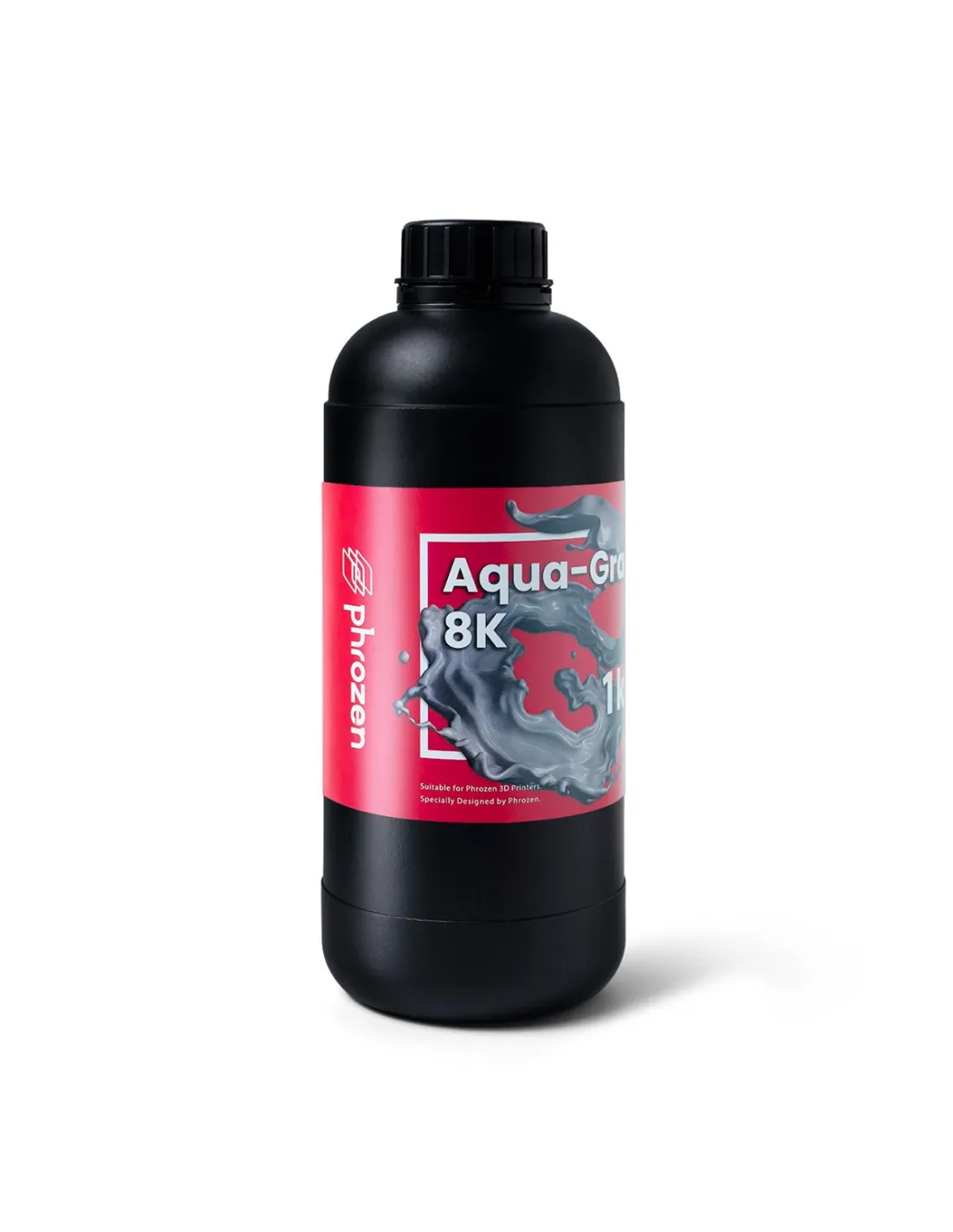
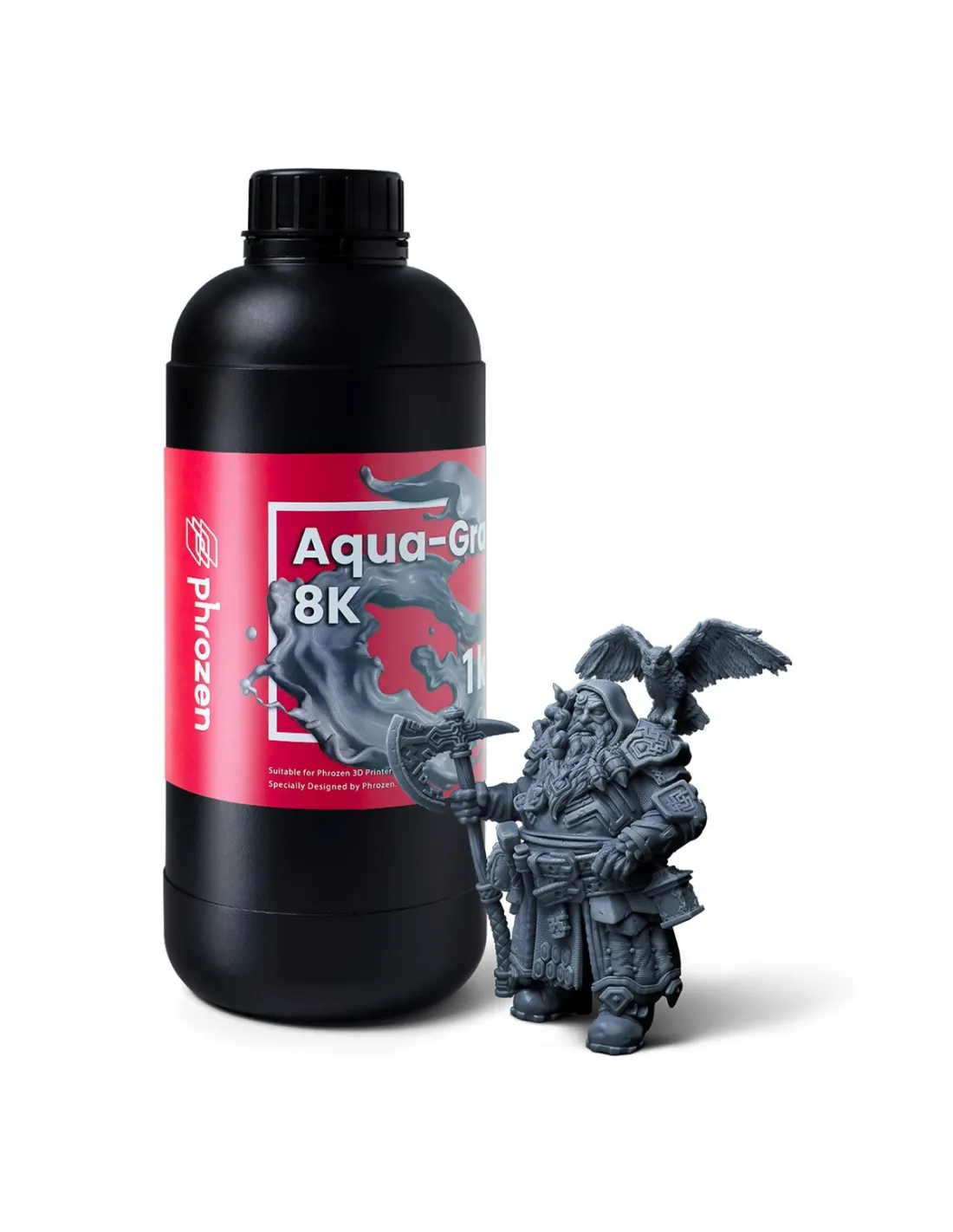
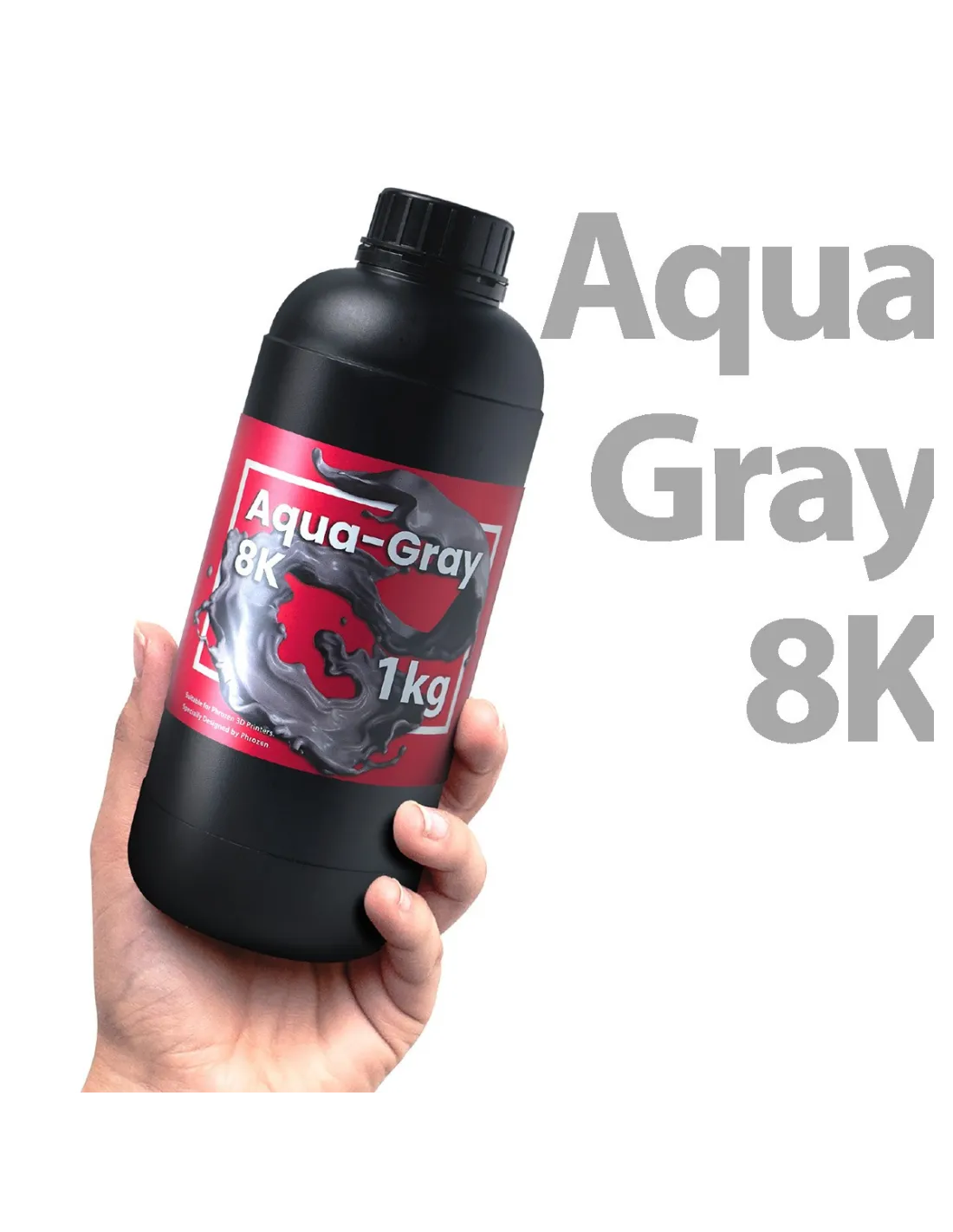
Phrozen Aqua-Gray 8K is a standard grey photopolymer resin formulated to get the most out of high-resolution MSLA printers. Its low-viscosity, low-shrinkage formula delivers precise, dimensionally stable parts with exceptional detail, and its reduced odour makes workshop use more comfortable.
Technical specifications
Parameter
Value
Colour
Grey
Weight per bottle
1 kg
Density
1.1 g/cm³
Viscosity
280–380 cps
Surface hardness
85 Shore D
Tensile strength (UTS)
47 MPa
Tensile modulus
2256 MPa
Elongation at break (EAB)
23 %
Flexural strength
54 MPa
Flexural modulus
1551 MPa
Izod impact resistance (notched)
9.63 J/m
HDT at 0.45 MPa
77 °C
Target resolution
8K
Type
Standard / High Definition
What it's used for
Aqua-Gray 8K is designed for those who need parts with a very fine level of detail and good dimensional stability. The neutral grey colour makes it easy to visually inspect surfaces and details before painting or final finishing. Its most common applications are:
Architecture and product design models with smooth surfaces
Collectible figures and scale miniatures for painting
Functional and presentation prototypes in engineering
Jewellery and goldsmithing in the form validation stage
Industrial accessories and parts under low mechanical load
Special effects: prosthetics and prop elements requiring fine finishing
Master moulds for subsequent casting in silicone or polyurethane resin
How to use it
Shake the bottle for at least 30 seconds before pouring the resin into the vat. Pigments and components may settle during storage.
Configure the print parameters in your slicing software following Phrozen's recommended profiles for this resin. Adjust exposure times according to the UV power of your printer.
Start the print and wait for it to complete without opening the lid unnecessarily, to avoid exposure to ambient light.
Remove the part from the build plate using a spatula and nitrile gloves. Always handle uncured resin with proper protection (gloves, safety glasses).
Allow to drain and dry in the open air or with the help of compressed air before final curing.
Perform UV post-curing in a Cure Lamp such as the Phrozen Cure Mega "S" for the time recommended by Phrozen (generally 2–5 minutes depending on the size and geometry of the part).
Remove supports and carry out the desired surface finishing: sanding, priming, painting.
Important — Safe handling of photopolymer resins: Uncured resin is irritating to skin and eyes. Always wear nitrile gloves and safety glasses, and work in a well-ventilated space. Avoid direct contact and do not pour uncured resin down the drain. Once cured, the part is safe to handle. Consult the safety data sheet before first use.
Usage tips
Working temperature
The viscosity of Aqua-Gray 8K is sensitive to temperature. Below 20 °C it may thicken and make layer separation more difficult. The ideal working range is between 20 and 30 °C. If your workshop is cold, leave the bottle at room temperature for an hour before printing, or gently warm the vat with a low-temperature heating pad.
Storage and shelf life
Store the resin in its original, tightly sealed bottle in a cool place away from direct sunlight and UV light sources. Once opened, use preferably within the following months. If resin remains in the vat after printing, filter it back into the bottle using a paint strainer to remove any cured particles that could contaminate future prints.
Optimising exposure profiles
The grey colour of this resin absorbs UV light differently from transparent resins. Run an exposure matrix test when switching to a new printer or a new batch of resin to calibrate layer times correctly. Excessive bottom layer exposure time can cause elephant foot (widening at the base) and reduce dimensional accuracy.
Frequently asked questions
Which printers is this resin compatible with?
Aqua-Gray 8K is optimised for MSLA printers with an 8K screen, such as the Phrozen Mighty 8K, the Sonic MEGA 8K V2 and the Sonic MEGA 8K S. In general, it is compatible with any MSLA/LCD resin printer that emits in the 405 nm range, although exposure parameters will need to be adjusted according to the power of each unit.
What solvent is used to clean parts before curing?
The recommended solvent for washing uncured photopolymer resin is 99.9% isopropyl alcohol. Submerge the part and agitate for 2–3 minutes. Replace the alcohol when it becomes saturated with resin (it will turn cloudy and yellowish) to ensure effective cleaning.
Is post-curing necessary? What happens if it's skipped?
Yes, UV post-curing is essential. A freshly printed part has not completed its polymerisation and may still be partially brittle and slightly tacky on the surface. Post-curing in a UV Cure Lamp (such as the Phrozen Cure Mega "S") finishes cross-linking the polymer, achieving the final mechanical values: 85 Shore D hardness, 47 MPa tensile strength and the rigidity stated in the technical data sheet.
Can this resin be used to make master moulds?
Yes, it is one of its most common uses. The high surface definition and low shrinkage of Aqua-Gray 8K make it ideal as a pattern for silicone moulds or polyurethane resin castings. Make sure the part is fully cured and apply a suitable release agent before pouring the silicone.
Why do my parts come out with elephant foot or base widening?
Elephant foot occurs when the exposure time for the bottom layers is excessive. UV light spreads beyond the model's perimeter and solidifies resin outside the intended area. Progressively reduce the bottom layer exposure time in your slicer and run a calibration test to find the optimal value for Aqua-Gray 8K on your specific printer.
Can it be mixed with other resins?
Mixing Aqua-Gray 8K with resins from other formulations or brands is not recommended, as exposure times, viscosity and photoinitiators may be incompatible. The result can be uneven curing, brittle parts or vat contamination. If you want to modify the colour, use pigments specifically designed for photopolymer resin at very low ratios (max. 0.1–0.3% by weight).
How should uncured resin be disposed of correctly?
Uncured photopolymer resin is a hazardous waste material. Never pour it down the drain or dispose of it as liquid waste. Expose resin residues (in an open, shallow container) to direct sunlight or a UV lamp until fully cured. Once solidified, it can be disposed of as ordinary solid waste. Wash alcohol contaminated with resin must be treated similarly: expose it to UV to cure the suspended residues, then handle it as chemical waste in accordance with local regulations.
Why has the resin in the vat thickened or developed lumps?
If the resin has been in the vat for a long time or has been exposed to ambient light, it may have begun partial polymerisation, forming lumps or a cured film. Always filter the resin before reusing it with a fine-mesh paint strainer. If the workshop temperature has dropped significantly, viscosity will naturally increase — simply bringing the bottle to room temperature is enough. If there are abundant lumps, discard that resin and clean the vat before reloading.
Video tutorial
How to do the printing test for Sonic Mighty 4K - Phrozen LCD 3D Printer
Cookies on this site are used to personalise content and ads to deliver social media features and to analyse traffic. We also share information about your use of the site with our social media partners for advertising, personalisation and web analytics.. More information.