Shopping Cart


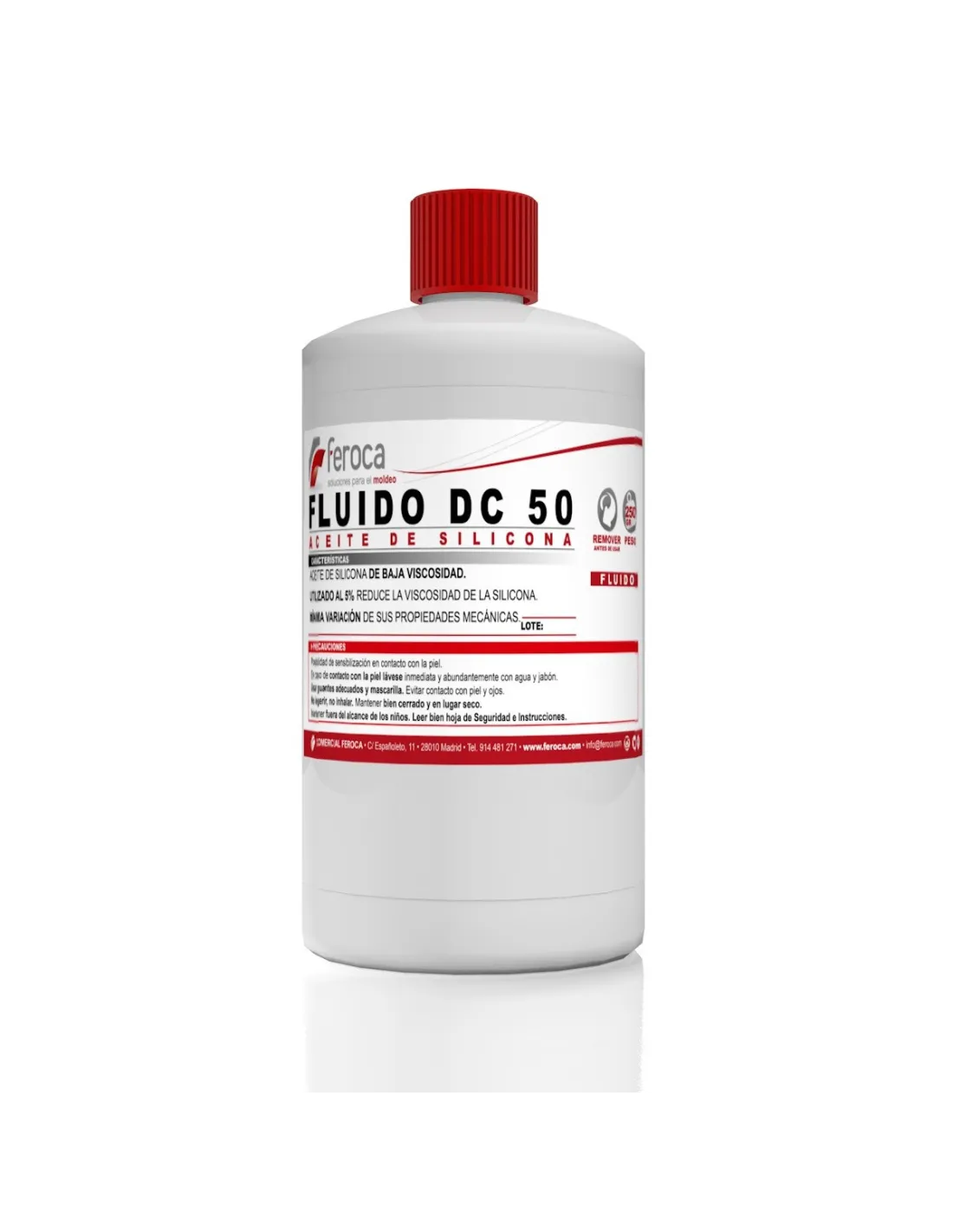
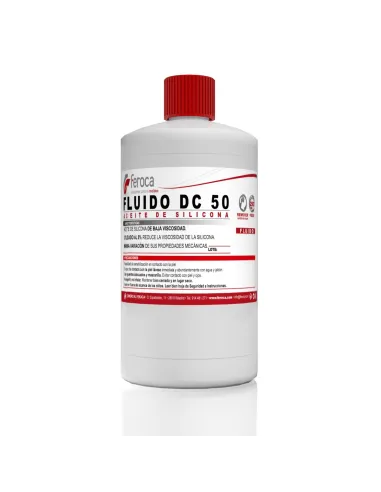
DC 50 Fluid Silicone Oil
203105002
€12.00
14,52 € Tax incl.
14,52 € Tax incl.
Low-viscosity silicone oil. Added at 5% it reduces the viscosity of silicones without altering their mechanical properties.
Fluido DC 50 is a low-viscosity silicone oil specifically designed to reduce the viscosity of liquid silicones before curing. Added in controlled proportions — typically around 5% — it improves workability and pouring of the mix without appreciably compromising the final mechanical properties of the cured elastomer. It is a simple and highly effective workshop additive when you need to fine-tune the flow of your silicone.
Technical specifications
| Parameter | Value |
|---|---|
| Product type | Silicone oil (polydimethylsiloxane) |
| Viscosity | Low |
| Recommended usage dose | ~5% of the total weight of the silicone mix |
| Effect on mechanical properties | Does not appreciably alter them at recommended dose |
| Compatibility | Condensation (tin) and addition (platinum) silicones |
| Appearance | Clear, colourless liquid |
What it is used for
Fluido DC 50 is a workshop additive intended for situations where the silicone is too viscous for the intended working process. Its main use is to reduce pour resistance and improve penetration into moulds with complex geometries, small recesses or fine details.
- Reducing the viscosity of silicones before pouring them into moulds with complex geometry.
- Facilitating the impregnation of very fine textures or surfaces with high detail.
- Improving pouring in deep moulds where thick silicone makes bubble elimination difficult.
- Adjusting consistency when working without a vacuum chamber and a more free-flowing silicone is needed.
- Complementing the use of a thixotropic additive in different layers of the process (fluid surface layer vs. thickened fill layer).
How to use it
- Prepare the base silicone according to the manufacturer's instructions: weigh parts A and B in the indicated ratio.
- Before adding the catalyst, incorporate Fluido DC 50 into part A (the silicone base) at approximately 5% of the total weight of the mix. For example: if you are working with 200 g of silicone in total, add 10 g of Fluido DC 50.
- Mix the fluid thoroughly into the silicone base until fully and evenly incorporated.
- Add the appropriate catalyst — such as Agente de Curado 81 VF for condensation silicones — in the indicated proportion and mix again.
- Pour the mix over the model or into the mould as usual. The cure time does not change from that indicated by the base product.
- Allow to cure for the specified time before demoulding. Apply release agent on the model if required.
Usage tips
Do not exceed the recommended dose
The key to Fluido DC 50 lies in dosing. At 5%, the viscosity reduction is effective and the mechanical properties of the cured elastomer remain within normal parameters. If you significantly increase the proportion, the resulting elastomer may lose tear resistance or end up softer than desired. Always work with a precision scale — never by eye.
Combine it well with other additives
If your process requires a highly detailed surface layer and a more robust fill layer, you can use Fluido DC 50 for the first layer (greater fluidity, better detail penetration) and Thixo Additive to thicken the subsequent fill. Both additives are compatible within their respective mixes, as long as they are incorporated before the catalyst.
Cure time does not change
Adding Fluido DC 50 neither accelerates nor delays the curing of the silicone. The gel time and demould time are the same as those indicated by the base product. If you need to adjust the working time, do so by changing the ambient temperature or using an appropriate catalyst such as Agente de Curado 81 VF — never by modifying the amount of Fluido DC 50.
Frequently asked questions
How much silicone oil do I need to add to notice a difference in flow?
With Fluido DC 50 at 5% of the total weight of the mix, a clear reduction in viscosity is already noticeable. This is the reference dose and the one that ensures the mechanical properties of the cured elastomer are not appreciably compromised. For finer adjustments, you can try between 3% and 7%, but it is not recommended to exceed that range without prior testing.
Is it compatible with platinum (addition) silicones?
Yes, Fluido DC 50 is compatible with both condensation silicones (tin-catalysed) and addition silicones (platinum-catalysed). In both cases it is incorporated into the base before adding the catalyst, at the usual proportions.
Does the silicone oil affect cure time?
No. Fluido DC 50 is inert with respect to the curing process: it neither accelerates nor delays it. The gel time and demould time are exactly the same as those indicated by the base product.
Can I add it after mixing in the catalyst?
It is not recommended. Fluido DC 50 must be incorporated into the silicone base before adding the catalyst, to ensure a homogeneous mix. Adding it afterwards may result in uneven distribution and areas with different consistency in the cured elastomer.
Can it be used to thin thixotropic silicones?
Yes, this is precisely one of its most practical uses. If you have over-thickened a silicone with Thixo Additive, Fluido DC 50 can help you partially counteract that effect and find the consistency you need. Always work by adding small amounts and mixing well before evaluating the result.
Does it alter the colour or transparency of the silicone?
No. Fluido DC 50 is a clear, colourless liquid that does not modify the visual appearance of the silicone. It does not affect the pigmentation or translucency of the cured elastomer.
Is it necessary to use a release agent when working with silicone that has had this fluid added to it?
The use of a release agent depends on the model onto which the silicone is poured, not on the presence of Fluido DC 50. If the model material requires it, apply Ferosil V 32 or the appropriate release agent before pouring the mix.
No reviews
Tap to zoom