Shopping Cart


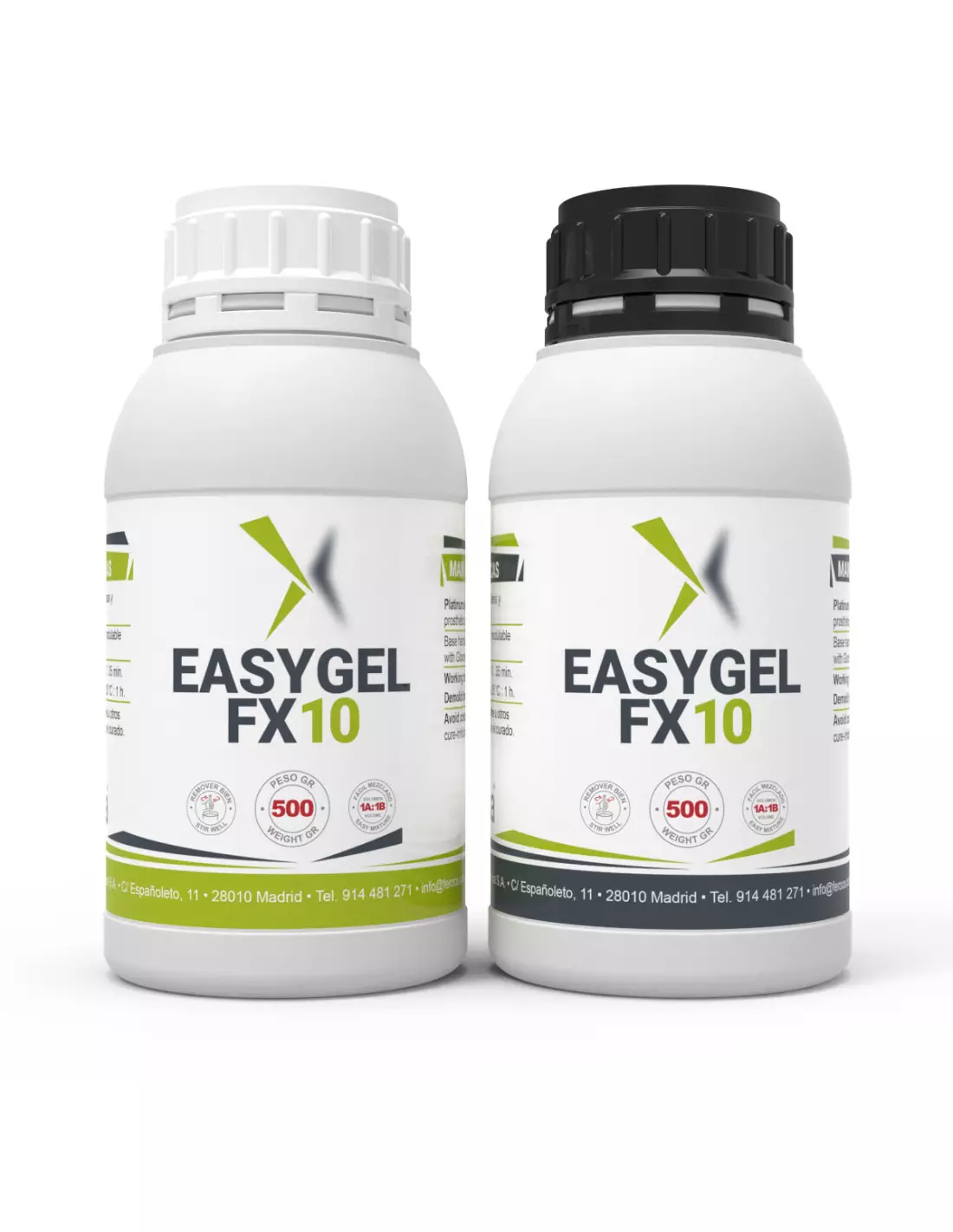
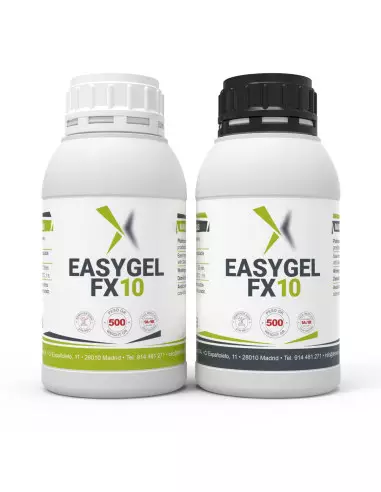
EasyGel FX10 - Silicone for Prosthesis FX and Mold -
201353501
€27.00
32,67 € Tax incl.
32,67 € Tax incl.
Platinum silicone Shore A10, 1:1 ratio, translucent. 35 min working time, 1 h cure. Ideal for FX prosthetics and high-definition moulds.
EasyGel FX10 is a platinum (addition) silicone with Shore A10 hardness, specifically formulated for special effects prosthetics and high-definition moulds. Its 1:1 ratio by weight and volume simplifies studio mixing, while its high translucency and low viscosity allow precise capture of micro-details and featherable edges, with no appreciable shrinkage and no bubbles. It is the reference material for prosthetic work where softness, realism and detail fidelity are essential.
Technical specifications
| Parameter | Value |
|---|---|
| Type | Platinum silicone (addition) |
| Shore Hardness | A10 |
| Colour | Translucent |
| Mix ratio (weight) | 100A : 100B |
| Mix ratio (volume) | 100A : 100B |
| Working time (23 °C) | 35 min |
| Cure time (23 °C) | 1 hour |
| Shrinkage | No appreciable shrinkage |
| Compatibility | Gloomer Deadener |
| Usage range | 10% (slight modification) — 30% (human skin feel) |
| Ratio for encapsulated prosthetics | 1A : 1B : 10–30% Deadener |
What it is used for
EasyGel FX10 is designed for special effects professionals and studios who need an ultra-soft, translucent, fine-detail silicone. Its Shore A10 hardness and excellent compatibility with platinum silicone pigments make it highly versatile for reproducing skin and soft tissue with realistic results. It is also an ideal base to combine with deadener and adjust softness to extreme levels.
- FX prosthetics for film, television and theatre
- Anaplastological prosthetics: ears, noses, simulated scars and wounds
- High-definition moulds for Life Cast and skin texture capture
- Encapsulated prosthetic pieces with thin featherable edges on the skin
- Soft tissue, fat and skin effects for set design and audiovisual productions
- Fine-detail moulds for reproduction of organic surfaces
How to use it
- Make sure all materials, moulds and surfaces are clean and free of inhibiting contaminants (latex, tin silicone, sulphur, fresh polyester, epoxy). See the inhibition notice below.
- If you are going to cast the material into a mould with vertical areas or complex detail, consider adding thixotropic additive to control sagging without affecting cure time.
- Weigh or measure components A and B in a 1:1 ratio (by weight or by volume). The 1:1 mix simplifies work and reduces dosing errors.
- If you are going to pigment, add Key-Pigments to component A before mixing with B. Mix the pigment until you achieve a homogeneous colour.
- If you need an even softer texture, incorporate Gloomer Deadener into component A before adding B. For encapsulated prosthetic applications, ratios of 10–30% deadener relative to the total silicone weight are typically used.
- Mix components A and B with a spatula for at least 2–3 minutes, scraping the sides and bottom of the container thoroughly. Mix slowly and evenly to minimise air incorporation.
- If you have a vacuum chamber, degas the mixture to eliminate bubbles before pouring. For small pieces, the low viscosity of EasyGel FX10 is usually sufficient for clean results without vacuum.
- Pour or apply the silicone into the mould. You have 35 minutes of working time at 23 °C before gelation begins.
- Allow to cure at room temperature for at least 1 hour. A moderate temperature increase (40–50 °C) accelerates curing if you need a higher production rate.
- Demould carefully, as Shore A10 is extremely soft. If the piece is to be used as an encapsulated prosthetic, apply the encapsulant (e.g. Key-Cap Plastic) to reinforce the edges before removing from the mould.
Important notice — Platinum silicone inhibition
EasyGel FX10 is a platinum (addition) silicone. The platinum catalyst is highly sensitive to certain materials that inhibit or prevent curing, leaving the silicone tacky or uncured. Avoid contact with:
EasyGel FX10 is a platinum (addition) silicone. The platinum catalyst is highly sensitive to certain materials that inhibit or prevent curing, leaving the silicone tacky or uncured. Avoid contact with:
- Tin silicone (condensation) — they are not compatible with each other
- Natural latex and latex gloves
- Plasticines, modelling clays and any material containing sulphur
- Petroleum jelly and some petroleum-based release agents
- Freshly cured polyester and incompletely cured epoxy resins
- Urethane rubbers and certain unsealed metals
- Vinyl — completely inhibits surface curing
Usage tips
Temperature and cure acceleration
At 23 °C, EasyGel FX10 cures in 1 hour. If you need to shorten production times, you can place the mould in an oven at 40–50 °C to accelerate curing without compromising the properties of the piece. Avoid temperatures above 60 °C during the mixing phase, as they drastically reduce working time and make application difficult. In cold environments (below 18 °C), curing slows down noticeably; work in a stable temperature environment for reproducible results.
Mixing with deadener for ultra-soft prosthetics
For encapsulated prosthetics where maximum softness and skin movement are required, mix EasyGel FX10 with Gloomer Deadener at ratios of 10–30% deadener relative to the total silicone weight (components A+B). The deadener does not affect the platinum cure, but significantly reduces final hardness and increases translucency. Always incorporate the deadener into component A before adding catalyst B, and mix thoroughly to ensure homogeneity.
Using encapsulant and professional pigmentation
For prosthetics that will be adhered to the skin of an actor or patient, apply an encapsulant such as Key-Cap Plastic to the edges of the piece before demoulding. This allows the edges to be feathered onto the skin and facilitates subsequent makeup application. For intrinsic pigmentation, add Key-Pigments to component A before mixing: the translucency of EasyGel FX10 enhances colour depth and the subsurface scattering effects characteristic of human skin. If you need to apply silicone in layers or on vertical areas, the thixotropic additive turns the mixture into a controllable paste without modifying cure time.
Frequently asked questions
What materials inhibit the curing of a platinum silicone?
Platinum silicones like EasyGel FX10 are sensitive to several inhibiting materials: tin silicones (condensation), natural latex, plasticines and sulphur-containing clays, petroleum jelly, freshly cured polyester and epoxy, urethane rubbers and vinyl. Contact with any of these materials can cause the silicone to remain tacky or fail to cure. Always perform a compatibility test before working on the full piece.
Can I mix platinum silicone with tin silicone in the same project?
No. Platinum silicone will not cure in contact with tin silicone (condensation): it becomes inhibited and remains uncured. If you need to make the mould with one material and cast with another, make sure both belong to the same family or use a compatible sealer. EasyGel FX10 must be used with moulds made from non-inhibiting materials.
Is it necessary to use an encapsulant for silicone prosthetics?
It is recommended to use an encapsulant such as Key-Cap Plastic when a prosthetic made with EasyGel FX10 is to be applied directly to the skin. The encapsulant allows the edges of the piece to be feathered onto the actor's or patient's skin, provides greater resistance to handling and facilitates subsequent makeup for perfect visual integration.
Can I use deadener to get a softer piece?
Yes. EasyGel FX10 is compatible with Gloomer Deadener. For encapsulated prosthetic applications, ratios of 10–30% deadener relative to the total weight of the A+B mix are typically used. This further reduces final hardness and increases translucency, ideal for imitating soft tissue with maximum realism. Always incorporate the deadener into component A before adding catalyst B.
How can I pigment the silicone to achieve skin tones?
Use Key-Pigments, pigments specifically formulated for platinum silicones. Add them to component A before mixing with B to ensure even distribution. The high translucency of EasyGel FX10 enhances colour depth and the light effects that imitate human skin. Avoid pigments not formulated for platinum, as some contain sulphur or other inhibitors.
Do I need a vacuum chamber to work with this silicone?
For small pieces or simple geometries, the low viscosity of EasyGel FX10 is usually sufficient to achieve bubble-free results without vacuum. For large pieces, high-demand moulds or when working with deadener (which increases viscosity), degassing in a vacuum chamber guarantees maximum quality and the complete absence of pores.
Can I accelerate curing with heat?
Yes. A moderate temperature increase (40–50 °C) significantly shortens the cure time of EasyGel FX10 without compromising the properties of the piece. Avoid exceeding 60 °C during the mixing and application phase, as excessive heat drastically reduces working time. In cold environments, curing slows down; work at a stable temperature for reproducible results.
Is a mother mould necessary when working with such soft silicones?
Yes, it is recommended to use a rigid mother mould (plaster, resin or similar) to support the EasyGel FX10 mould during casting of the reproduction material. Being Shore A10, the mould is very flexible and without external support it can deform, affecting the dimensional accuracy of the reproduced pieces.
- Color
- Translucent
- Working Time
- 35min
- Curing Time
- 1hora
- Shore Hardness
- A10
- Volume Mixing Ratio
- 100A:100B
- Mixed Weight Ratio
- 100A:100B

No reviews
Tap to zoom