Shopping Cart



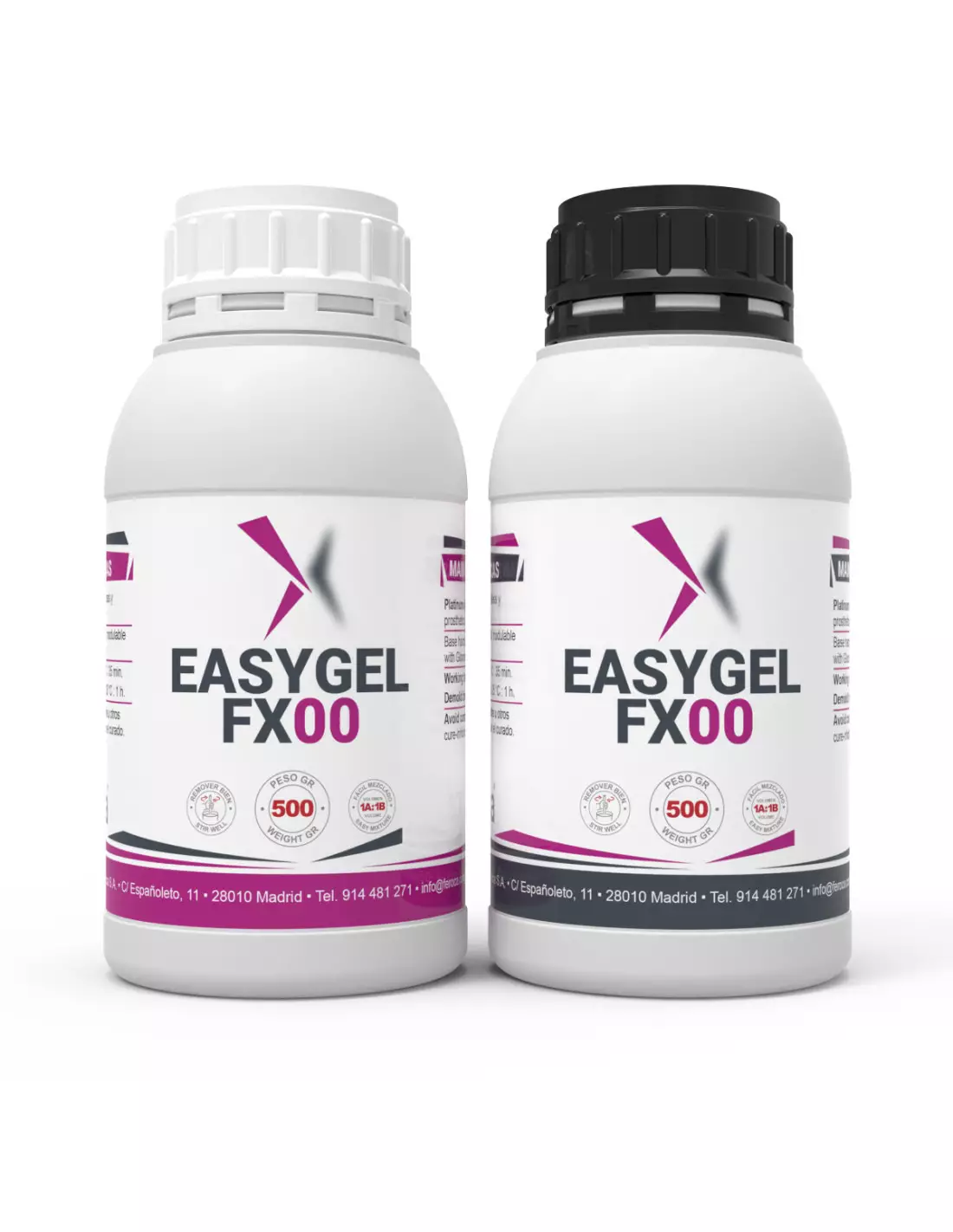
EasyGel FX00 - Silicone for Prosthesis FX
201353201
€27.00
32,67 € Tax incl.
32,67 € Tax incl.
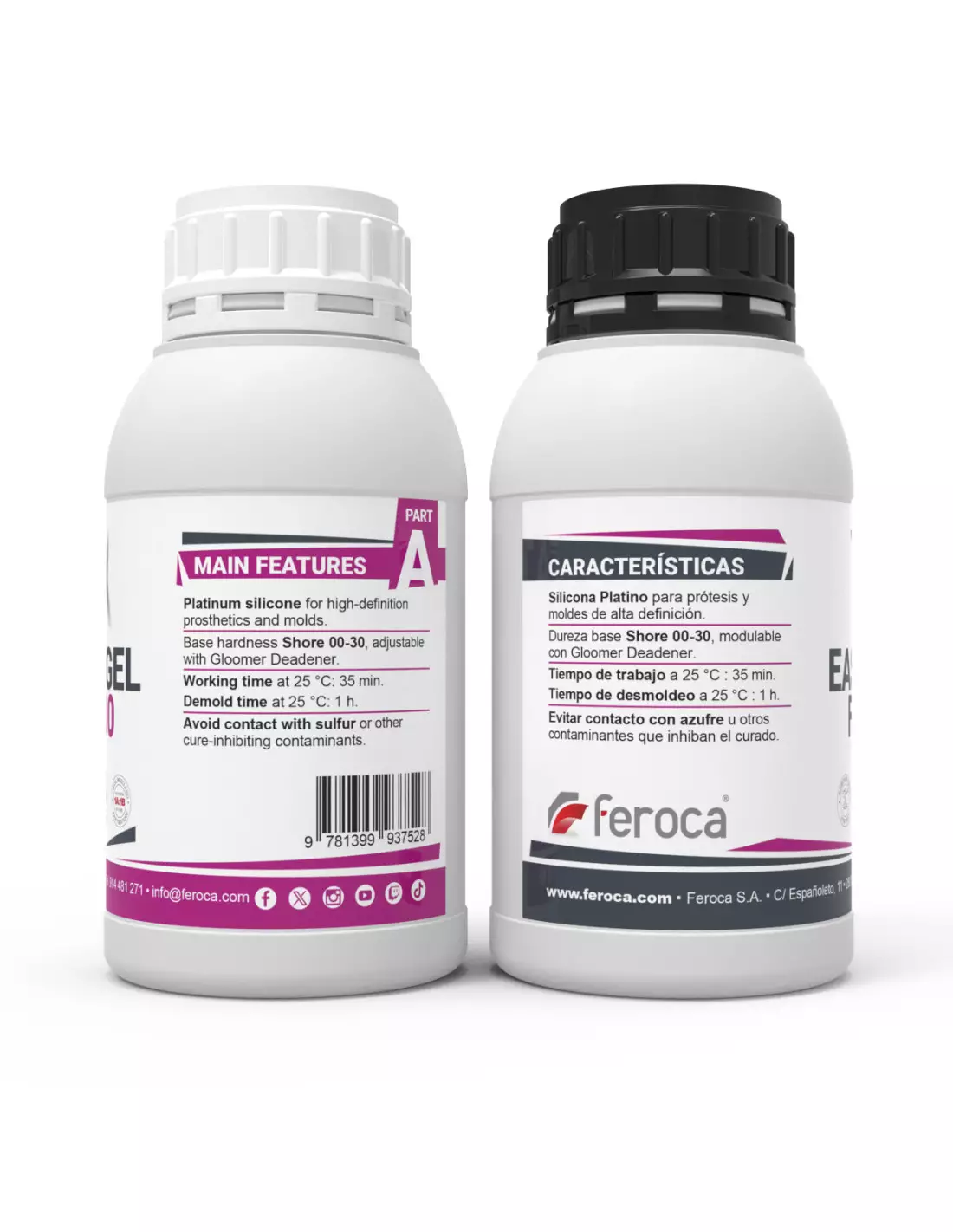
Shore 00-30 platinum silicone for FX prosthetics and synthetic skin. 1:1 ratio, 35 min working time, 1 h demould. Translucent and pigmentable.
EasyGel FX00 is an ultra-soft Shore 00-30 platinum (addition) silicone formulated specifically for special effects prosthetics, anaplastology and hyperrealistic synthetic skin. Its controlled flowability allows reproduction of ultra-thin edges that blend seamlessly with real skin, and its translucent formulation makes it ideal for pigmenting with silicone-specific pigments to achieve completely natural skin tones.
Technical specifications
| Parameter | Value |
|---|---|
| Type | Platinum silicone (addition) |
| Colour | Translucent |
| Shore Hardness | 00-30 |
| Mix ratio (weight) | 100A : 100B |
| Mix ratio (volume) | 100A : 100B |
| Working time at 25 °C | 35 min |
| Demould time at 25 °C | 1 hour |
What it is used for
EasyGel FX00 is designed for FX makeup professionals, anaplastologists and synthetic skin manufacturers who need an extremely soft, translucent and pigmentable silicone. Its fluid consistency facilitates pouring into complex geometry moulds and produces edges that integrate with the skin without requiring excessive finishing. Thanks to its Shore 00-30 hardness, the resulting pieces faithfully mimic the texture and movement of real soft tissue.
- Facial and body prosthetics for film, television and theatre
- Anaplastological prosthetics: ears, nose, nipple and cranial areas
- Synthetic skin for mannequins, hyperrealistic figures and medical simulators
- Reborn babies and high-fidelity collectible dolls
- Special effects wounds, burns and soft tissue effects
- Prosthesis encapsulation in combination with Key-Cap Plastic
- Blending with deadener to further reduce hardness and increase tactile realism
- Colour tests with Key-Pigments for skin tone matching
How to use it
- Prepare the mould and apply release agent if necessary. If the mould is made of platinum silicone, no release agent is required, but make sure it contains no residues of inhibiting materials.
- If you are going to pigment, add the Key-Pigments to part A before mixing with part B. Mix thoroughly until a uniform colour is achieved.
- Mix part A and part B in a 1:1 ratio by weight or by volume. Stir slowly and evenly for at least 2–3 minutes to avoid incorporating air bubbles.
- If you need to increase viscosity for layer applications or on vertical surfaces, add thixotropic additive in small amounts until the desired consistency is achieved.
- EasyGel FX00 has an extremely low hardness (Shore 00-30), so it is not advisable to add Gloomer Deadener to this silicone: the deadener is designed to soften silicones with a higher Shore, and with FX00 it can reduce strength and make demoulding more difficult. If you need to adjust hardness with deadener, consider EasyGel FX10 or EasyGel FX25.
- Pour or apply the mixture into the mould. You have 35 minutes of working time at 25 °C.
- Allow to cure at room temperature. The piece will be ready to demould in approximately 1 hour at 25 °C.
- Demould carefully, especially at ultra-thin edges. If you are going to encapsulate the prosthesis, proceed with Key-Cap Plastic once demoulded and clean.
Warning: inhibition risk
EasyGel FX00 is a platinum (addition) silicone. Platinum is sensitive to certain materials that prevent curing. Before working, make sure that the mould, surface or any material in contact does NOT contain:
EasyGel FX00 is a platinum (addition) silicone. Platinum is sensitive to certain materials that prevent curing. Before working, make sure that the mould, surface or any material in contact does NOT contain:
- Sulphur or clays and oil-based clays containing sulphur (some modelling clays contain sulphur)
- Unsealed tin silicone (condensation)
- Latex
- Petroleum jelly or tin silicone-based lubricants
- Freshly cured, unsealed polyester or epoxy resins
- Urethane rubbers
- Vinyl
Usage tips
Temperature control to adjust timing
Ambient temperature directly influences working and curing time. Above 25 °C, times shorten; below, they lengthen. If you are working in summer or in a warm workshop, refrigerate the components before mixing to gain extra working time. If you need to speed up demoulding, you can place the mould in an oven at low temperature (40–50 °C), which will significantly reduce curing time without affecting the final properties.
Bubble elimination
Due to its low viscosity, EasyGel FX00 releases bubbles easily, but in very thin pieces or complex geometries it is advisable to use a vacuum chamber after mixing to ensure a completely pore-free piece. If you do not have a vacuum chamber, always mix slowly and avoid sudden movements. Pour in a thin stream from a height to break bubbles as the material falls.
Pigmentation
To achieve realistic skin tones, always mix the Key-Pigments into part A before adding part B. This ensures homogeneous colour dispersion. Note that it is not advisable to add Gloomer Deadener to EasyGel FX00, as its Shore 00-30 hardness is already very low and the deadener could reduce its strength. Work with a precision scale to maintain the correct ratio and obtain reproducible results.
Frequently asked questions
What materials can inhibit the cure of a platinum silicone?
Platinum silicones like EasyGel FX00 are sensitive to several materials: sulphur-containing clays and oil-based clays, unsealed tin silicone, latex, petroleum jelly, freshly cured unsealed polyester and epoxy resins, urethane rubbers and vinyl. The most common symptom is that the piece remains sticky or does not cure. Always carry out a small test before the final pour if you have doubts about the compatibility of your mould or surface.
Can I use a tin silicone mould to cast platinum silicone?
No. Tin silicone (condensation) inhibits the cure of platinum silicone. They are not compatible with each other. If you need a mould to work with EasyGel FX00, use resin, plaster, fibreglass or other properly sealed platinum silicone moulds with release agent between silicones.
Is it necessary to use an encapsulant with silicone prosthetics?
It is highly recommended. The encapsulant (such as Key-Cap Plastic) allows the edges of the EasyGel FX00 prosthesis to blend with the performer's or patient's skin, achieving an almost invisible integration. It also facilitates the subsequent makeup process on the prosthesis.
Can I use Gloomer Deadener with EasyGel FX00?
Not advisable. EasyGel FX00 has an extremely low Shore 00-30 hardness, so on its own it already provides the softness and soft-tissue movement sought in prosthetics, without the need for deadener. Adding Gloomer Deadener to such a soft silicone can compromise its tear resistance and make demoulding more difficult. If you want a silicone with a higher Shore that does accept deadener to adjust hardness, use EasyGel FX10 or EasyGel FX25.
Can I add thixotropic additive to a platinum silicone?
Yes. Thixo Additive increases the viscosity of the mixture without modifying the cure time or the final mechanical properties. It is useful when you need to apply EasyGel FX00 in layers on vertical surfaces or when you want to control flow in open moulds. Add it in small amounts until the desired consistency is reached.
How long does it take for the piece to be ready to demould?
At 25 °C, EasyGel FX00 is ready to demould in approximately 1 hour. If the workshop temperature is lower, the time will be longer. You can accelerate curing by placing the mould in an oven at 40–50 °C. Never demould before the piece has fully cured, especially at thin edges, to avoid breakage.
How are anaplastological prosthetics made with platinum silicone?
The general process begins with a Life Cast impression of the area to be replicated, using a silicone specifically designed for skin contact. The positive is then obtained, the rigid containment mould is made, and the prosthetic silicone — such as EasyGel FX00, pigmented to the desired skin tone with Key-Pigments — is cast. Release agent in spray form is always applied between mould and silicone. Once cured and demoulded, the prosthesis is encapsulated with Key-Cap Plastic to achieve invisible edges on the skin.
Can the silicone be pigmented before mixing the two parts?
Yes, and it is the recommended method. Add the Key-Pigments to part A and mix thoroughly until a uniform colour is achieved before adding part B. This ensures homogeneous pigment dispersion throughout the final piece. Always use pigments formulated specifically for platinum silicones, as other pigments may contain inhibiting agents.
- Color
- Translucent
- Working Time
- 35min
- Curing Time
- 1hora
- Shore Hardness
- 00-30
- Volume Mixing Ratio
- 100A:100B
- Mixed Weight Ratio
- 100A:100B

No reviews
Tap to zoom