Shopping Cart



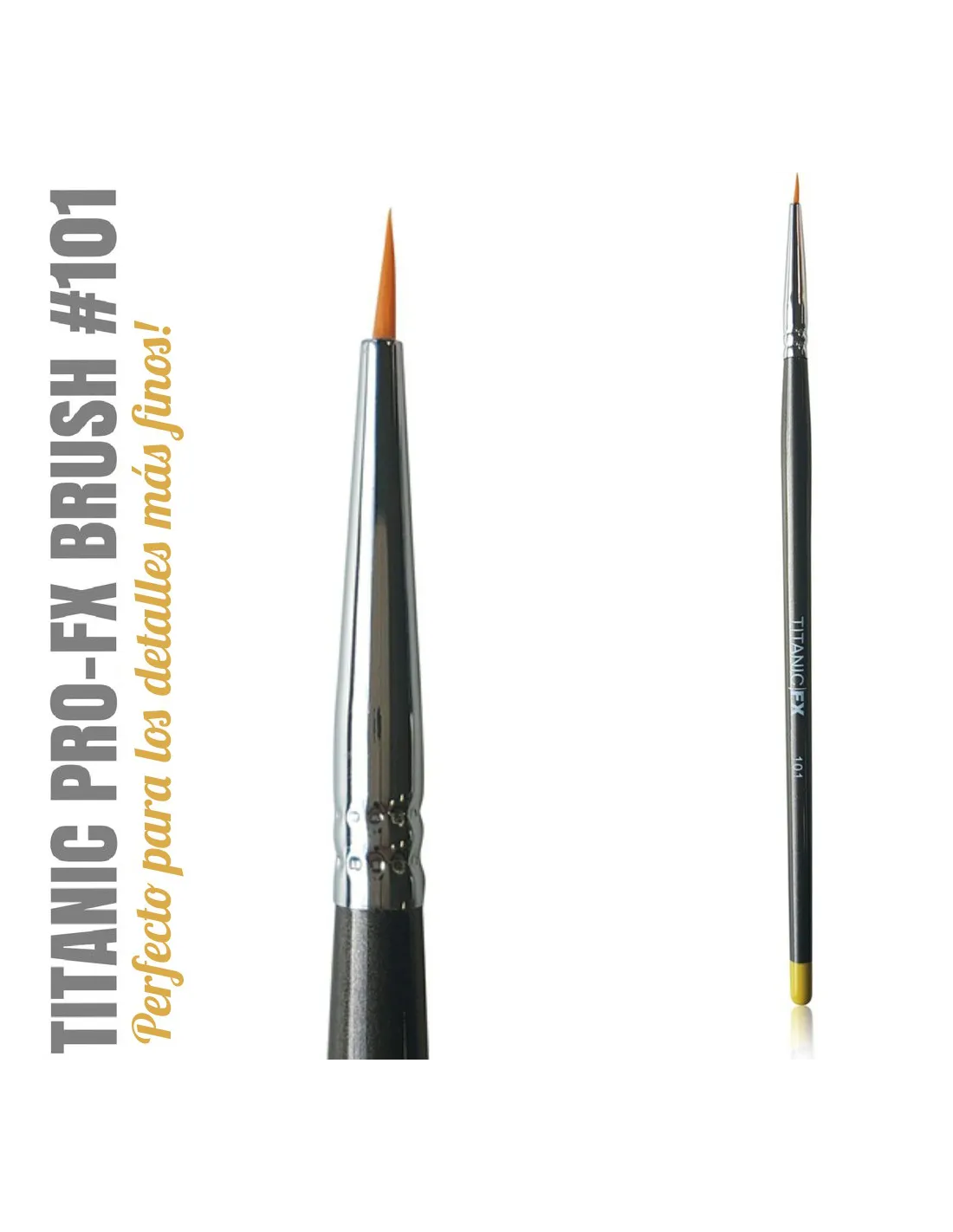
TITANIC PRO-FX BRUSH 101 -Fine delineator-
615001000
€12.00
14,52 € Tax incl.
14,52 € Tax incl.
Fine liner brush for professional FX makeup. Solvent-resistant synthetic vegan bristles, sustainable handle. Ideal for prosthetic detail work.
The Titanic Pro-FX Brush 101 is a fine liner brush designed specifically for special effects makeup and prosthetics work. Its synthetic vegan bristles withstand contact with solvents and prosthetic adhesives, and the extra-fine tip allows you to work with a precision that general-purpose brushes simply cannot offer. If you apply, paint or remove silicone or latex prosthetics, this brush is the right tool.
Technical specifications
| Feature | Detail |
|---|---|
| Brush type | Fine liner (thin line) |
| Reference | Pro-FX Brush 101 |
| Bristles | Synthetic vegan |
| Solvent resistance | Yes |
| Bonding adhesive | Solvent resistant |
| Materials | Ethically sustainable |
| Main use | FX makeup, prosthetics, modelling |
What it is used for
The 101 is designed for tasks where you need total control over a very fine line or a small application area. It is the go-to brush when the job demands millimetre precision on edges, details and transitions:
- Applying prosthetic adhesives along the edges of silicone or latex prosthetics to achieve a seamless blend with the skin.
- Painting fine details on prosthetics: veins, pores, expression lines, hair-like textures.
- Removing excess adhesive or material in delicate areas.
- Applying intrinsic or extrinsic pigments to detail areas of silicone pieces.
- Acrylic or alcohol-based paint work in professional artistic makeup.
- Drawing lines and contours in theatrical, film and television character work.
- Applying latex in thin layers over models or directly onto skin.
How to use it
- Make sure the brush is clean and dry before you start. If it is new, remove any packaging residue from the bristles.
- Load the brush with just the right amount of material: for fine lines, less is more. Too much product on the tip makes it harder to control.
- Apply with minimal pressure and smooth movements. The fine tip responds well to short, controlled strokes.
- If working with prosthetic adhesive, apply it to the edge of the prosthetic and let it become almost dry before pressing it against the skin (contact technique).
- For detail painting on silicone, work in very thin layers. Allow each layer to dry before applying the next.
- Clean the brush immediately after use with the appropriate solvent for the material used (isopropyl alcohol, diluted acetone or others depending on the product). The synthetic bristles can handle it, but immediate cleaning prolongs the brush's lifespan.
- Store the brush with the bristles facing upward or in a horizontal position. Never let it rest on its tip.
Usage tips
Cleaning with solvents
One of the main advantages of the Titanic Pro-FX range is that the adhesive bonding the bristles to the handle resists the solvents commonly used in FX workshops. You can clean the brush with isopropyl alcohol or specific solvents for prosthetic adhesives without the bristles coming loose or the handle deteriorating. Submerge only the bristle section, never the full handle, and dry with absorbent paper rather than rubbing.
Precision on prosthetic edges
To achieve an invisible transition between the prosthetic and the skin, load the brush with a minimal amount of adhesive and work the edge with short strokes from the outer edge of the prosthetic outward. Avoid building up adhesive in a single spot: several light passes are better than one heavy-loaded one. The fine profile of the 101 lets you reach areas that a wider brush cannot access without smearing the adjacent skin.
Combining with other brushes in the range
The 101 works best as a final detail brush. To prepare and cover larger surfaces, first use a brush with greater coverage such as the Titanic Pro-FX Brush 103 medium filbert, and save the 101 for finishing touches. If you need angled work for folds or raised areas, the Titanic Pro-FX Brush 102 angled liner is the natural complement.
Frequently asked questions
Do the bristles hold up to continuous use with strong solvents?
Yes. The synthetic vegan bristles of the Pro-FX Brush 101 are designed to withstand contact with the solvents commonly used in special effects: isopropyl alcohol, prosthetic adhesive solvents and similar products. The critical point is not the bristles but their bonding to the handle, and in this brush that adhesive is also solvent resistant. With proper cleaning (without submerging the handle) the brush maintains its performance through many uses.
What type of paint is compatible with this brush?
The Pro-FX Brush 101 is compatible with alcohol-based paints, acrylics, silicone pigments (both intrinsic and extrinsic) and liquid prosthetic adhesives. Being synthetic bristles, they do not retain paint in the same way as natural ones, which allows for controlled application in thin layers and easier cleaning.
Can I use this brush to apply latex directly onto skin?
Yes, it is one of its standard applications. The fine tip of the 101 allows latex to be applied to edges and detail areas with precision. Clean the brush with warm water and soap immediately after use with latex, before it dries, to prevent the bristles from becoming stiff.
What is the difference between brush 101 and brush 102?
The Pro-FX Brush 101 has a straight, fine tip, designed for direct lines and precision strokes. The Pro-FX Brush 102 has an angled tip, which makes it easier to work on folds, raised areas or when you need to keep your wrist in a more natural position. Both are complementary and many professionals use both in the same session.
Are these brushes suitable for professional use on set or on stage?
Yes. The Titanic Pro-FX range is designed specifically for professional special effects environments, film, television and theatre. The solvent resistance, bristle durability and tip precision make them suitable for long sessions and demanding working conditions.
How should I store the brushes to make them last longer?
Always store them clean and dry, with the bristles facing upward or horizontally. Avoid resting them on the tip, as this deforms the bristles over time. When transporting them, use a case or brush roll that protects the tips from friction and pressure.
Is it necessary to clean the brush between layers during the same session?
It depends on the material. If you are working with the same colour and product, it is not strictly necessary between every layer, although a quick wipe with a cloth or absorbent paper helps maintain the precision of the stroke. If you change product or colour, you should clean the brush thoroughly before continuing to avoid contamination.
No reviews
Tap to zoom