Shopping Cart


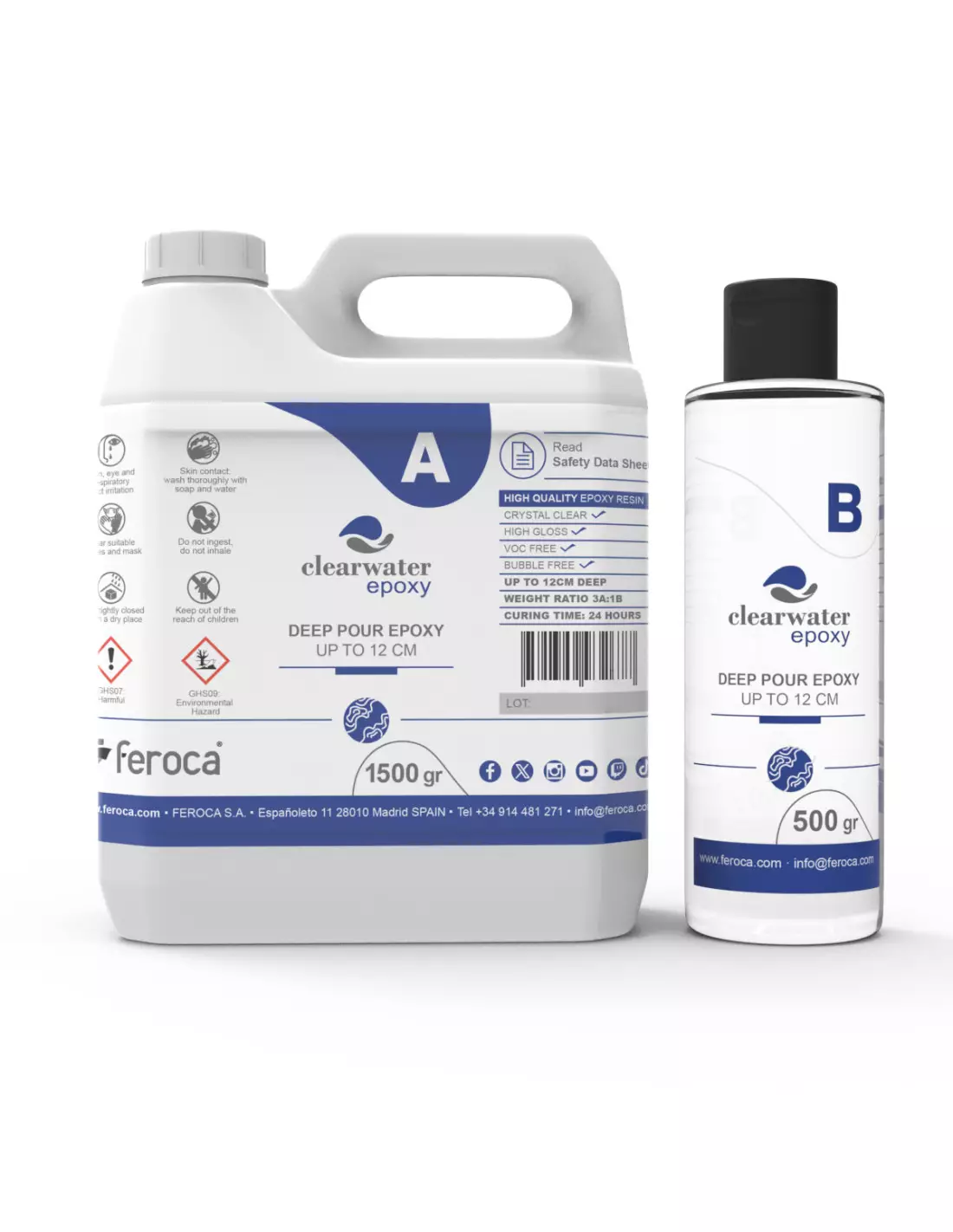
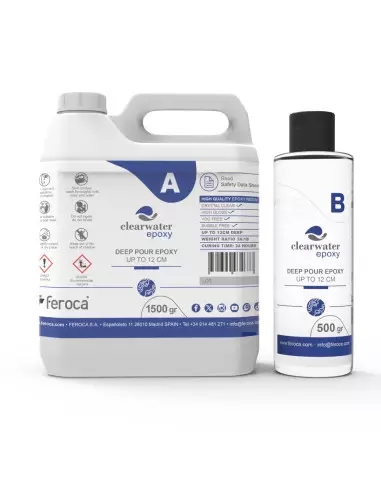
ClearWater Deep Pour Epoxy -High-thickness resin
405805002
€46.00
55,66 € Tax incl.
55,66 € Tax incl.
Transparent high-depth epoxy resin, up to 12 cm in a single casting. Mix ratio 100A:30B by weight. Ideal for river tables and encapsulation.
ClearWater Deep Pour is a high-quality transparent epoxy resin designed for deep casting: it allows pouring up to 12 cm in a single pass without risk of excessive overheating. With high UV yellowing resistance, excellent flowability and minimal heat generation during curing, it is the natural choice for large-format river tables, encapsulations and high-volume artistic projects.
Technical specifications
| Parameter | Value |
|---|---|
| Type | High-depth transparent epoxy resin |
| Colour | Transparent |
| Mix ratio (by weight) | 100A : 30B |
| Working time | 40 minutes |
| Cure time | 24 hours (at 20 °C or above) |
| Shore Hardness | 80D |
| Maximum depth per casting | 12 cm |
| Maximum volume per session | Up to 60 kg |
| Application | casting / Art |
| UV resistance | High (anti-yellowing) |
| Minimum working temperature | 20 °C recommended |
What it is used for
ClearWater Deep Pour is designed for projects requiring deep castings in a single pass, where conventional epoxy resins would fall short or generate too much heat. Its crystal-clear transparency and UV resistance make it ideal for both decorative and functional applications:
- Large-format river tables with wood, stone or natural element inclusions
- Encapsulation of objects, decorative elements and electronics
- Sculptural and volumetric art, including large-depth three-dimensional pieces
- Recreation of water or ice effects in scale models and dioramas
- Jewellery and gemstones in high-depth silicone moulds
- Craft and large-scale resin accessory production
- Countertops, decorative panels and mould-cast surfaces
How to use it
- Prepare the environment: work in a space with a minimum temperature of 20 °C and low humidity. Lower temperatures slow down curing and may affect clarity.
- Prepare the mould or formwork: use silicone moulds, sealed wood or laminates that do not contain inhibiting substances. Apply Release agent 34D if the mould is not naturally non-stick.
- Weigh the components: mix in a ratio of 100 parts component A to 30 parts component B, always by weight. Use a precision scale.
- Mix slowly: stir with a spatula or low-speed mixer for at least 3–4 minutes, scraping the sides and bottom of the container thoroughly. Avoid incorporating air.
- Add pigments if needed: incorporate epoxy-compatible dyes or additives before pouring, mixing until fully homogenised.
- Pour into the mould: cast in a continuous and controlled manner. The maximum depth per casting is 12 cm. Do not exceed this in a single pass.
- Remove bubbles: gently pass a heat gun or torch at a distance over the surface to break any surface bubbles. Do not apply excessive heat.
- Cure undisturbed: leave the piece without moving it for at least 24 hours at 20 °C or above. For optimal curing, keep the environment stable.
- Demould and finish: once cured, the resin is completely safe. You can sand, polish or apply a surface finish such as Top Coat Epofer EX201+E202 for extra gloss and protection.
Caution — handling in liquid state: components A and B of the epoxy resin are irritants in their uncured state. Always work with nitrile gloves, safety glasses and adequate ventilation. Avoid contact with skin and eyes. Once fully cured, the resin is inert and non-toxic.
Usage tips
Temperature control: key to clarity
The ambient temperature and the temperature of the components themselves directly affects the result. Below 18 °C, viscosity increases, mixing becomes more difficult and the cure may be incomplete or cloudy. If you work in a cold workshop, warm up components A and B in a warm water bath (40–50 °C) for 10–15 minutes before mixing. This improves flowability and helps eliminate bubbles.
Castings deeper than 12 cm: work in layers
If your project requires more than 12 cm of depth, divide the casting into multiple layers. Wait for each layer to have gelled (but not fully cured — around 12–16 hours depending on temperature) before pouring the next one. This ensures good adhesion between layers and prevents the build-up of exothermic heat that could yellow or crack the piece.
Pre-sealing wood for river tables
If you are going to form-cast natural wood for a river table, apply a thin coat of diluted epoxy resin or an Epoxy Top Coat over the wood before the main casting. This prevents air or moisture trapped in the wood's pores from generating bubbles in the resin body during curing. Allow this sealing coat to dry before assembling the formwork and pouring ClearWater Deep Pour.
Frequently asked questions
Can I cast more than 12 cm in a single pour?
It is not recommended. The maximum casting depth of ClearWater Deep Pour is 12 cm. Exceeding this limit can trigger an excessive exothermic reaction that may yellow, crack or deform the piece. For deeper projects, work in successive layers, waiting for each one to gel before pouring the next.
What happens if the workshop temperature is below 20 °C?
Curing slows down and may remain incomplete, with sticky or cloudy areas. Warm up the components before mixing and, if possible, use a heating chamber with controlled heat. Do not work below 15 °C.
How long do I have to work the mix once combined?
The working time is approximately 40 minutes at 20 °C. After this time, viscosity increases rapidly and the resin starts to gel. Prepare the mould and all elements before mixing to make the most of the working window.
Can this resin be pigmented?
Yes. ClearWater Deep Pour accepts epoxy-compatible pigments and dyes. Add them to component A before mixing with component B, and homogenise thoroughly. Use pigments specifically designed for epoxy resin to ensure transparency and chemical compatibility.
Is it heat resistant once cured?
Not especially. ClearWater Deep Pour is not formulated as a heat-resistant resin. It is not suitable for surfaces that will be continuously exposed to high temperatures (countertops near heat sources, coasters, etc.). For such uses, consult other resins in the Feroca catalogue.
Do I need a release agent for all moulds?
It depends on the mould. Silicone moulds are naturally non-stick and do not require a release agent. For wood, MDF, acrylic or other porous or semi-porous materials, apply Release agent 34D or a suitable separation film to ensure clean demoulding without damaging the piece.
Can it be used to simulate water in scale models or dioramas?
Yes, it is one of its most common applications. Its crystal-clear transparency and ability to cure in large volumes make it very well suited for recreating bodies of water, rivers or ice effects in large-scale models and dioramas. For very thin layers or surface coatings, also consider the Top Coat Epofer EX201+E202.
How long should I wait before sanding or polishing the piece?
Full cure is reached in 24 hours at 20 °C. However, for comfortable sanding or machining, it is advisable to wait between 48 and 72 hours to ensure the piece has reached its final hardness (80 Shore D). At lower temperatures, extend these times accordingly.
Video tutorials
Underwater diorama with ClearWater Deep Pour
Titanic diorama with epoxy resin
Sunken tank diorama with epoxy resin
Epoxy resin lake for nativity scene
Wargame bases with epoxy resin
Crystal skull with epoxy resin
Magic potions with epoxy resin
- Color
- Transparent
- Working Time
- 40min
- Curing Time
- 24horas
- Shore Hardness
- 80D
- Mixed Weight Ratio
- 100A:30B
- Type
- Resin
- Application
- Art
Casting
No reviews
Tap to zoom