Shopping Cart


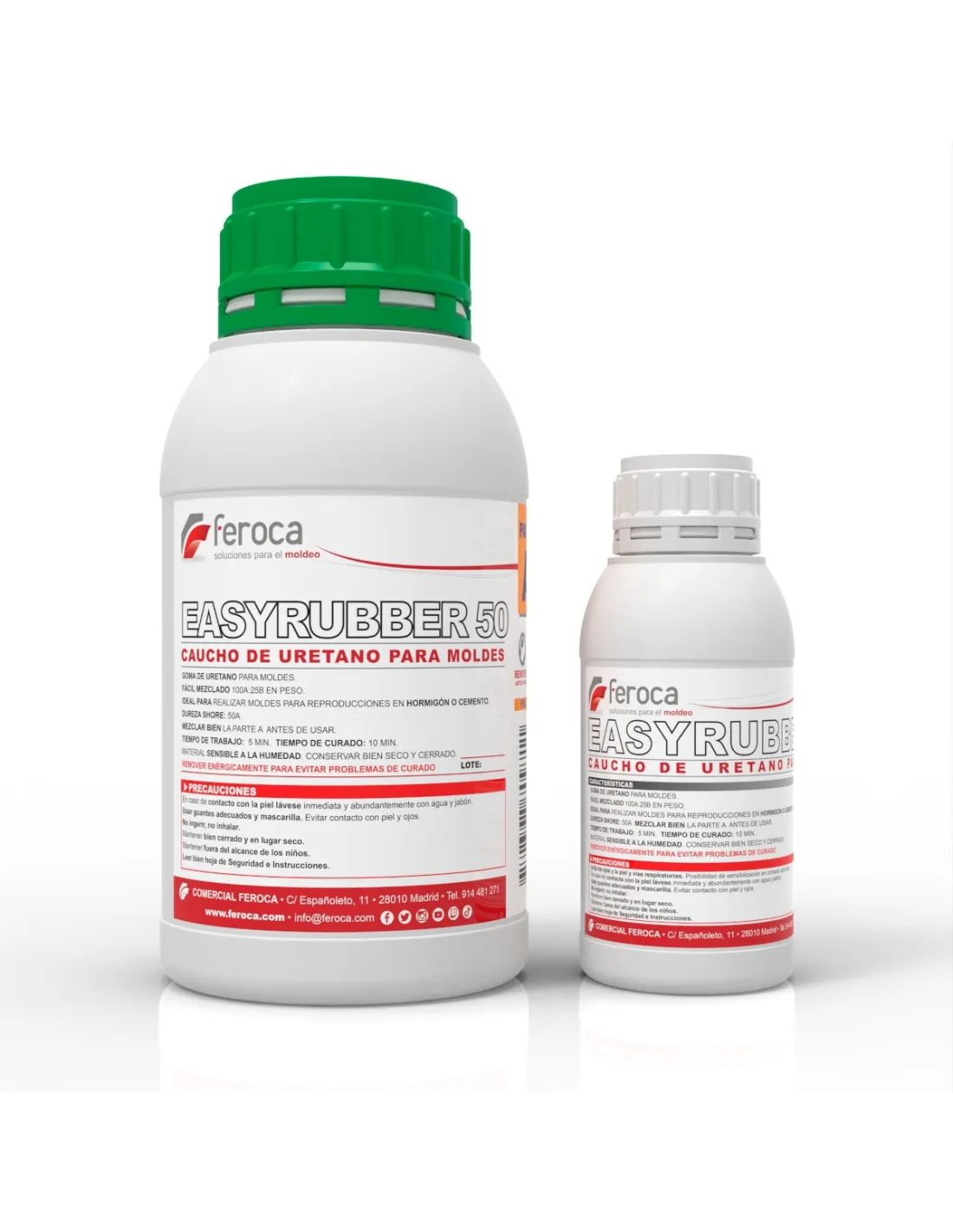
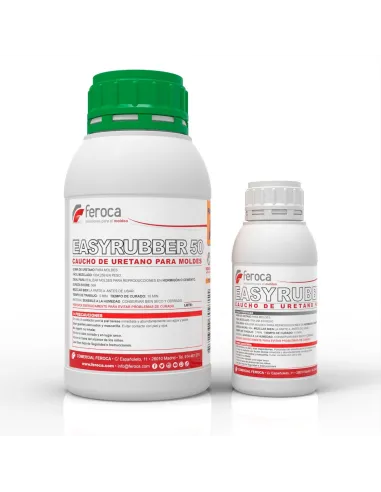
EasyRubber 50 -Fast Urethane Elastomer-
422372001
€13.00
15,73 € Tax incl.
15,73 € Tax incl.
Fast-cure Shore 50A urethane elastomer. Mix ratio 100A:25B, 3-minute pot life, demold in 7 min. Low viscosity, no shrinkage.
EasyRubber 50 is a fast-curing polyurethane elastomer with Shore 50A hardness, formulated for when you need flexible parts in the shortest possible time. Its low viscosity makes mixing and casting easy, ensuring good detail reproduction without hard-to-eliminate bubbles. It cures at room temperature with no appreciable shrinkage, making it ideal both for mold making and for producing flexible end-use parts.
Technical specifications
| Parameter | Value |
|---|---|
| Color | White |
| Shore Hardness | A50 |
| Mix ratio (by weight) | 100A : 25B |
| Pot life | 3 min |
| Demold time | 7 min |
| Mixed viscosity | 1,200 mPa·s |
| Specific gravity | 1.1 g/cm³ |
| Tear resistance | 15 ± 2 kg/cm |
| Cure | Room temperature |
| Shrinkage | No appreciable shrinkage |
What it is used for
EasyRubber 50 is aimed at applications where cycle speed is a priority and a flexible, durable result with good surface detail is required. Its demold time of just 7 minutes makes it a key tool in production workshops or whenever deadlines are tight.
- Flexible mold making for resins, plaster or wax
- Reproduction of models and decorative pieces
- FX and character prosthetics parts
- Rapid prototyping of flexible components
- Small-run production of rubber parts
- Encapsulation and flexible coatings
- Artistic and craft reproductions with high detail definition
How to use it
- Prepare the mold or master: make sure the surface is clean, dry and dust-free. Apply a suitable release agent if the substrate requires it to facilitate demolding.
- Weigh the components: mix at a ratio of 100 parts component A to 25 parts component B, always by weight. Do not use volumetric measurements — they can introduce errors.
- Mix vigorously and quickly: pot life is only 3 minutes. Stir forcefully, scraping the sides and bottom of the container thoroughly, to ensure a homogeneous cure. Incomplete mixing will result in uncured areas.
- Cast immediately: pour the mixture into the mold or over the master in a thin, continuous stream, preferably from the lowest point, so the material naturally displaces the air.
- Demold at 7 minutes: the material will have cured enough to demold safely. For optimal mechanical properties, allow the part to rest for at least 1 hour before subjecting it to stress.
- Colorize if needed: if you want colored parts, add polyurethane-compatible paste pigments to component A before mixing with component B.
Warning — Moisture-sensitive product: component B (isocyanate) reacts with ambient moisture and with any trace of water on tools. Work in a dry environment, close containers immediately after use and do not introduce damp tools. Additionally, pot life is very short (3 min): prepare all materials before starting to mix. Incomplete or slow mixing will result in uncured areas in the final part.
Usage tips
Control ambient temperature
Temperature directly affects working and cure times. Above 25 °C, the material may cure faster and reduce available pot life. In cold environments (below 18 °C), curing slows down and viscosity increases, making casting more difficult. Work ideally between 20 and 25 °C to achieve the times stated in the technical data sheet.
Mix with no margin for error
With only 3 minutes of pot life, efficiency in the mixing process is essential. Always use a precision scale to weigh the components — do not rely on volumetric markings. Prepare the mold and all tools before starting to mix. Use a container with a curved or conical bottom to facilitate thorough scraping. If you need to produce several parts in a row, prepare each batch independently — do not mix large volumes that you cannot pour in time.
Pigmentation and color effects
EasyRubber 50 cures white, making it an ideal base for coloring. Add polyurethane-compatible paste pigments to component A and mix thoroughly before incorporating component B. Start with small amounts of pigment (1–3% of total mix weight) to avoid altering the material's mechanical properties. Do not use water-based pigments or additives incompatible with polyurethane systems.
Frequently asked questions
What temperature can this type of polyurethane elastomer withstand?
Polyurethane elastomers like EasyRubber 50 should not exceed 60 °C continuously. Above that temperature, mechanical properties are compromised and the part may deform or degrade. It is not a suitable material for applications involving prolonged heat exposure.
Is it necessary to use a release agent when working with polyurethane rubbers?
Yes, in most cases it is recommended to apply a release agent to the master or mold before pouring the polyurethane. This is especially important on porous substrates (plaster, wood, gypsum) or on surfaces where the polyurethane might bond. On silicone molds it is generally not necessary, as silicone acts as a natural release against polyurethane.
Can the elastomer be colored before curing?
Yes. EasyRubber 50 cures white, which makes pigmentation straightforward. Add polyurethane-compatible paste pigments directly to component A before mixing with component B. The typical proportion is between 1 and 3% of the total mix weight. Make sure the pigment is fully integrated into component A before starting the mix with the hardener.
What happens if I do not mix the two components properly?
If mixing is incomplete, the material will not cure evenly. Areas with excess component A will remain tacky or uncured, while areas with excess component B may become brittle or show an irregular surface. With EasyRubber 50, given the 3-minute pot life, it is essential to mix quickly and vigorously, scraping the sides and bottom of the container thoroughly.
Can this material be used to make molds for resin casting?
Yes, EasyRubber 50 is suitable for making flexible molds for casting polyurethane resin, epoxy or polyester resins, plaster and wax, among others. Shore 50A hardness offers a good balance between flexibility for demolding and sufficient rigidity to maintain the mold's shape. For rigid resin castings such as Feropur PR55+E55, an EasyRubber 50 mold is a very practical option.
Why is the material not curing properly and remains tacky?
The most common causes are: insufficient or too-slow mixing, incorrect component ratio, or moisture contamination. Component B (isocyanate) is very sensitive to moisture: if tools were damp or the container had been left open for some time, the component may have partially reacted before mixing. Always check that containers are properly sealed and that the material has not exceeded its shelf life.
Can textile reinforcements be laminated into this elastomer?
It is not recommended to laminate reinforcement fabrics (fibreglass, carbon or others) into polyurethane elastomers like EasyRubber 50. These fabrics are designed to provide structural rigidity in rigid materials. In flexible matrices, adhesion is poor and the fabric does not perform correctly, compromising the final result.
How long can the product be stored unopened?
Stored in a dry, cool place with containers properly sealed, EasyRubber 50 retains its properties for approximately 12 months from the date of manufacture. Once opened, it is essential to seal containers airtight after each use, especially component B (isocyanate), which absorbs moisture from the air and can degrade within a few weeks if left exposed.
- Color
- White
- Working Time
- 3min
- Curing Time
- 7min
- Shore Hardness
- A50
- Mixed Weight Ratio
- 100A:25B
No reviews
Tap to zoom