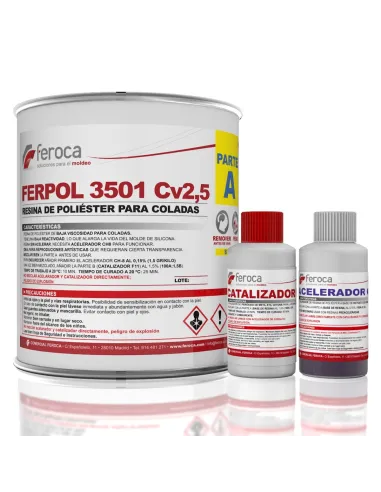
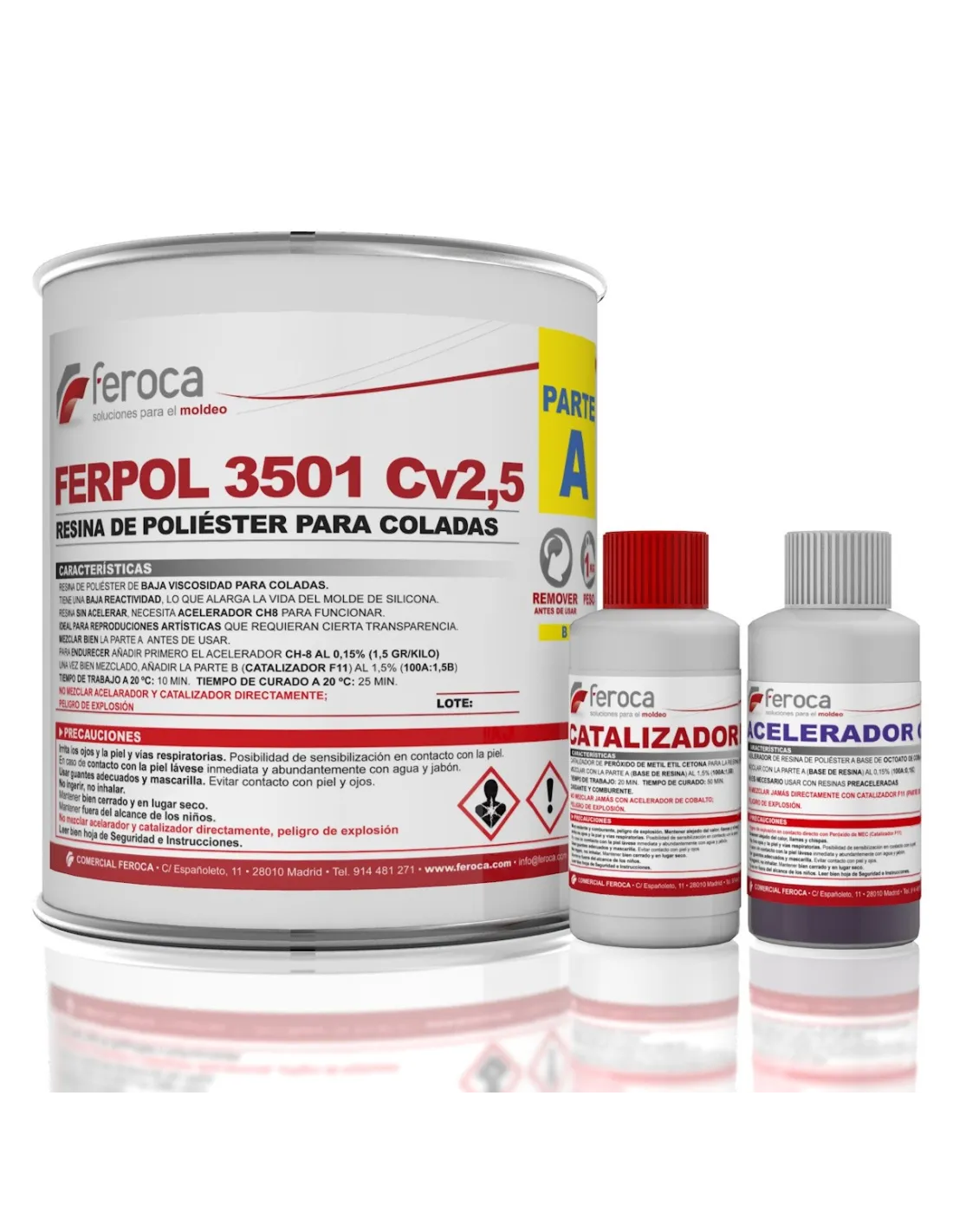
Ferpol 3501 CV2,5 is a casting polyester resin formulated with low viscosity and low reactivity, designed for those who need clean reproductions with minimal impact on the mould. Its special formulation extends the service life of silicone moulds, making it a highly valued option in workshops with serial production.
Technical specifications
| Parameter |
Value |
| Application |
Casting |
| Colour |
Bluish transparent |
| Working time |
10 min |
| Cure time |
20-25 min |
| Viscosity |
Low (CV2,5) |
| Reactivity |
Low |
| System |
Resin + Accelerator CH-8 + Catalyst F-11 |
Kit composition
| Format |
Resin |
Accelerator CH-8 |
Catalyst F-11 |
| Kit 1 kg |
1 kg |
20 g |
25 g |
| Kit 5 kg |
5 kg |
20 g |
100 g |
| Kit 25 kg |
25 kg |
80 g |
500 g |
What it is used for
Ferpol 3501 CV2,5 is designed for mould casting, especially when working with silicone moulds that need to withstand many production runs. Its low reactivity reduces the exothermic heat generated during curing, one of the main factors in mould degradation. Typical applications:
- Serial reproduction of figures, sculptures and decorative elements
- Casting in tin or platinum silicone moulds to extend their service life
- Simulation of water effects, orgonites and inclusions with a bluish tone
- Creation of props, window display elements and audiovisual production pieces
- Decorative pieces, souvenirs and small industrial series
- Prototypes and models that do not require high structural load
How to use it
- Prepare the mould: apply a suitable release agent, such as Desmoldeante 34D in paste form or Alcohol Polivinílico PVA Alcote Desmofer V8130 in liquid form, and allow to dry before casting.
- Add accelerator CH-8 to the resin: incorporate the indicated amount for the chosen kit and mix thoroughly until homogeneous. The accelerator may already be pre-mixed into the resin in some kits; check before use.
- Incorporate catalyst F-11: add the corresponding amount according to the kit format. Mix evenly without generating excessive bubbles.
- Cast into the mould: pour the mixture slowly to avoid air bubbles. You have approximately 10 minutes of working time before the resin begins to gel.
- Wait for curing: under normal conditions (20-25 °C), the part will be demoulable in 20-25 minutes. At lower temperatures, the time increases.
- Demould carefully: remove the part without forcing it. If there are resin residues in the mould, clean with acetone AC-1 before it fully cures.
- Post-cure: although the part is handleable after 20-25 min, full cure takes several hours. Allow this time before sanding, painting or subjecting the part to stress.
Important warning — Chemical product with real hazards
Polyester resin contains styrene and organic peroxides. Always work in a well-ventilated space or with local extraction. Wear nitrile gloves, safety goggles and a respirator with organic vapour filter. Catalyst F-11 (MEKP) is a strong oxidiser: do not mix it directly with accelerator CH-8 without the resin in between, as this can cause a violent reaction. Store both components separately and away from heat and flames. Note that curing is exothermic: in large volumes, significant heat can be generated. If casting thick sections, divide into layers or use moulds that dissipate heat effectively.
Usage tips
Temperature and cure times
Ambient temperature directly affects gelification and cure times. Below 18 °C the process slows considerably and you may experience incomplete curing. Above 30 °C, times shorten and you may run out of working time. Ideal working conditions are between 20 and 25 °C. In workshops with variable temperatures, adjust the catalyst proportion slightly within the recommended range, but do not exceed it: more catalyst does not mean greater strength — it means more brittleness and more exothermic heat.
How to extend the life of a silicone mould
The low reactivity of Ferpol 3501 CV2,5 is precisely its greatest advantage in serial production: it generates less heat during curing, reducing thermal stress on the silicone mould. To maximise this effect, always use a release agent (Desmoldeante 34D works very well with polyester), do not force demoulding before the part is ready, and avoid large-mass castings in a single pour. Remember that freshly cast polyester can inhibit platinum silicones if it comes into contact with them while still reactive, so if you work with both materials in the same workshop, avoid contaminating the moulds.
Fillers and special effects
You can add mineral fillers to the mix before casting to modify the appearance or weight of the part. Carfer Carbonato Cristalino (Marmolina) is a common option for achieving stone-like finishes and increasing part density. Add it to the resin before incorporating the catalyst and mix well to avoid lumps. For water effects or transparent decorative castings, work without filler and in thin layers to minimise the streaking typical of polyester.
Frequently asked questions
What release agent should I use with polyester resin?
For polyester castings like Ferpol 3501 CV2,5 you can use a paste release agent (Desmoldeante 34D) or a liquid one (Alcohol Polivinílico PVA Alcote Desmofer V8130). PVA is particularly useful on porous moulds or surfaces where wax does not penetrate well. With silicone moulds, a release agent is not always essential, but it significantly extends mould life.
Can I use polyester resin in silicone moulds?
Yes. Silicone is a mould material compatible with polyester. However, keep in mind that freshly cast polyester can inhibit the curing of platinum silicones if it comes into contact with them while still reactive. If you make platinum silicone moulds in the same space where you work with polyester, be meticulous about cleaning tools and work surfaces.
What is the difference between this resin and Ferpol 1973?
Ferpol 1973 is specifically formulated for inclusions and decorative castings where transparency is the main requirement (water models, orgonites, etc.). Ferpol 3501 CV2,5 is aimed at production casting, where low reactivity, mould preservation and ease of serial work take priority. Both are casting polyester resins, but with different profiles.
Can polyester resin be pigmented?
Yes. You can add paste or powder pigments compatible with polyester before incorporating the catalyst. The natural colour of Ferpol 3501 CV2,5 is bluish transparent, so bear this in mind if you are aiming for a very specific final colour: it can affect light or pastel shades.
What happens if I add too much catalyst?
Exceeding the recommended amount of catalyst F-11 does not improve curing: it causes a more exothermic reaction, drastically shortens working time, can cause cracks or brittleness in the part, and increases the risk of damaging the mould through the heat generated. Always respect the proportions indicated for the kit format you are using.
How do I clean tools after working with polyester?
Clean tools with acetone AC-1 before the resin cures. Once polymerised, polyester resin cannot be dissolved with solvents and must be removed mechanically. Work in a ventilated space when using acetone and keep away from ignition sources.
Can I add fillers to the resin to change its weight or appearance?
Yes. Fillers such as Carfer Carbonato Cristalino (Marmolina) are compatible with polyester and allow you to achieve stone-like effects or increase part density. Add them to the resin before incorporating the catalyst and mix thoroughly for even distribution.
What is accelerator CH-8 for and can I leave it out?
Accelerator CH-8 is the component that enables catalyst F-11 (MEKP) to activate curing at room temperature. Without it, the resin would take an extremely long time to cure or would not cure under normal workshop conditions. You must not omit it. Also, never mix the accelerator directly with the catalyst without the resin: that combination can be hazardous.
How much product do I need?Calculate the exact amount before buying and avoid wasting material.
Go to the calculator →