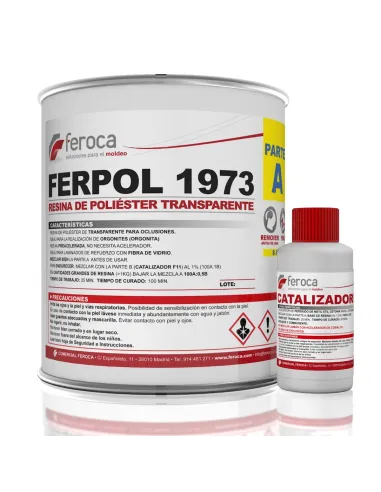
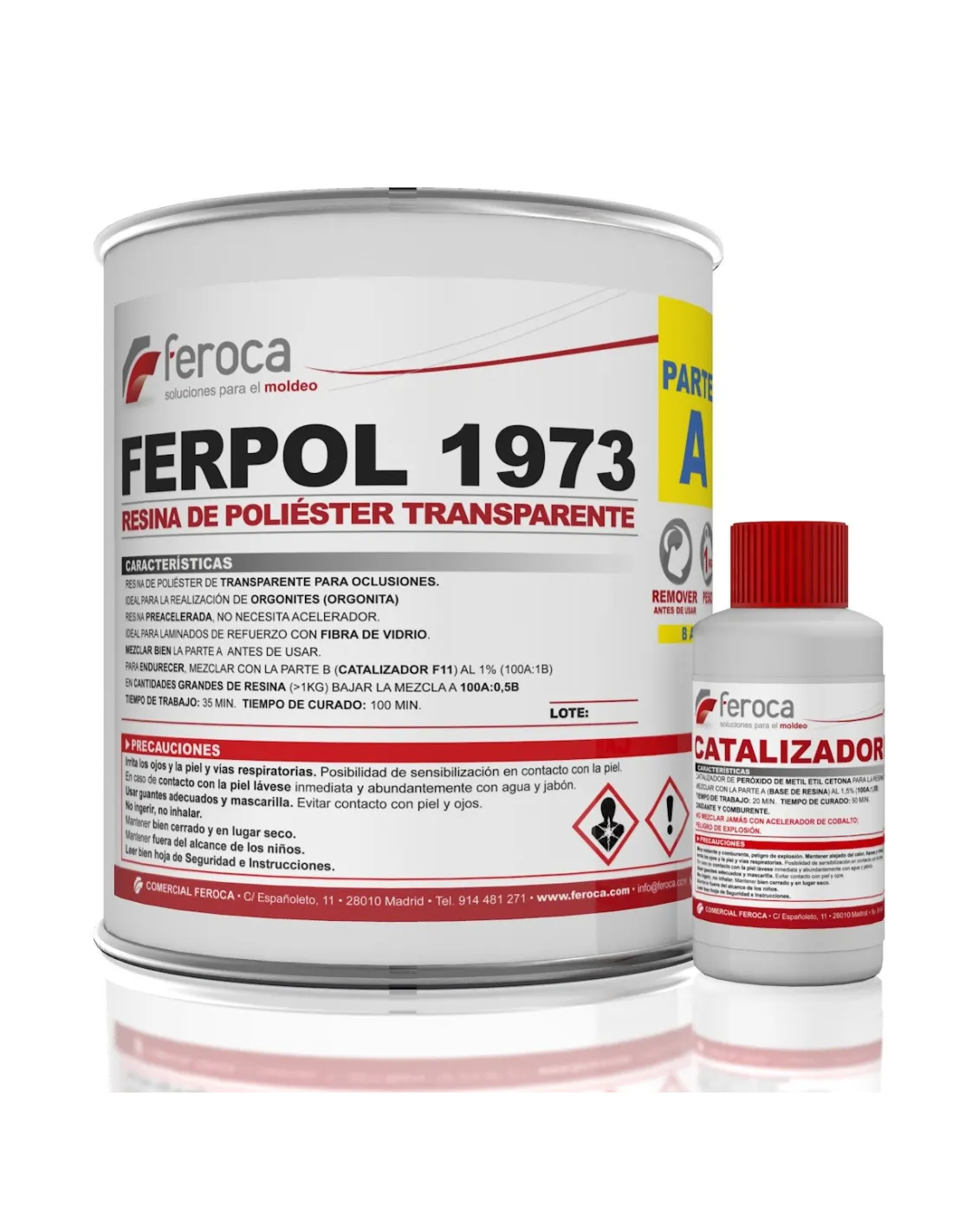
Ferpol 1973 is a transparent, colourless polyester resin specifically formulated for encapsulations: it embeds objects, crystals and organic elements inside the cured mass with a glass-like finish. It is the go-to choice for orgonites, resin jewellery and decorative effects requiring transparency at low cost, with a simple mix ratio of 100 parts resin to 2 parts Catalizador F11.
Technical specifications
| Parameter |
Value |
| Resin type |
Encapsulation polyester (accelerated) |
| Colour |
Transparent and colourless |
| Mix ratio |
100 : 2 by weight (resin : catalyst) |
| Catalyst |
Catalizador F11 |
| Working time (100 g at 20 °C) |
approx. 35 min |
| Cure time (100 g at 20 °C) |
approx. 100 min |
| Volumetric equivalence |
1 kg ≈ 820 cc |
| Main applications |
Encapsulations, jewellery, decorative casting |
What it is used for
Ferpol 1973 is designed for projects where transparency and the ability to encapsulate elements are the priority. Its low viscosity makes casting in fine-detail moulds easy and ensures that embedded objects remain perfectly visible after curing.
- Making orgonites with crystals, metals and decorative elements inside
- Resin jewellery: pendants, rings, cabochons and encapsulated pieces
- Simulating crystal or ice blocks for decoration and window displays
- Static water effects in scale models and dioramas
- Fictional drinks for audiovisual productions and shop windows (combined with UltraColor translucent pigments)
- Decorative pieces with embedded flowers, leaves or small objects
How to use it
- Work in a well-ventilated area and wear nitrile gloves, safety goggles and a respirator with an organic vapour filter.
- Weigh out the Ferpol 1973 resin into a clean, dry container.
- Add Catalizador F11 at a ratio of 2 g per 100 g of resin. Do not deviate from this ratio: too much catalyst causes rapid curing and excessive heat; too little may leave the piece uncured.
- Stir slowly and evenly for 2–3 minutes, scraping the sides and bottom of the container.
- If you want to add colour, stir in a few drops of UltraColor and mix until you achieve a uniform shade.
- Pour a thin first layer into the mould (silicone, polypropylene or polyethylene). Let it begin to gel before placing the objects to be encapsulated, to prevent them from sinking.
- Position the decorative elements and cover with a second casting up to the desired level.
- Allow to cure at room temperature (minimum 20 °C). Working time is approximately 35 min; full cure is reached at around 100 min.
- Demould carefully. If needed, clean any residue from the surface with AC-1 acetone.
Warning — polyester product: Ferpol 1973 contains styrene and emits vapours during curing. Always use a respirator with an organic vapour filter, nitrile gloves and forced ventilation. The reaction is exothermic: in thick castings (more than 3–4 cm) the heat generated can cause distortion, bubbles or, in extreme cases, ignition. Split thick castings into layers. Keep away from heat sources and open flames.
Usage tips
Control casting thickness
The polyester curing reaction is exothermic. In castings over 3 cm thick, the accumulated heat can generate bubbles, distortion or even cracking. Divide the work into layers of 2–3 cm maximum, allowing each one to gel before pouring the next. For very deep pieces, consider combining Ferpol 1973 with Ferpol 3501 CV2,5, which is specifically formulated for higher-volume castings.
Temperature and catalyst ratio
Below 18 °C curing slows down noticeably. In those conditions you can slightly increase the catalyst ratio (without exceeding 3%) or work in a temperature-controlled space. Above 25 °C working time is reduced: in summer, prepare smaller batches to avoid the mix gelling before you finish the pour.
Surface finish and streaks
Polyester can produce visible surface streaks, especially on pieces with a large area exposed to air. To minimise them, work in closed moulds wherever possible. If you need a perfectly smooth, streak-free finish on the top face, sand progressively (from 400 to 2000 grit) and polish with abrasive compound. For decorative colour effects, add UltraColor translucent pigments or Magic Powder metallic powder to create pieces with an encapsulated mineral or metallic look.
Frequently asked questions
What catalyst do I need for this resin?
Ferpol 1973 is catalysed exclusively with Catalizador F11 at a ratio of 2 parts per 100 parts of resin, always by weight. Do not use catalysts from other families: the ratio and type are specific to this formulation.
Can it be used in silicone moulds?
Yes, silicone moulds are fully compatible with Ferpol 1973. Silicone does not adhere to polyester and allows for clean demoulding. Bear in mind that freshly cured polyester can inhibit platinum silicones if used as a master in a subsequent step: wait until the piece is completely cured before using it as a master for a platinum mould.
How many layers can I cast at once?
It is recommended not to exceed 2–3 cm per layer. If you need greater depth, pour a first layer, wait for it to gel (without reaching full cure) and then add the next one. This lets you control the exothermic heat and avoid distortion or bubbles. For large volumes, Ferpol 3501 CV2,5 is specifically formulated for thicker castings.
Can it be pigmented without losing transparency?
Yes. With UltraColor translucent pigments you achieve tinted shades while maintaining the crystal effect. Add a few drops, mix well and adjust until you reach the desired intensity. Opaque pigments, on the other hand, will eliminate transparency.
What happens if I add too much catalyst?
Too much Catalizador F11 dramatically accelerates the reaction, generates more heat, can yellow the piece and increases the risk of bubbles and distortion. If the excess is very large, the mix may cure so fast there is no time to pour it. Always respect the 100:2 ratio by weight.
Is it suitable for simulating water in scale models?
Yes, Ferpol 1973 is one of the most cost-effective options for static water effects in dioramas and scale models. Bear in mind that it can produce visible surface streaks. If you need a perfectly smooth, streak-free finish, transparent epoxy resins deliver better results, albeit at a higher cost.
Do I need a release agent?
It depends on the mould. With silicone moulds it is not necessary: silicone already acts as a natural release agent. With moulds made of other materials (resin, wood, plaster, metal) always apply a suitable release agent before pouring to ensure clean demoulding without damaging the piece or the mould.
How do I clean my tools after use?
Clean cups, spatulas and work surfaces with AC-1 acetone before the resin cures. Once polymerised, polyester resin cannot be dissolved: cleaning is only effective while the resin is still liquid.
How much product do I need?Calculate the exact quantity before buying and avoid wasting material.
Go to the calculator →