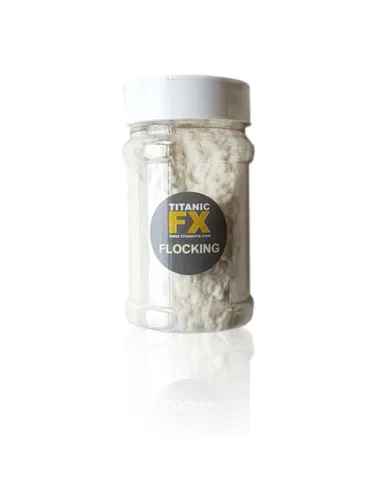
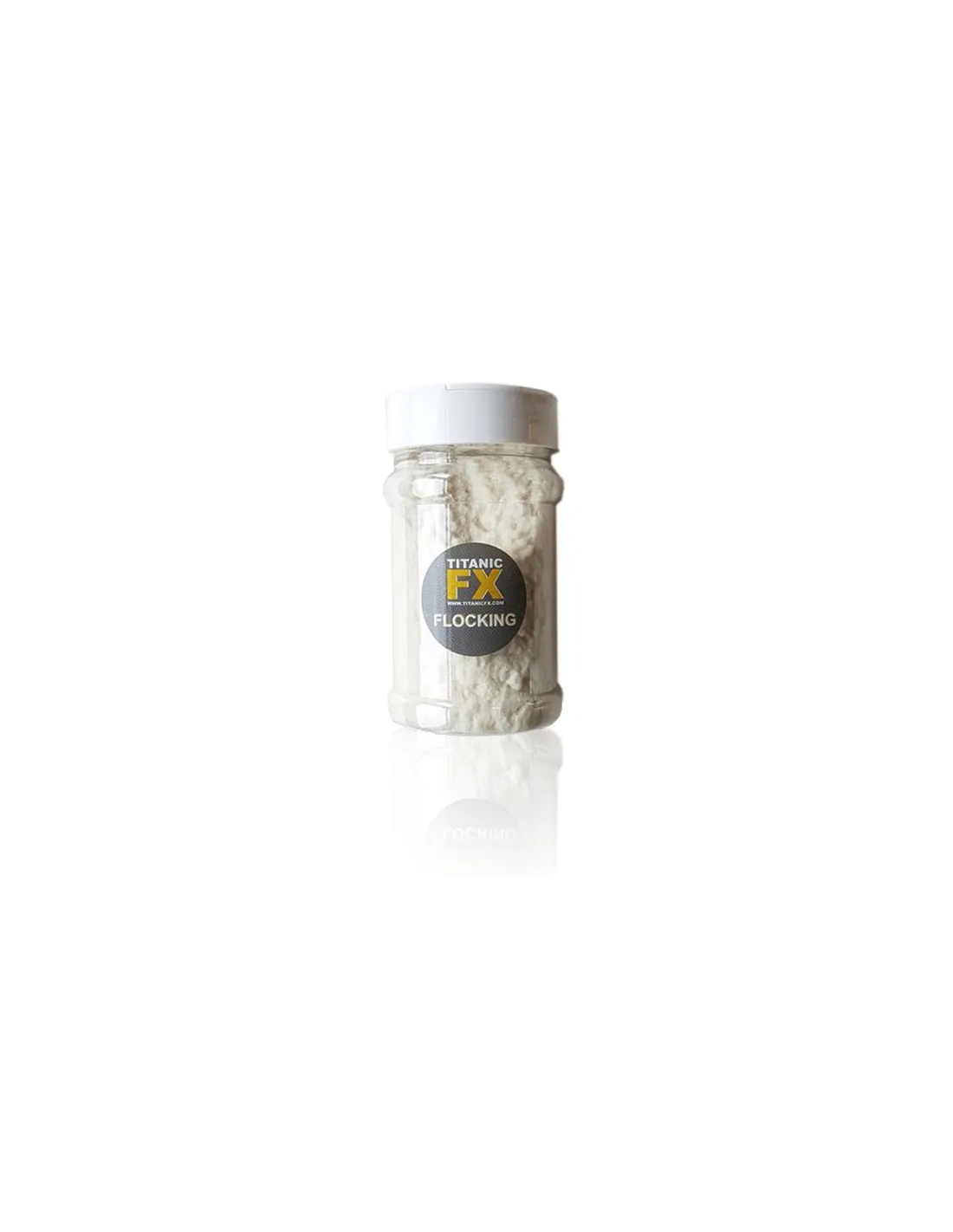
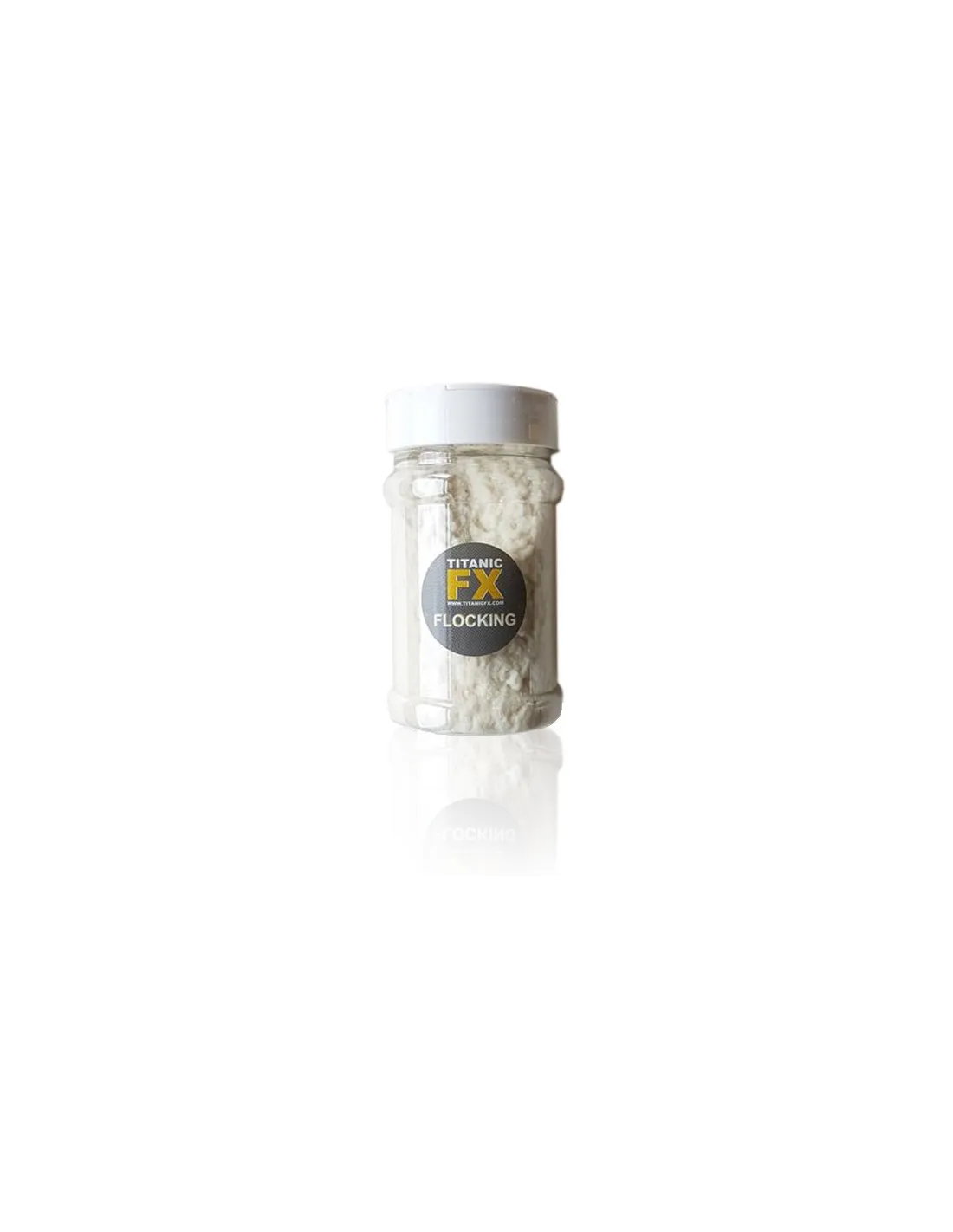
Titanic Fx Flocking White are coloured micro-fibres designed to pigment platinum silicones, gelatines and other prosthetics and special effects materials. Unlike conventional paste or liquid pigments, the fibres float within the mix and create a unique colour depth that mimics the translucent texture of real skin. An extremely light filler that does not settle, ensuring a homogeneous distribution in every application.
Technical specifications
| Feature |
Detail |
| Material type |
Flocking micro-fibres |
| Colour |
White |
| Compatibility |
Platinum silicones, tin silicones, gelatines, foams, latex |
| Behaviour in mix |
Does not settle, homogeneous distribution |
| Application method |
Manual or with flocking machine |
| Packaging |
Airtight container with dual-speed dispensing cap |
| Brand |
Titanic Fx (distributed in Spain by Feroca) |
What it is used for
White Flocking is an essential tool in the creation of character prosthetics and special effects, particularly when achieving skin tones, flesh or tissue with a three-dimensional, realistic appearance. The micro-fibres act as a chromatic filler that adds depth to the base colour — something impossible to achieve with liquid or paste pigments alone. Use it to:
- Pigment platinum silicones for facial prosthetics, character bodies and FX pieces.
- Colour gelatines for theatrical, film and television characterisation.
- Create custom skin tones by mixing with other Flocking colours or pigments.
- Add controlled opacity to translucent silicones without losing visual depth.
- Apply over foams or latex to add colour nuances in layers.
- Combine with a flocking machine for velvety surface finishes.
How to use it
- Prepare the silicone or gelatine according to the manufacturer's instructions. For platinum silicones such as PlatSil Gel-10, first mix components A and B in the indicated ratio.
- Add the white Flocking directly to the mix before pouring or applying. Start with small amounts and keep adding until you achieve the desired colour intensity.
- Stir thoroughly with a spatula to distribute the fibres evenly throughout the mix. As it is a light filler it does not settle, but it is best to mix with slow movements to avoid introducing bubbles.
- Combine with other Flocking colours or conventional pigments to create unique, custom skin tones.
- If you want to apply the Flocking onto an already cured surface (velvety surface effect), use a flocking machine or apply it manually over a layer of adhesive.
- Use the dual-speed cap on the container to dispense precisely and avoid wasting material.
- Close the airtight container securely after each use to preserve the properties of the fibres.
Usage tips
Dosing and colour mixing
White Flocking is especially useful for lightening dark skin tones or for creating base tones over which to layer other colours. By mixing it with pink, yellow or brown Flocking shades you can achieve an extremely wide range of flesh tones. Always start with less than you think you need: the micro-fibres have a strong visual impact and it is easy to overdo it on the first mix. Keep a record of the proportions used so you can reproduce exactly the same tone in future work.
Compatibility with platinum silicones
Titanic Fx Flocking is fully compatible with addition-cure (platinum) silicones. It does not interfere with the curing process or cause inhibition. When working with platinum silicones, bear in mind that other additives or contaminants can inhibit the cure: make sure all materials and surfaces you work with are clean and free of sulphur compounds, tin, latex or cyanoacrylate adhesives. If you need to adjust the cure speed, you can use the Cure Agent 81 VF.
Storage and preservation
The airtight container with dual-speed security cap is designed to protect the fibres from moisture and airborne dust. Store the product in a cool, dry place away from direct sunlight. If the material has not been used for some time, gently shake the container before opening to ensure the fibres are loose and ready to dispense.
Frequently asked questions
What is the difference between using Flocking and paste pigments to colour silicones?
Paste or liquid pigments provide a flat, uniform colour, whereas Flocking, being composed of suspended micro-fibres, creates a visual depth that mimics the internal texture of skin. Titanic Fx Flocking White, for example, allows you to achieve translucent, natural tones that conventional pigments cannot replicate. Both systems are complementary and can be combined.
Can this material be used directly in platinum silicones without affecting the cure?
Yes. Titanic Fx Flocking does not contain compounds that inhibit the cure of addition-cure (platinum) silicones. You can add it directly to the mix without any risk. What can inhibit the cure are other materials present in the working environment, such as sulphur-containing clays, latex, or cyanoacrylate adhesives.
Can it be applied over already cured surfaces?
Yes. In addition to being mixed into the bulk of the material, Flocking can be applied over already cured surfaces to achieve a velvety surface effect. To do so, apply a layer of compatible adhesive and deposit the fibres on top, either by hand or with a flocking machine.
Can it be mixed with other Flocking colours?
Yes, and in fact this is the standard way of working. By combining white Flocking with other shades from the Titanic Fx range you can create custom, reproducible flesh tones. It is advisable to weigh the amounts so you can repeat exactly the same result across different batches.
How much Flocking should be added to the silicone?
There is no fixed ratio, as it depends on the desired effect and the type of silicone. It is recommended to start with a small amount, mix well and evaluate the tone before adding more. The micro-fibres have a strong visual presence, so it is easy to achieve the desired effect with moderate quantities.
Can it be used in prosthetic gelatines as well as silicones?
Yes. Titanic Fx Flocking is compatible with characterisation gelatines, which is one of its most common uses in the theatrical and film special effects industry. It provides the same depth and naturalism effect as in silicones.
Does the material settle inside the silicone before it cures?
No. One of the main advantages of Flocking over other pigments or fillers is precisely that, being extremely lightweight, it remains in suspension within the mix and does not settle during the curing process. This guarantees a uniform colour distribution throughout the piece.
Is a special release agent needed for silicone pieces coloured with Flocking?
The use of a release agent depends on the type of mould and silicone, not on the colorant. For silicone moulds or porous materials, Ferosil V 32 is a common workshop option. Flocking does not change the need for or type of release agent to be used.