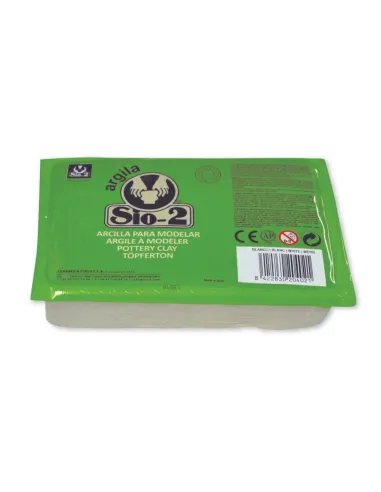
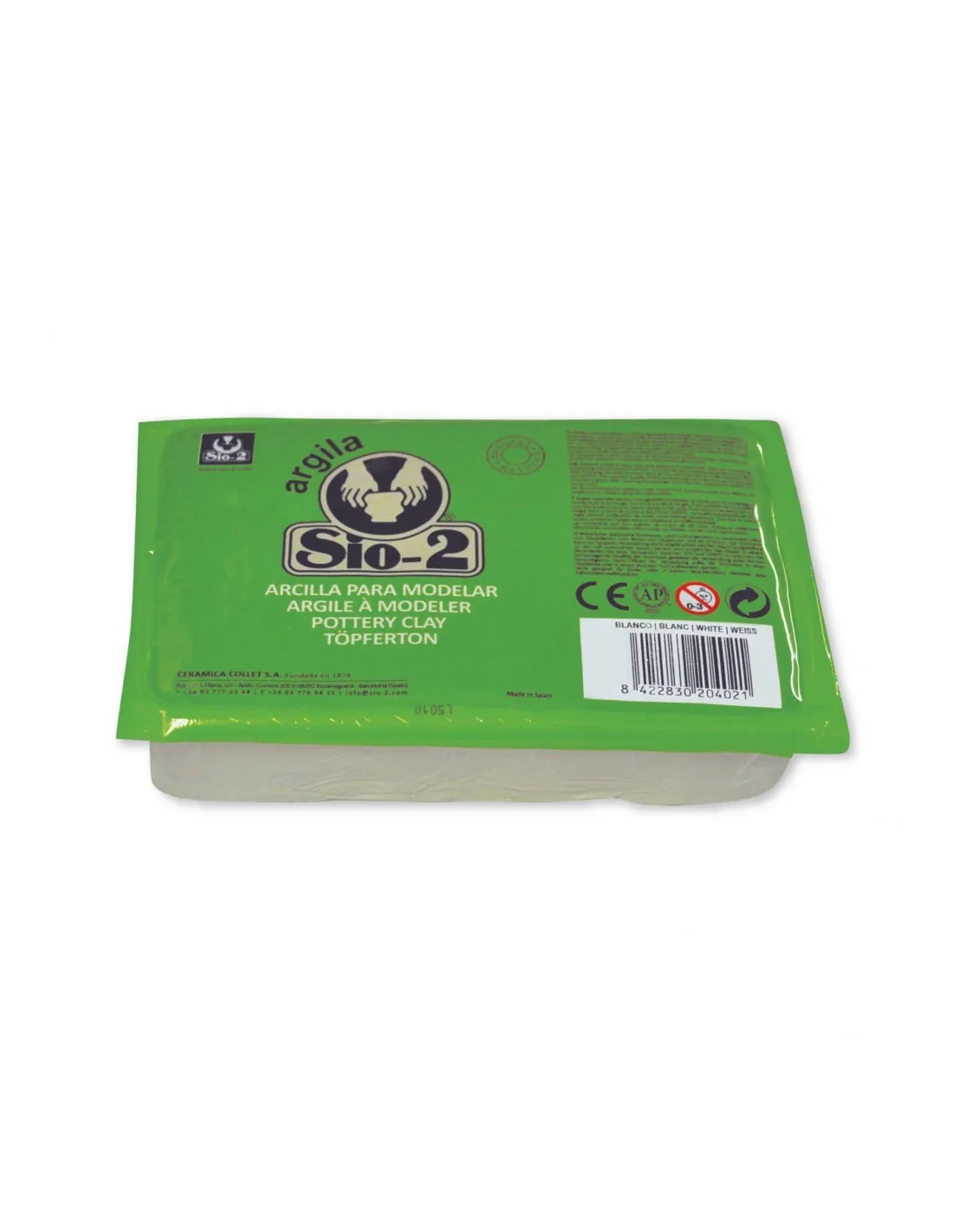
100% natural potter's clay, white. Ideal for hand modelling, sculpture and wheel throwing. Suitable from 3 years. Available in 1.5 kg and 5 kg formats.
Sio-2 ARGILA White Clay is a 100% natural composition clay — pure potter's clay, finely ground — designed for those seeking an honest material, free from additives, with balanced plasticity that performs equally well in hand modelling, on the wheel and in sculpture. Its vacuum packaging ensures it arrives in perfect condition and remains unaltered for a minimum of two years.
Technical specifications
Composition
100% natural clay (potter's clay) + water
Raw colour
White
Fired colour
White (raw colour is retained)
Recommended firing temperature
970 – 1050 °C (ceramic kiln)
Available formats
1.5 kg (individual vacuum pack) / 5 kg
Available colours
White / Red
Glaze compatibility
Compatible with standard ceramic glazes on the market
Suitable for children
Yes, from 3 years of age (compliant with EN-71)
Shelf life (unopened)
Minimum 2 years; non-perishable if packaging is undamaged
Preservatives / synthetic additives
None
What it's used for
Sio-2 ARGILA White Clay is a general-purpose clay, suitable for both educational and creative settings as well as professional ceramic workshops. Its fine particle size and balanced plasticity make it particularly versatile:
Sculpture and clay prototyping for subsequent firing
Making functional ceramic pieces (bowls, vessels, slabs)
Educational activities and children's workshops (from 3 years)
Creative arts and general crafts
Development of tactile perception and creativity
Base for glazed pieces with ceramic glazes
How to use it
Open the vacuum pack and knead the clay with your hands until it regains uniform temperature and elasticity. If it is very cold, a few minutes of kneading will suffice.
Model, throw or sculpt the piece using the appropriate tools. For detail work, modelling tools or loop tools make finishing and hollowing out pieces easier.
Leave to air dry at room temperature, in a place without sudden draughts to avoid cracking. Depending on the thickness of the piece, drying can take from 24 hours to several days.
First firing (bisque): place the completely dry piece in the ceramic kiln. Raise the temperature progressively until reaching between 970 and 1050 °C.
Apply ceramic glaze to the bisque piece if you want a glazed decoration or waterproof finish.
Second firing (stoneware or earthenware): fire again according to the instructions of the chosen glaze.
Store the leftover clay wrapped in airtight plastic or in the original container tightly sealed to prevent it from drying out.
Usage tips
Preparation and kneading
Proper kneading is the foundation of everything. Knead until all air bubbles are eliminated — a bubble inside the piece can cause it to crack during firing. The "spiral kneading" technique (similar to kneading bread) is the most effective for homogenising the clay without introducing more air. If you find it too dry, add a few drops of water and continue kneading; if it is too soft, leave the clay to rest for a few minutes on an absorbent surface (unvarnished wood or plaster).
Crack-free drying
The number one enemy of drying is unevenness: if one area dries much faster than another, cracks appear. Cover the piece with thin plastic during the first few days to slow down the process. If you are working with pieces of varying thickness, reinforce the joins with slip (clay diluted in water to a yoghurt-like consistency) and cover again. Hollow pieces — worked with loop tools — dry more evenly and fire with less risk.
Firing and glazes
Make sure the piece is completely dry before placing it in the kiln: residual moisture can cause explosions during the heating phase. Sio-2 ARGILA White Clay performs excellently with the standard ceramic glazes available on the market; its white raw colour makes it easy to visualise the glaze before firing and allows for more vivid colours that are truer to the final result. If you are going to combine it with other clays, check the firing temperature compatibility.
Frequently asked questions
Can this clay be used unfired, as a permanent modelling material?
Yes, but the unfired piece is fragile and sensitive to moisture. Sio-2 ARGILA White Clay can be used without firing for prototypes, models or temporary educational projects. For a durable, waterproof piece, firing in a ceramic kiln is essential.
At what temperature does this clay need to be fired?
The recommended range is 970 to 1050 °C in a ceramic kiln. Within that range, the exact temperature depends on the finish you are looking for and the glaze you are going to apply. It is not suitable for conventional domestic ovens.
Is it safe for children?
Yes. Sio-2 ARGILA White Clay is formulated with natural clay and water, without synthetic additives or preservatives. It complies with the European toy safety standard EN-71 and is suitable from 3 years of age. Even so, as with any workshop material, adult supervision is recommended with young children.
What is the difference between this clay and Sio-2 PLUS?
Sio-2 PLUS is formulated with greater plasticity and is specially optimised for more demanding modelling techniques or for students who need an even more workable clay. ARGILA is equally high quality but with a more neutral plasticity, suitable for a wide range of techniques including wheel throwing.
How do I store leftover clay?
Wrap the leftover clay in cling film or an airtight bag, squeezing out the air. You can also place it back in the original container, tightly sealed. If the clay has partially dried out, you can rehydrate it: break it into pieces, add water and leave it covered to rest for 24–48 hours before kneading again.
Can two clay pieces be joined once modelled?
Yes. The correct technique is to use slip — clay diluted in water — as a "glue". Score the surfaces to be joined lightly, apply slip to both faces and press together. Leave to dry slowly to prevent the join from cracking. Do not use conventional adhesives on pieces that are going to be fired.
Can I paint the piece without ceramic glazes?
If the piece is to be fired, use only ceramic glazes or slips suitable for the firing temperature. If you are not going to fire the piece, you can paint it with acrylic paints once it is completely dry; in that case apply a final protective varnish to improve durability.
How long does it take to dry before firing?
It depends on the thickness of the piece and environmental conditions. Thin pieces can be ready in 24–48 hours; thick pieces or those with uneven walls may need several days. The most important thing is that they are completely dry — uniform colour, with no darker areas — before placing them in the kiln.
Cookies on this site are used to personalise content and ads to deliver social media features and to analyse traffic. We also share information about your use of the site with our social media partners for advertising, personalisation and web analytics.. More information.