Shopping Cart


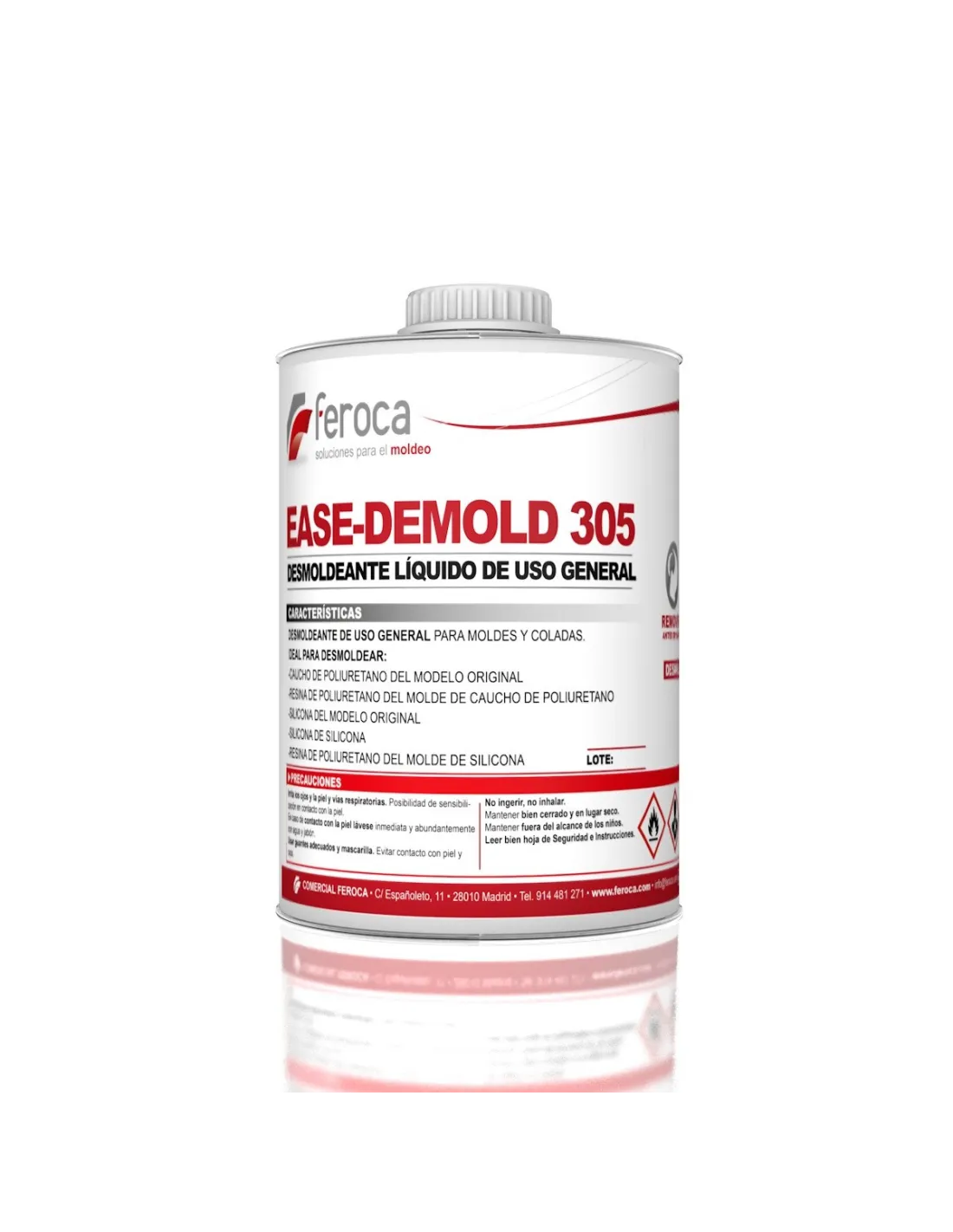
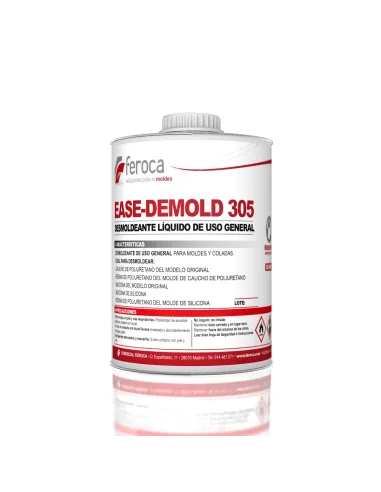
Ease-Demold 305 -Universal Liquid Release Agent-
480320500
Temporarily out of stock
€12.00
14,52 € Tax incl.
14,52 € Tax incl.
Universal liquid release agent compatible with polyurethane, silicone, polyester, epoxy and more. Fast drying, matte finish, effective from 20 °C to 260 °C.
Ease-Demold 305 is a general-purpose liquid release agent designed to facilitate demolding across a wide variety of material combinations and surfaces. Its solvent-based formula applies easily, dries fast, and leaves a matte finish that does not interfere with fine mold detail reproduction.
Technical specifications
| Parameter | Value |
|---|---|
| Type | Universal liquid release agent |
| Base | Solvent |
| Finish | Matte |
| Effective temperature range | 20 °C to 260 °C |
| Application | Brush, sponge or spray |
| Drying | Fast |
| Compatible with polyurethane foams | Not recommended |
What it is used for
Ease-Demold 305 is formulated to act as a release agent for molds and castings across a wide variety of material combinations. It is especially useful when working with systems that tend to bond to each other without a proper separating agent.
- Release of polyurethane rubber from the original model
- Release of polyurethane resin from a polyurethane rubber mold
- Release of silicone from the original model
- Release of silicone from silicone
- Release of polyurethane resin from a silicone mold
- Steel, aluminum, chrome and epoxy molds and surfaces
- Sealed plaster, concrete and wax molds
- Urethane plastics and rubbers
- Series production of polyester resin parts
How to use it
- Make sure the mold or model surface is clean, dry and free of dust or residue from previous castings.
- If you are making a urethane or silicone mold directly on a porous model, seal it first with a suitable sealing agent before applying the release agent.
- Apply Ease-Demold 305 with a brush, sponge or spray, forming a thin, even coat over the entire surface.
- Allow to dry completely until the solvent has evaporated. Drying is fast under normal workshop conditions.
- If the surface is very absorbent or the mold is complex, apply a second coat once the first is dry.
- Pour or apply the casting or molding material once the release agent is completely dry.
- After the material has cured, demold carefully. Repeat the release agent application for each new casting cycle.
Safety precautions: Solvent-based product. Always work with good ventilation. Do not smoke or use ignition sources during application or while the solvent is evaporating. Store and use at room temperature. Wear gloves to avoid prolonged skin contact, which may cause dryness. Protect eyes with safety glasses to avoid splashes. Do not use to release polyurethane foams.
Usage tips
Thin coats, not thick ones
The usual temptation is to apply a generous coat to "play it safe". With Ease-Demold 305, the opposite is better: two or three thin, well-dried coats are more effective and less intrusive than a single thick one, which can build up in fine details and reduce the definition of the final piece.
Importance of pre-sealing porous models
Materials such as plaster, wood or certain porous plastics absorb the release agent before it forms a protective film on the surface. If you are working with these materials, apply a compatible sealer first and allow it to cure before using Ease-Demold 305. This ensures a continuous film that acts correctly as a release barrier. For surfaces where PVA polyvinyl alcohol is the sealing and release option in a single coat, consider combining it according to the material system.
Maintenance between castings in series production
In repetitive cycles, do not wait for the mold to lose efficiency before reapplying. With polyurethanes especially, it is advisable to apply a maintenance coat every 3–5 castings depending on mold geometry and resin system aggressiveness. Keeping a cycle count log will help you systematize the process and avoid stuck parts.
Frequently asked questions
Is a release agent necessary when working with polyurethane rubber?
Yes, it is highly recommended. Polyurethane rubbers, especially on epoxy, plastic or other urethane models, tend to bond without a release agent. Ease-Demold 305 creates an effective barrier that allows demolding without damaging either the mold or the part.
Can this release agent be used with silicone on silicone?
Yes. The silicone-on-silicone combination is one of the most problematic because silicones tend to bond to each other. Ease-Demold 305 is effective in this combination, although it is recommended to apply at least two well-dried coats to ensure a proper barrier.
For which materials is this release agent not suitable?
Ease-Demold 305 should not be used to release polyurethane foams. For all other common workshop combinations (resins, rubbers, silicones, plasters, concrete, metals), it works effectively.
How many coats should be applied?
In most cases, one or two thin, well-dried coats are sufficient. On porous surfaces, complex geometries or highly adhesive material combinations, it is preferable to apply three thin coats, allowing each one to dry completely before applying the next.
Does the release agent affect the reproduction of mold details?
No, as long as it is applied in thin coats. Ease-Demold 305 is specifically formulated not to interfere with fine detail reproduction. A thick or poorly applied coat can fill very fine textures, so application technique is key.
Can it be applied on aluminum or steel molds?
Yes. Ease-Demold 305 is effective on a wide variety of metal surfaces, including steel, aluminum and chrome, as well as epoxy, plastics and urethane rubbers.
At what temperature does it work correctly?
Ease-Demold 305 is effective over a temperature range of 20 °C to 260 °C, making it compatible with hot molding processes as well as the usual room-temperature applications.
Do I need to ventilate the workspace properly?
Yes, it is essential. As a solvent-based product, the vapors generated during application and drying require adequate ventilation. Do not use ignition sources while applying the product or while the solvent is evaporating.
No reviews
Tap to zoom