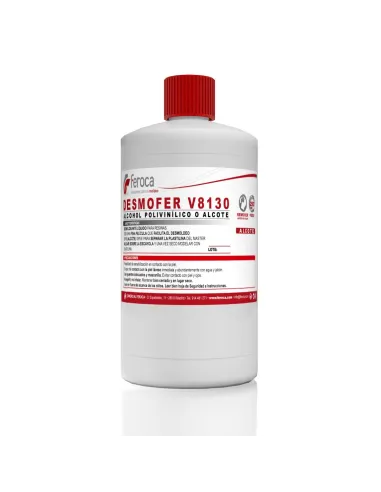
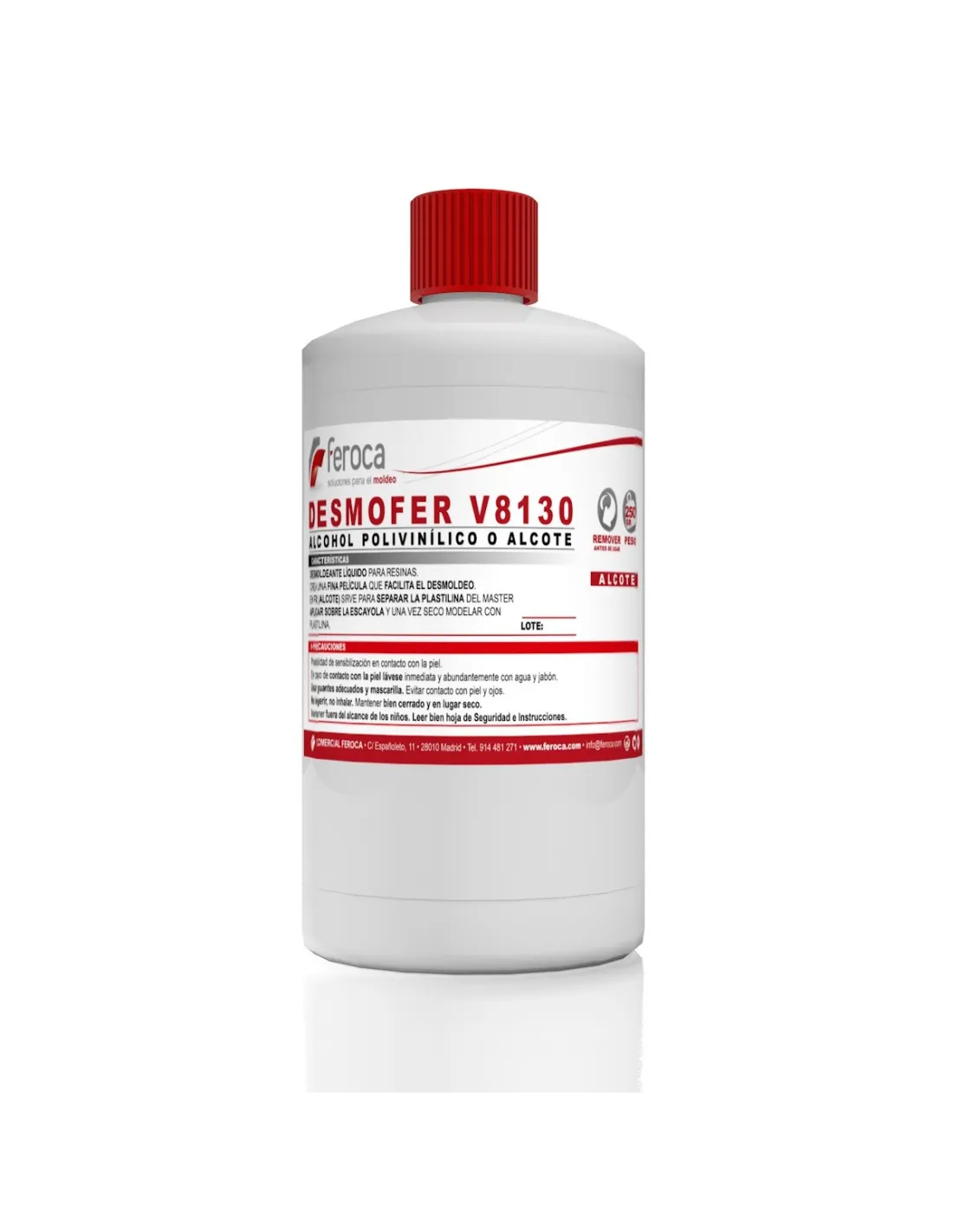
Alcohol Polyvinylico PVA Alcote Desmofer V8130 is a low-viscosity liquid release agent that, as the solvent evaporates, forms a continuous and uniform film between the mould and the part. It is the standard choice in polyester resin lamination workshops, prosthetics and special effects when working on plaster or other porous surfaces where wax alone does not provide a sufficient barrier. Cleanup afterwards is straightforward: the film dissolves with water.
Technical specifications
| Parameter |
Value |
| Product type |
Liquid release agent |
| Chemical base |
Polyvinyl Alcohol (PVA) |
| Viscosity |
Low |
| Mechanism of action |
Film formation by solvent evaporation |
| Application method |
Brush or spray gun |
| Film solubility |
Water-soluble |
| Compatible moulds |
Plaster, acrylic, polyester and porous surfaces in general |
What it is used for
The V8130 is the reference release agent when working with polyester resins for lamination on plaster moulds or other porous surfaces where release wax alone is not a sufficient barrier. It is also the classic "Alcote" in FX and facial prosthetics work, where a clean physical separation between incompatible materials is required.
- Demoulding of laminates with polyester resins for lamination on plaster moulds
- Barrier for castings with transparent polyester resins or casting polyester resins in porous moulds
- Separation between plaster and acrylic in the manufacture of dentures and dental prostheses
- Separation of professional clay from the master in Life Casts and advanced prosthetic work (Alcote technique)
- Re-floating sections of professional clay during adjustments in special effects work
- Complementary barrier over already-waxed moulds to ensure risk-free demoulding
How to use it
- Prepare the mould. Clean the mould surface, removing dust, material residues or contaminants. If working on new plaster, make sure it is completely dry.
- Apply wax if necessary. On polyester moulds or non-porous surfaces, first apply one or more coats of release wax and let it cure. On plaster or other porous substrates, PVA can be applied directly.
- Shake the container well before use to ensure a homogeneous mixture.
- Apply the V8130 with a soft-bristle brush or low-pressure spray gun, in thin, even coats. Avoid build-ups or puddles.
- Allow each coat to dry until the film is transparent and non-tacky to the touch (usually several minutes depending on temperature and ventilation).
- Apply at least two coats, allowing each to dry completely before the next, to ensure a continuous, pore-free barrier.
- Laminate or cast the reproduction material directly onto the dry PVA film.
- Demould carefully once the material has cured. The part will release cleanly.
- Clean any remaining film with running water. No solvents needed.
Usage tips
Number of coats and brush technique
Always apply a minimum of two coats. The first will seal the mould's pores; the second will create the actual barrier. On very porous plaster moulds, three coats may be needed. Use a soft-bristle brush and work in a single direction to avoid marks or bubbles. If using a spray gun, set the pressure to the minimum required to achieve a fine, even mist.
Temperature and drying times
Drying depends on ambient temperature and workshop ventilation. At 20 °C with good air circulation, each coat dries in about 5–10 minutes. In cold or humid conditions, the time increases. Do not apply the next coat or the reproduction material until the film is completely transparent and dry to the touch: a poorly dried film can cause adhesion or surface defects on the part.
Combining with release wax
On polyester moulds or smooth non-porous surfaces, the combined use of release wax plus PVA offers maximum security, especially on complex parts or when the mould is new. The wax acts as the first barrier and the PVA as an additional physical barrier. On plaster, PVA is usually sufficient on its own. Once work is complete, clean off any excess PVA with water before it dries on tools or surfaces you do not want coated.
Frequently asked questions
What is a PVA release agent and how does it differ from a wax?
Release wax acts as a surface lubricant that reduces adhesion between the mould and the part. PVA like the V8130 goes a step further: it forms a solid, continuous physical film that acts as a real barrier between both surfaces. This is especially useful on porous moulds such as plaster, where wax penetrates the pores and does not create a complete barrier. In addition, the PVA film is water-soluble, which greatly simplifies cleanup.
Can it be used on any type of mould?
The V8130 is especially effective on plaster, gypsum, acrylic and porous surfaces. It can also be used on polyester moulds, normally as an additional layer over release wax. It is not intended for silicone moulds, which already have inherent non-stick properties and do not require a release agent.
How many coats should be applied?
In general, two well-dried coats are sufficient to achieve a continuous barrier. On very porous plaster moulds or in work where perfect demoulding is critical (prosthetics, dental prostheses), three coats are recommended. The key is to allow each coat to dry completely before applying the next.
Can it be used directly on plaster without applying wax first?
Yes. One of the advantages of the V8130 is that it can be applied directly onto dry plaster without the need for prior waxing. The PVA film seals the plaster's pores and acts as a sufficient barrier for most polyester resins. If you want an extra layer of security, you can apply wax first, although this is not essential on plaster surfaces.
How is the PVA film cleaned after demoulding the part?
The Polyvinyl Alcohol film is water-soluble, so simply washing both the mould and the part with running water is enough to remove any residue. No solvents or special products are needed. Clean before the residue dries completely to make the process easier.
Is it compatible with polyurethane or epoxy resins?
The V8130 is specifically formulated for use with polyester resins, and is the reference release agent for this family. For polyurethane or epoxy resins, there are more suitable specific release agents. Consult the Feroca team before using it with other resin families to ensure compatibility.
What is the "Alcote" technique in prosthetics and special effects?
The Alcote technique involves applying Polyvinyl Alcohol (the classic "Alcote", hence the name) onto professional clay or onto a plaster positive before proceeding with casting or lamination. This allows sections of clay to be separated from the master, adjusted and reattached without the materials adhering to each other. It is a standard technique in special effects and advanced facial prosthetics workshops.
Does the PVA film affect the surface finish of the part?
When applied correctly in thin, even coats, PVA leaves a very smooth surface on the final part. Brush marks or build-ups only appear if applied unevenly or in excess. For an optimal finish, work with thin coats, allow each to dry thoroughly, and use a soft-bristle brush or spray gun.