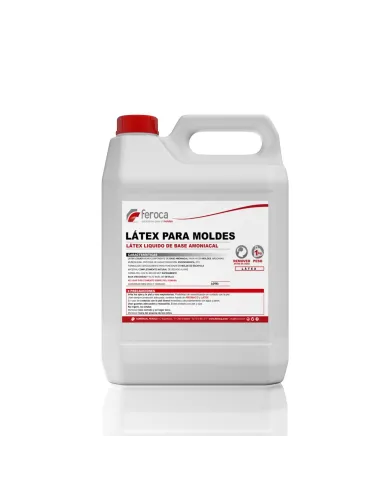
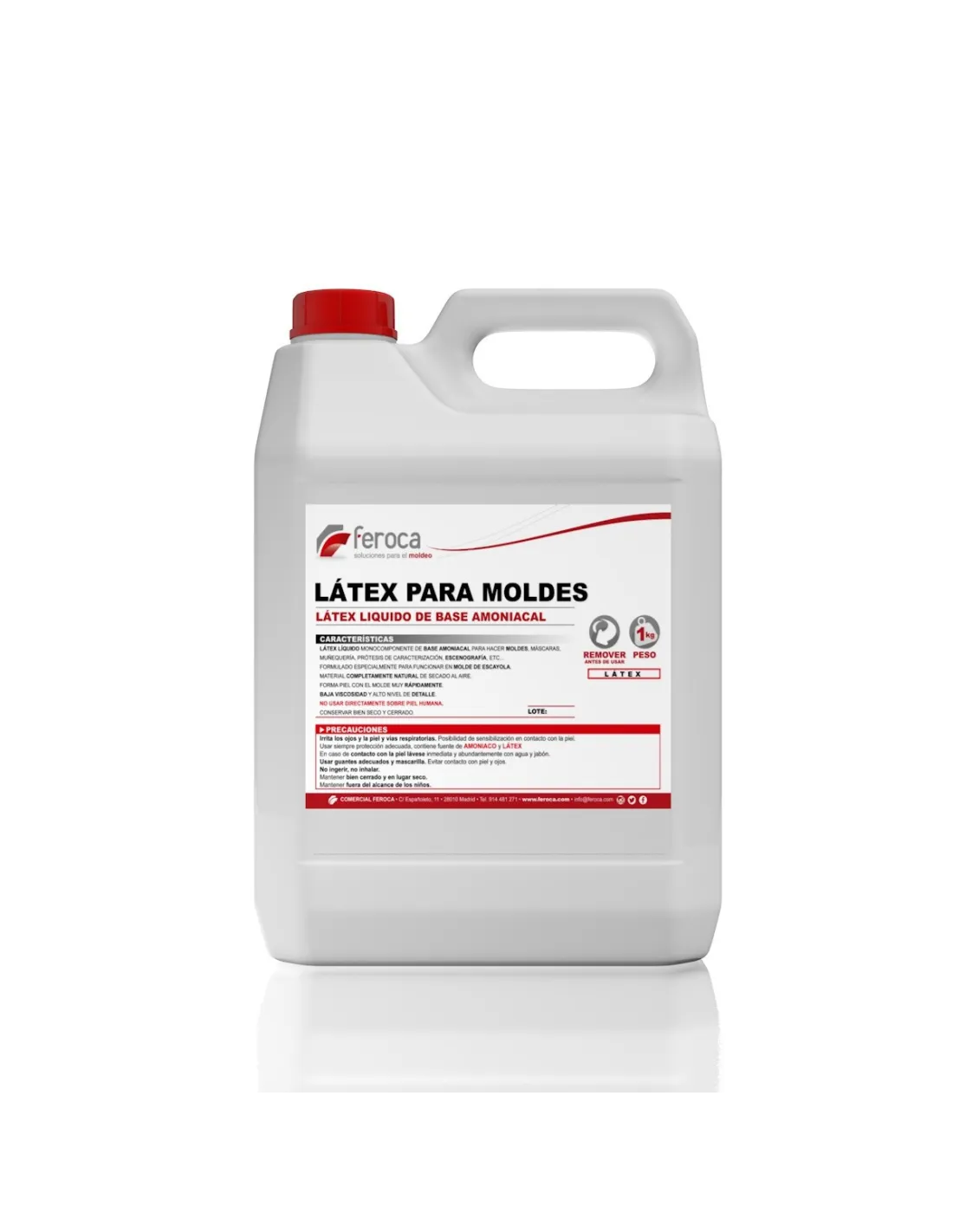
Feroca's Liquid Latex for Moulds is a single-component, ammonia-based latex with very low viscosity that reproduces detail with maximum fidelity. It is pre-vulcanised and air-dries without any additional treatment, making it a practical and versatile option for workshop, set design and special effects.
Technical specifications
| Components |
1 (single-component) |
| Base |
Ammonia-based natural latex |
| Viscosity |
Very low (fluid, similar to milk) |
| Cure |
Air drying (evaporation) |
| Vulcanisation |
Pre-vulcanised — no additional process required |
| Colour |
Milky white in liquid / translucent when dry |
| Compatibility |
Compatible with Feroca latex paints |
| Application |
By casting or by immersion in porous mould |
What it is used for
It is a reference material in artisan moulding workshops, doll making and special effects. Its low viscosity allows it to flow into every corner of the mould and reproduce very fine textures. Its most common uses are:
- Fabrication of latex moulds by casting or by immersion over plaster
- Artisan doll making and puppet fabrication
- Masks and prosthetics for theatrical and film character work
- Set design: decorative elements, artificial rocks, surface coverings
- Low-cost replicas and prototypes in the workshop
- Base for special effects makeup (SFX) projects
How to use it
Method 1: casting into a mould
- Make sure the mould (usually plaster) is completely dry. The drier it is, the better the absorption.
- Pour the liquid latex filling the mould completely.
- Leave it to rest for approximately 10 minutes so the plaster absorbs the outer layer.
- Empty the mould by returning the excess latex to the container.
- Leave to dry until the piece is semi-dry.
- If the thickness obtained is not sufficient, repeat the layers as many times as necessary, allowing to dry between each layer.
- Demould when gently pulling the rubber it does not change colour (indicating complete cure).
Method 2: immersion of porous mould
- The plaster piece must be as dry as possible and free of dirt, grease and dust.
- Leave the latex to rest in its container until it degasses; remove any foam from the surface before immersing.
- Submerge the plaster piece in the latex. The immersion time determines the final thickness of the layer.
- Remove the piece and leave to dry in a suitable position to avoid build-ups.
- Repeat the immersion if more thickness is needed, allowing to dry between layers.
- Once the work is finished, filter the used latex and store it in a separate container from the unused latex.
- Demould when the rubber does not change colour when pulled.
Warning — Read before use: This product contains ammonia and natural latex. Always work in a well-ventilated space and wear gloves and eye protection. It is not suitable for direct contact with human skin: for makeup applications or dermal prosthetics, use latex foam specifically formulated for that purpose. People with latex allergies must take extreme precautions and avoid any contact.
Usage tips
Control drying between layers
The key to obtaining a strong mould is patience between layers. If you apply a new layer before the previous one has dried sufficiently, the layers may peel apart or generate internal bubbles. In humid environments, you can accelerate drying with air at room temperature (avoid excessive heat that may dry the surface too quickly before the interior has cured).
Thicken the latex when you need thick layers without immersion
If you want to apply the latex by brush on vertical surfaces or need thicker layers without using the casting method, add Thixotropic Latex Thickener to increase the viscosity and prevent the material from running before it dries.
Storage and filtering
Latex used in immersion accumulates plaster residues and particles that degrade the material. Always filter the latex after each work session and store it in a closed, opaque container, separate from virgin latex. Avoid freezing it: temperatures below 0 °C destroy it irreversibly. If a skin forms on the surface, remove it carefully before use.
Frequently asked questions
Does it need vulcanisation or any additional process to cure?
No. Feroca's Liquid Latex for Moulds is pre-vulcanised. It dries simply by evaporation in open air, with no need for ovens, catalysts or additional treatments.
How many layers do I need to obtain a strong mould?
It depends on the size of the piece and the intended use of the mould. For small moulds with few details, between 5 and 8 layers are usually sufficient. For larger moulds or heavy use, 15 layers or more may be necessary. The key is to allow each layer to dry thoroughly.
What type of base mould is most suitable?
The ideal support is hard moulding plaster, such as EXADURO or Arquero high-strength plaster. The porous plaster gradually absorbs the latex, forming the solid layer. The harder and drier the mould, the better the results.
Can the latex be painted once dry?
Yes. The Liquid Latex for Moulds is compatible with paints formulated for latex. For quality finishes on masks, puppets or set pieces, you can use Mask Paint by Monster Makers, specially designed to adhere and flex with latex without cracking.
Is it safe to apply on skin?
No. This latex is formulated for industrial and artisan moulding, not for dermal contact. For character makeup and skin prosthetics, use products specifically formulated for that purpose, such as RD-407 Masking Latex, designed for that use. People allergic to latex must avoid any contact with this product.
How can the viscosity be increased for brush application?
In its natural state, the latex has very low viscosity, making it ideal for casting and immersion but impractical for brush application on vertical surfaces. By adding Thixotropic Latex Thickener you can adjust the consistency until it is suitable for brush use without the product running.
How should it be stored correctly?
Store in a closed container, at a temperature between 5 °C and 30 °C, protected from cold and direct sunlight. Never freeze it: latex that has been frozen coagulates irreversibly and becomes unusable. Used latex must be filtered and stored separately from the virgin product.
How long does each layer take to dry?
The drying time between layers depends on the temperature and humidity of the environment. Under normal workshop conditions (20–25 °C and moderate humidity), each layer dries in 20–40 minutes. In colder or more humid environments the process slows down considerably. Do not force drying with intense heat: it can cause cracking on the surface.
How much product do I need?Calculate the exact amount before buying and avoid wasting material.
Go to the calculator →