Shopping Cart


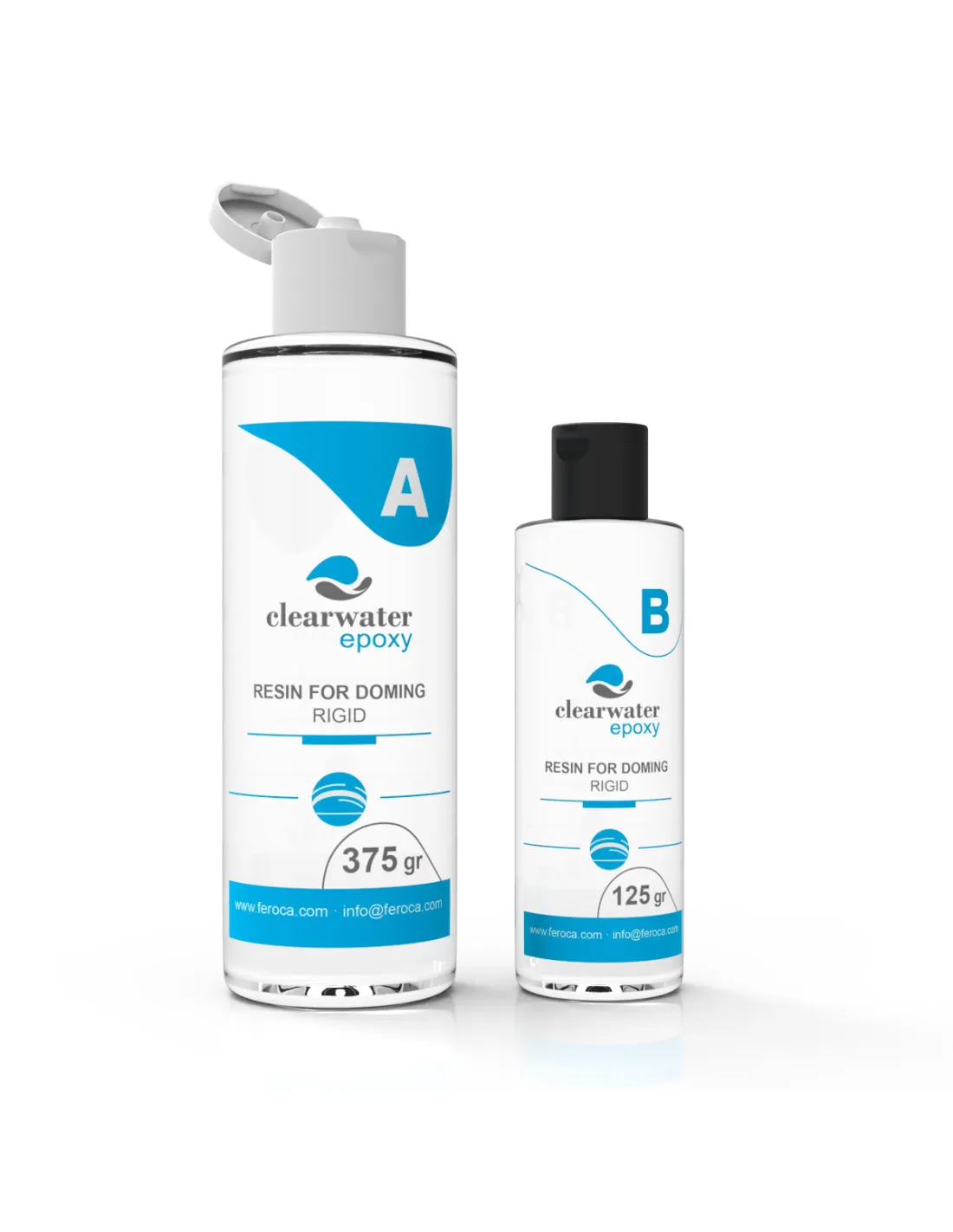
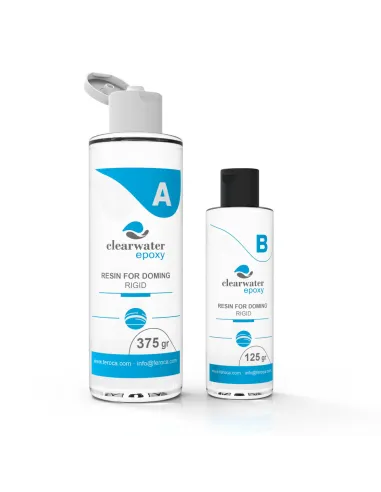
ClearWater Epoxy Doming Rigid -Resin Drop
405803002
€15.00
18,15 € Tax incl.
18,15 € Tax incl.
Rigid transparent epoxy resin for doming. Mix ratio 100A:30B, Shore Hardness 80D, 15 min working time, cured in 24 h.
ClearWater Epoxi Doming Rígida is a low-viscosity, high optical clarity epoxy resin specifically designed for the doming technique: apply it over stickers, magnets, keyrings or any flat substrate and get that dome-shaped, glossy and durable finish characteristic of professional jewellery and merchandising. With enhanced UV resistance, natural defoamer and room-temperature cure, it is the direct solution for artisan and semi-industrial production of decorative items.
Technical specifications
| Parameter | Value |
|---|---|
| Type | Clear epoxy resin (doming) |
| Colour | Transparent |
| Mix ratio (by weight) | 100A : 30B |
| Working time (pot life) | 15 minutes |
| Cure time | 24 hours |
| Shore Hardness | 80D |
| UV resistance | High |
| Application | Art / 3D Decoration |
What it is used for
This resin is optimised for thin-layer coating applications over flat or slightly curved surfaces where the characteristic dome effect of doming is required. The low viscosity facilitates self-levelling of the drop and the surface sets perfectly smooth without any additional intervention.
- Magnets with printed photo or graphic (merchandising)
- Keyrings and badges with dome finish
- Dome stickers and adhesive labels for premium labelling
- Decorative pins and brooches
- Identification plates and artisan signage
- Encapsulation of illustrations, photographs and decorative papers
- Jewellery seals and pendants
- Protective and decorative finish over wood, cardboard or metal
How to use it
- Prepare the substrate: make sure the surface is clean, dry and perfectly level. Any tilt will cause the drop to shift before curing.
- Weigh the components: mix 100 parts of component A (resin) with 30 parts of component B (hardener) by weight. Use a precision scale; the ratio is critical for correct curing.
- Mix slowly: stir for 2–3 minutes scraping the sides and bottom of the container thoroughly. Vigorous stirring introduces bubbles; the resin has a natural defoamer, but avoid generating more than necessary.
- Apply to the substrate: pour or deposit with a syringe, dispenser or stick directly onto the piece. The surface tension of the resin will form the dome automatically if the correct amount is applied.
- Remove residual bubbles: pass a heat gun or lighter briefly at about 10–15 cm from the surface. The heat breaks the bubbles without burning the resin.
- Leave to cure without moving: keep the pieces in a horizontal position in a dust-free, draught-free space for at least 24 hours at room temperature (18–25 °C).
- Demould or handle: after full cure the piece will have Shore Hardness 80D and can be handled normally. For full mechanical cure, wait 48–72 hours.
Warning: This is an epoxy resin. It contains no platinum and is not subject to sulphur inhibition. Nevertheless, always work with nitrile gloves and in a ventilated space: components A and B are irritating to skin and eyes. Avoid direct contact and follow the instructions in the safety data sheet. Once 100% cured, the resin is inert.
Tips and advice
Temperature and levelling — two key factors
Doming depends almost entirely on the surface tension of the resin. If the piece is not level, the drop will shift before gelling. Use a small spirit level on the work surface. Regarding temperature, below 18 °C curing slows down and cloudy areas may appear; if the workshop is cold, warm the components in a gentle water bath (30–35 °C) before mixing. Above 30 °C the pot life shortens: work in small batches.
Quantity control for the perfect dome
The height of the dome depends on the amount of resin applied and the perimeter of the piece. For standard magnets or keyrings of 3–5 cm, one or two syringe drops are usually sufficient. If you apply too much, the resin will overflow the edges; if you apply too little, the dome will be flat. Always do a test with a couple of pieces before producing in series. If you want a top coat finish for larger surfaces, consider Epofer EX201+E202.
Pigmentation and encapsulation
Although ClearWater Doming Rígida is designed for transparent finishes, you can add epoxy pigments in a small proportion (maximum 3–5% of the total mix) to obtain translucent colour inks. If you are encapsulating paper or cardboard, seal the substrate first with a very thin layer of the same resin or with varnish to prevent moisture from the paper generating bubbles or white spots. For encapsulations with greater volume or depth, EpoFood may be an alternative if the final use requires food contact.
Frequently asked questions
What is the difference between a doming resin and a standard laminating epoxy resin?
Doming resins, such as ClearWater Epoxi Doming Rígida, have a low viscosity and controlled surface tension that allows the characteristic dome to form autonomously when applied to a flat surface. Laminating resins are formulated to impregnate fibres or be applied in layers and do not have that "drop" behaviour. Using a laminating resin for doming typically results in irregular edges and surfaces without curvature.
How much working time do I have before it starts to gel?
The pot life of ClearWater Epoxi Doming Rígida is 15 minutes at room temperature (20–22 °C). After that time, viscosity increases rapidly and the resin stops flowing naturally, preventing the dome from forming correctly. Work in small batches and have all pieces prepared and levelled before you start mixing.
Can it be used on any substrate material?
The resin adheres well to paper, cardboard, wood, metal, rigid plastics (ABS, PVC, acrylic) and printed surfaces. It does not adhere well to polyethylene (PE), polypropylene (PP) or silicone, which act as natural release agents. If you need to apply it to PE or PP, use an epoxy-specific adhesion promoter.
Does it yellow over time?
ClearWater Epoxi Doming Rígida has high UV resistance compared to standard epoxies, which significantly delays yellowing. However, no epoxy resin is completely immune to ultraviolet radiation in the long term. For pieces exposed to direct sunlight continuously, apply an additional UV protective varnish once cured.
Can I mix the resin by volume instead of by weight?
It is not recommended. The 100A:30B ratio is specified by weight and components A and B have different densities. Mixing by volume introduces an error that can cause incomplete curing, leaving sticky or soft areas that will not reach the specified Shore Hardness 80D. Always use a precision scale.
What should I do if bubbles remain after curing?
If bubbles were trapped before the resin gelled, it is no longer possible to remove them once cured. To avoid this: mix slowly, apply gentle heat with a heat gun in the first 5–10 minutes after pouring, and work at temperatures above 18 °C. If the problem persists, check whether the substrate (especially paper or wood) is releasing moisture or air; seal it first with a thin layer of the same resin.
Can it be applied to pieces that will come into contact with food?
The product description indicates that once cured it is safe for food contact. However, if your project requires a specific certification or frequent food contact, we recommend considering EpoFood -Epoxi Food Safe Incolora-, specifically formulated and certified for that use.
Can I accelerate curing with heat?
Yes. Applying moderate heat (40–50 °C) in an oven or Cure Lamp after the initial gel (approximately 1 hour after pouring) accelerates curing and improves final mechanical properties. Do not apply heat before the resin has gelled or you will deform the dome. Temperatures above 60 °C may cause surface micro-cracks in thin layers.
- Color
- Transparent
- Working Time
- 15 min.
- Curing Time
- 24horas
- Shore Hardness
- 80D
- Mixed Weight Ratio
- 100A:30B
- Type
- Resin
- Application
- 3D
Art
No reviews
Tap to zoom