
Shopping Cart
- Cosplay
- 0 likes
- 11318 views
- 0 comments
Cosplay is a demanding discipline: your pieces need to look great in photos, hold up through hours of convention wear, and in many cases, allow you to move freely. Choosing the right materials makes the difference between a costume that lasts and one that falls apart on its first weekend out.
This guide covers all the materials you need to make cosplay, from the simplest armour pieces to special effects prosthetics, with the real products we use at the Feroca workshop and what each one is for.
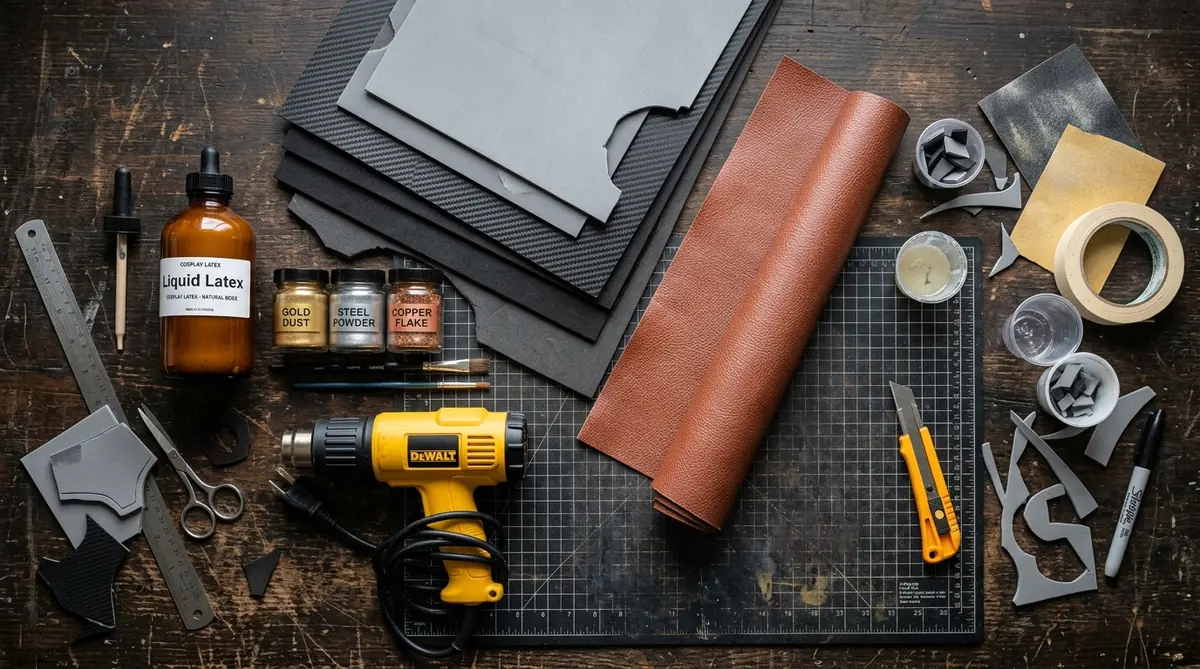
EVA Foam: the base material for every armour build
High-density EVA rubber is the starting point for most cosplays. You cut it with a craft knife, bend it with heat from a heat gun, glue it with contact adhesive, and paint it with acrylics. It's lightweight, affordable, and lets you build large pieces with relative ease.
Not all EVA foam is the same. Cheap sheets from craft stores are soft, deform easily, and can't handle the heat gun without burning. For serious cosplay you need high-density EVA foam (156 kg/m³), which holds its shape, accepts heat-tool texturing, and combines well with thermoplastics.
FRC FOAM by Feroca is the benchmark high-density EVA foam. Available in 2, 5 and 10 mm thicknesses in grey, black and white, it comes in L-size rolled sheets. The 5 mm is the most widely used for armour panels; the 2 mm for details, edges and secondary layers; the 10 mm for bulky pieces like pauldrons or base elements.
EVA AIR Foam Clay: for details the sheet can't deliver
Where EVA sheet reaches its limits — filigree work, gems, horns, joint filling, three-dimensional textures — EVA AIR steps in. It's a mouldable EVA-based foam clay that air-dries in 24–48 hours while retaining a slight flexibility. Once cured it can be sanded, cut with a Dremel, and painted without cracking.
The advantage over other modelling clays is that it adheres directly to EVA sheet and thermoplastics, with no need for special glues or primers. Available in black, grey and white in 300 g containers.
Worbla: the thermoplastic for rigid, detailed pieces
When you need real rigidity — pauldrons, helmets, plate armour — EVA foam alone isn't enough. Worbla thermoplastics activate at 90 °C with hot air, mould over any surface, and harden in minutes while holding their shape with precision.
What makes Worbla unique is its built-in adhesive on the shiny side: heat two pieces and press them together and they bond without any glue. On top of that, leftover offcuts can be reheated and reused — there's no waste.
Worbla's Finest Art (WFA) is the most popular: good rigidity, a slightly rough surface that grips paint well, and a comfortable working activation temperature of 90 °C. Worbla's Black Art has the same properties but in black, without WFA's granular texture — ideal if you want a smoother base finish.
For pieces with heavy relief detail — bracers, sculpted breastplates — the standard technique is to encapsulate EVA foam between two layers of Worbla: the foam provides volume and lightness, while the Worbla provides rigidity and finish.
→ Worbla's Finest Art · Worbla's Black Art
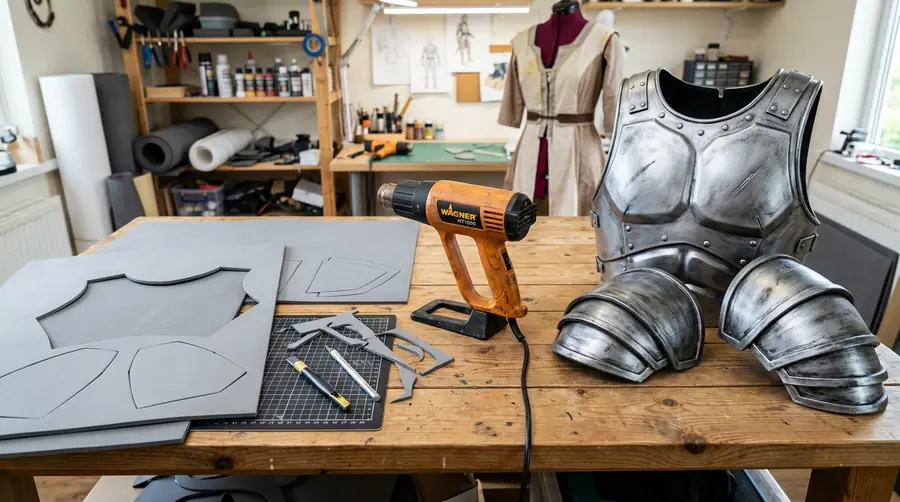
Latex: for masks, creatures and flexible props
Latex is the classic material for cosplay and SFX masks. Applied in layers over a mould, it forms a flexible skin that can be as thin as you need and holds up to continuous use without deforming.
ProMask Látex by Feroca is an air-drying latex formulated specifically for masks. You apply it with a brush over the mould, let each layer dry before adding the next, and the resulting piece captures detail with precision. Available in four colours (natural, white, flesh and black) to make finishing easier with fewer layers of paint.
Latex also works for soft props, flexible horns, claws, and any element that needs to withstand impacts or bend without breaking. To improve its durability against UV light and prolonged use, you can add Permatex to the mix (ratio 100:2).
Silicone for prosthetics and hyper-realistic effects
When cosplay enters special effects territory — face prosthetics, horns adhered to skin, scars, elf ears — platinum silicone is the right material. It has the texture and translucency of real skin, can be pigmented with intrinsic colours, and adheres directly to the face with medical-grade adhesives.
The EasyGel FX family from Feroca offers several hardnesses for different uses:
- EasyGel FX00: the softest, for prosthetics worn directly on skin that need to move with facial expressions.
- EasyGel FX10: medium hardness, the perfect balance between detail and workability for moulds and skin-contact pieces.
- EasyGel FX25: firmer, for pieces that need to hold their shape without support.
For full-body moulds or face lifecasts, KEY-FORM is the benchmark platinum silicone, with a viscosity that captures every skin detail.
→ Silicones for special effects
Alginate: the first step for any body mould
Before moulding in silicone, many cosplayers use alginate to capture the exact shape of body parts. Alginate is skin-safe, cures in minutes, and allows you to make precise moulds of hands, feet, faces or arms to then cast in plaster or silicone.
Alga-Cast from Feroca is formulated for contact with the human body and comes in a fast version (Fast) for smaller areas and a slow version (Slow) for larger body parts where you need more working time.
→ See the full guide: how to make a face mould with alginate
Paints, pigments and finishes
Building the piece is only half the work. The finish determines whether your cosplay looks convention-made or production-made.
Pearl Ex by Jacquard are powder pigments with metallic and pearlescent effects that mix into any acrylic, varnish or resin. They're a favourite among cosplayers and makers for achieving the gold, silver, copper or iridescent finish characteristic of fantasy armour. They're not real metals, so they won't oxidise or fade over time.
For painting directly on latex — without the paint cracking when you bend it — Mask Paint by Monster Makers are concentrated paints specifically formulated for rubber surfaces. They're highly elastic and can be mixed together to create any shade.
Isopropyl alcohol (IPA) deserves a special mention because it's the universal solvent of the cosplay workshop: it cleans surfaces before painting, activates alcohol colours on silicone, thins paints, and is the reagent for Piñata alcohol inks to achieve blotch and gradient effects on masks and armour.
→ Pearl Ex metallic pigments · Isopropyl Alcohol 99.9%
Comparison table: which material to use for each project
| Type of piece | Main material | Complement |
|---|---|---|
| Lightweight, flexible armour | FRC FOAM 5 mm | EVA AIR for details |
| Rigid armour with relief | Worbla over FRC FOAM | Pearl Ex for metallic finish |
| Soft character mask | ProMask Látex | Mask Paint Monster Makers |
| Horns and flexible elements | ProMask Látex or EasyGel FX | Latex pigments |
| Face and skin prosthetics | EasyGel FX00/FX10 | KEY-FORM (mould) + Alga-Cast |
| Small rigid props | Worbla Crystal Art or Deco Art | Acrylics + Pearl Ex |
| Joint filling and textures | EVA AIR Foam Clay | Sandpaper + spray primer |
| Body or face mould | Alga-Cast + plaster | EasyGel FX (final piece) |
Frequently asked questions about cosplay materials
Which foam is better for cosplay, standard or high-density?
For cosplay, always high-density foam. Standard craft foam is too soft, wrinkles under the heat gun, and doesn't take paint well. High-density FRC FOAM (156 kg/m³) holds its shape, handles heat texturing, and gives a clean finish.
Can I use Worbla directly without foam underneath?
Yes, but the result is heavier and you go through material much faster. The standard technique is to use EVA foam as a structural base and encapsulate it with a thin layer of Worbla, which adds rigidity and allows fine details to be captured. This way you get the weight of foam with the rigidity and detail of Worbla.
How many layers of latex do I need for a mask?
It depends on the size and use. For a full-face mask that needs to last, 8 to 12 layers is typical. Each layer must be dry before applying the next. The first thin layers capture the mould's detail; the subsequent ones add body and strength.
What's the difference between alginate and silicone for making a mould?
Alginate is fast, affordable and skin-safe, but the mould only lasts a few hours before shrinking and can't be used for multiple copies. Platinum silicone takes longer and costs more, but the mould lasts for years and allows hundreds of copies. For cosplay use where you need several identical pieces (horns, ears, gems), silicone is the right investment.
Can you paint EVA foam directly without primer?
Technically yes, but without primer acrylic paint tends to peel off with use. The most common approach is to apply a coat of flexible spray primer or seal the surface with a diluted PVA glue mix before painting. This makes the paint last much longer.
Can IPA be used to glue foam pieces together?
No. Isopropyl alcohol cleans and prepares surfaces, but it's not an adhesive. To bond EVA foam to itself or to Worbla, the right product is a contact adhesive such as EVA Contact Pro, or heat in the case of Worbla.
Explore the Feroca Cosplay Shop
If you want to see all cosplay materials in one place, our cosplay shop has them organised by project type: structures, moulds, SFX and finishes.
To get started on a specific project, you also have our step-by-step guides:
Comments (0)