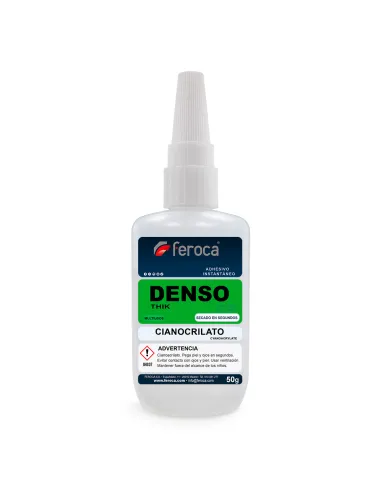
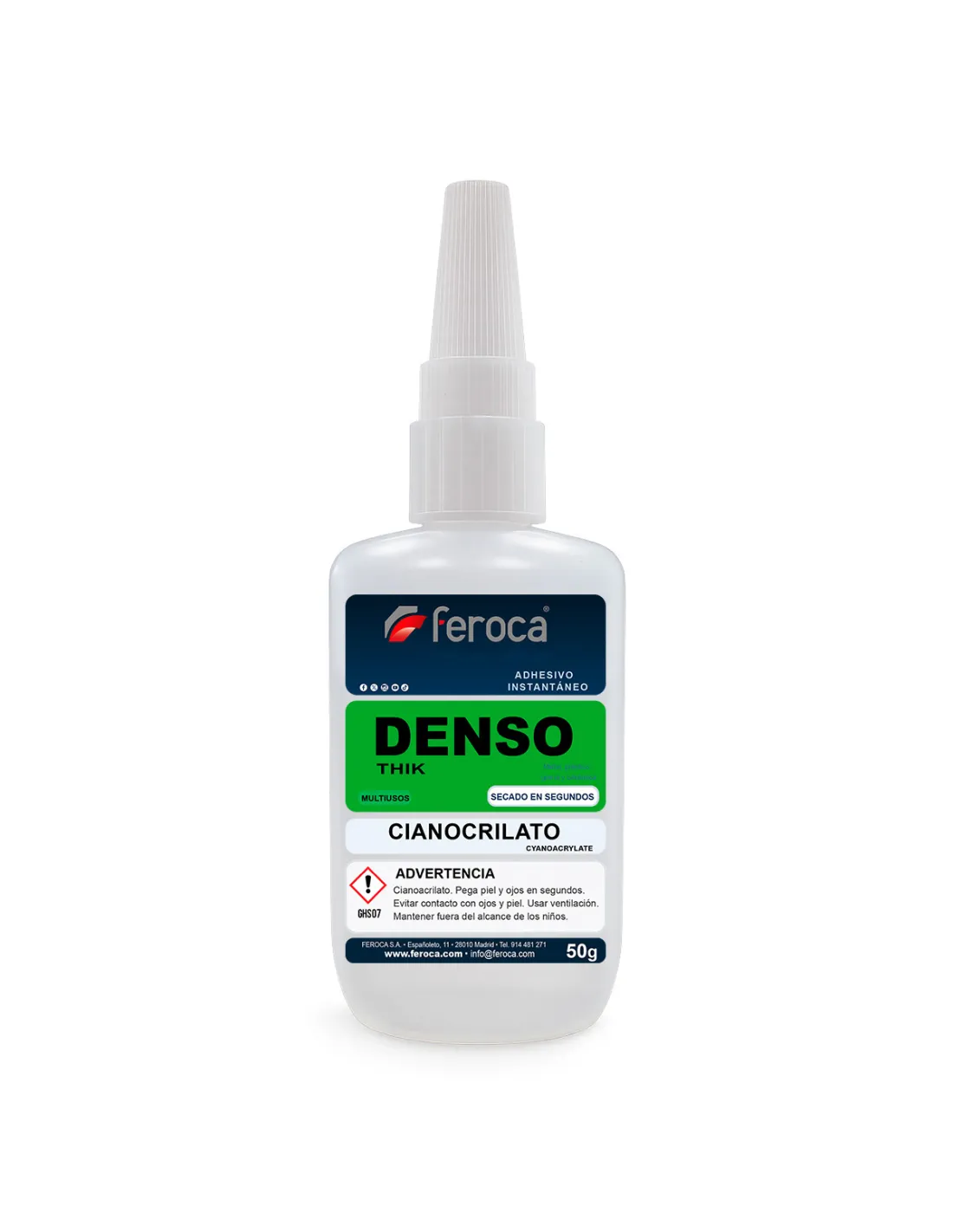
Ciano Denso is a high-viscosity, single-component cyanoacrylate adhesive that cures somewhat slower than standard cyanos. Its density lets you place the drop precisely, control the amount applied, and prevent the adhesive from seeping through pores or joints in the material before setting. Ideal when you need a little more working time without sacrificing the characteristic strength of cyanoacrylate adhesives.
Technical specifications
| Property |
Detail |
| Adhesive type |
Single-component cyanoacrylate |
| Viscosity |
High density (viscous) |
| Cure speed |
Slower than standard or very liquid cyano |
| Solvent content |
None |
| Cure mechanism |
Ambient moisture |
| Presentation |
50 g bottle |
| Compatible materials |
Metals, plastics, glass, ceramics, wood, leather, natural and synthetic rubber |
| Storage |
Cool, dry place away from direct sunlight |
What it's used for
Its high density makes it the cyano of choice when standard application is too fluid or when the substrate is porous or has a gap between parts. It is commonly used in the workshop for:
- Bonding parts with slightly gapped joints where a liquid cyano would run out before setting.
- Fixing porous materials such as wood, rigid foam or ceramics without the adhesive being over-absorbed.
- Joining components in special effects, prosthetics and character work where precise adhesive placement is needed.
- Repairing leather, rubber or gum in prop, costume or footwear items.
- Scale modelling and prototyping work where complex-geometry parts need to be bonded with adjustment time.
- Bonding acrylic, ABS, nylon and other engineering plastics in fabrication or composites workshops.
- Fixing metal or ceramic inserts onto non-metallic substrates without uncontrolled adhesive flow.
How to use it
- Clean and degrease both surfaces to be joined. Surfaces must be free of dust, oil and excessive surface moisture.
- Dry thoroughly before applying; ambient moisture activates the cure, but excess moisture on the substrate can create a white film.
- Open the bottle by removing the cap. If the nozzle is blocked, use a fine needle to clear it.
- Apply a small amount to one of the surfaces. With Ciano Denso the drop stays in place, giving you time to position the part.
- Bring both surfaces together and press firmly for 20–60 seconds depending on the porosity of the material and ambient conditions.
- If you need to speed up setting, apply Spray Acelerador de Ciano to the joint once the parts are in place.
- Allow to cure fully before subjecting the bond to mechanical stress. Full cure may take several hours depending on adhesive layer thickness and ambient humidity.
- Close the bottle immediately after use to preserve the product.
Caution: Cyanoacrylate bonds skin instantly. If skin contact occurs, do not try to pull fingers apart by force. Wash the area repeatedly with warm water until the bond releases. Work in a ventilated area: cyanoacrylate vapours are irritating to eyes and mucous membranes. Avoid eye contact. Keep out of reach of children.
Usage tips
Choose the right viscosity for the joint
Feroca offers three cyano viscosities: Ciano muy Líquido, Ciano Normal and this Ciano Denso. Use the dense version when parts do not fit perfectly or when the material is porous. If the surfaces fit perfectly and are smooth, the very liquid version penetrates better by capillary action and gives a stronger bond.
Storage and preservation
Store the bottle upright, tightly closed, in a cool place (between 5 and 20 °C), dry and away from direct sunlight. Avoid leaving it near heat sources. Properly stored, the product retains its properties for months. If the cyano has thickened excessively inside the bottle, it is no longer recoverable: do not add solvents.
How to avoid white film (hazing)
Cyanoacrylate vapours can leave a white residue on dark or glossy surfaces near the work area. To minimise this: apply the minimum amount necessary, work in ventilated spaces and use the Spray Acelerador de Ciano sparingly (excess also causes hazing). If the surface finish is critical, protect adjacent areas with masking tape before bonding.
Frequently asked questions
What is the difference between a thick and a liquid cyano?
Viscosity determines how the adhesive flows and how quickly it cures. Ciano Denso has higher viscosity: the drop does not flow or seep, allowing you to work with gaps or porous surfaces. Ciano muy Líquido penetrates by capillary action into tight joints and cures faster. For flat, well-fitting surfaces, use the liquid; for gapped joints or porous materials, use the dense.
Can I use this adhesive to bond foam?
Yes, with caution. Cyanoacrylate can react with certain polyurethane foams, generating heat or causing the cell structure to collapse. Always do a test on a hidden area before applying to the final piece. For flexible foams or large surfaces, a contact adhesive such as EVA Contact Pro may be a more suitable option.
How long does it take to fully cure?
The initial grip of Ciano Denso is achieved in 20–60 seconds under pressure. However, maximum mechanical strength is reached after several hours of full cure, depending on the thickness of the adhesive layer, the type of material and the ambient humidity. If you need to speed up the process, use the Spray Acelerador de Ciano.
How can a cyanoacrylate bond be undone?
Acetone (oil-free nail polish remover) is the most common solvent for softening cyanoacrylate bonds. Apply with a cotton bud or brush to the joint and wait a few minutes before attempting to separate the parts. Bear in mind that acetone can damage certain plastics, paints and surface finishes, so assess the substrate before applying it.
Can it be used on flexible materials or in vibrating applications?
Standard cyanoacrylates are rigid once cured and can crack under continuous flexion or vibration. For applications where the bond must withstand movement or impact, consider PERMABOND 2050 Ciano Semi-Flexible, which offers greater elasticity while retaining the fast cure speed of cyanoacrylate.
How much adhesive should I apply?
With cyanoacrylate adhesives, less is more. A thin layer is enough: applying too much slows curing, reduces bond strength and increases the risk of staining the part or adhesive overflow. One or two drops are usually sufficient for contact surfaces of a few square centimetres.
The adhesive has bonded my fingers — what do I do?
Do not try to pull your fingers apart by force, as you could injure your skin. Wash the area with plenty of warm water and soap, rubbing gently for several minutes. The bond releases gradually with moisture. Acetone also helps dissolve the adhesive on skin, but is irritating if used in excess. If the bond persists or there is pain, consult a doctor.
How do I keep the bottle so it lasts longer?
Close the bottle immediately after each use, without leaving the cap off between applications. Store it upright in a cool, dry place away from sunlight. If the nozzle becomes blocked between uses, you can try clearing it with a fine needle. Never store the bottle in the freezer: condensation when taking it out will accelerate curing inside the container.