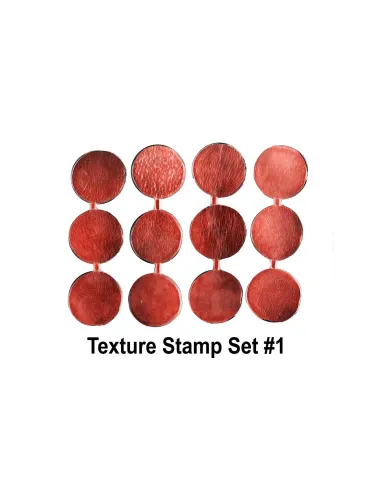
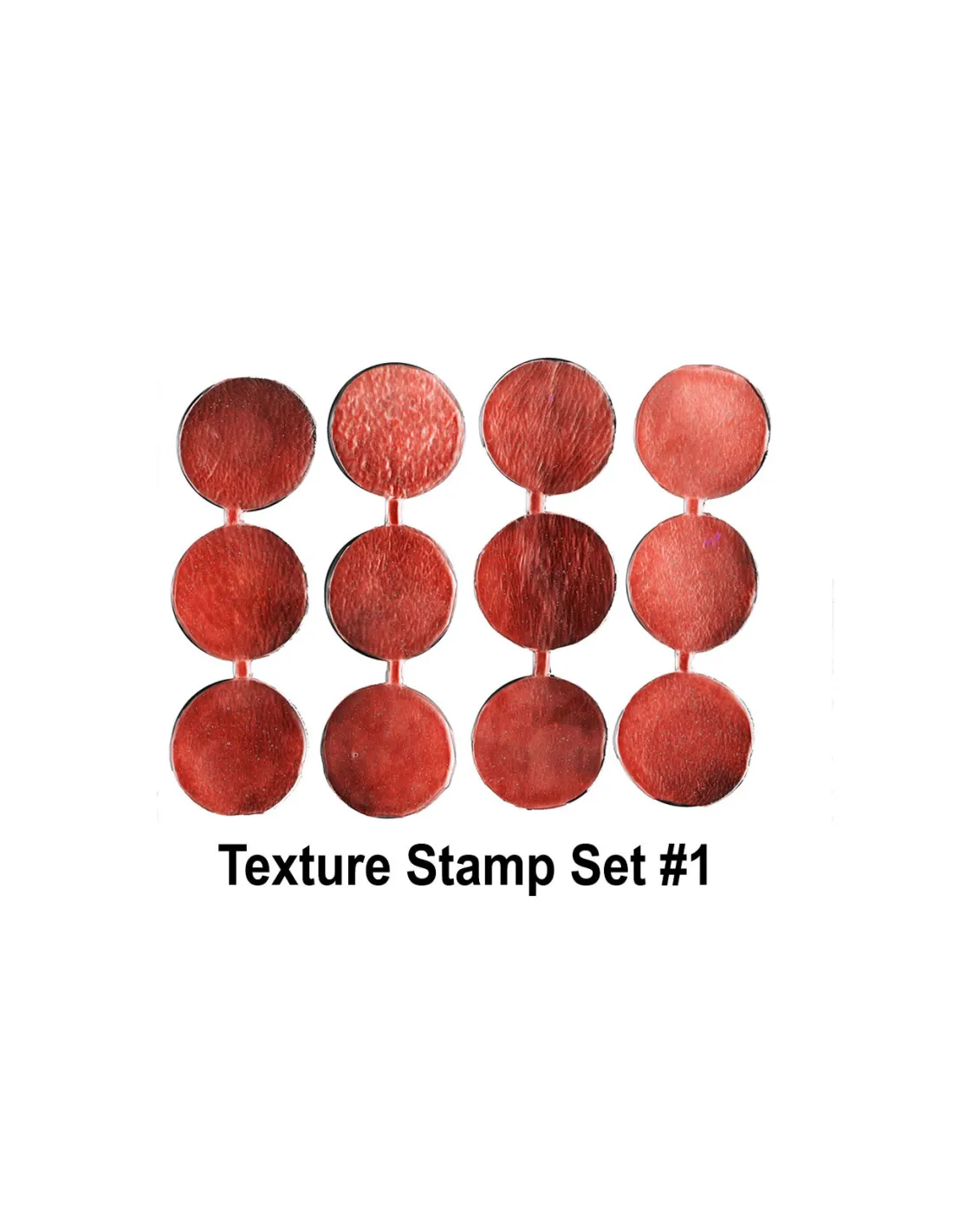
The Monster Makers Texture Stamps are texture stamps made from high-resistance urethane rubber, designed to print realistic skin textures onto professional plastilines and clays during the detailing process. Available in three sets of 12 stamps each, they cover everything from fine human skin textures to reptilian and alien surfaces, and clean up in seconds. Choose the set that best suits your project from the dropdown menu.
Technical specifications
| Feature |
Detail |
| Manufacturer |
Monster Makers |
| Material |
High-quality urethane rubber |
| Units per set |
12 texture stamps |
| Available sets |
Set #1 (human skins, coarse to fine), Set #2 (creature skins), Set #3 (reptilian and alien skins) |
| Compatibility |
Professional plastiline, clay, polymer clay |
| Cleaning |
Very easy, no solvents required |
| Price |
Per set (one set per unit) |
What they are used for
These stamps are an essential tool in the final detailing phase of any sculpture. They allow complex skin patterns to be transferred quickly and consistently — something practically impossible to reproduce by hand with conventional tools. They are commonly used in special effects, animatronics, theatrical and film character makeup, puppet making, and artistic sculpture.
- Texturing human skin on busts and figures for special effects
- Creating creature, monster, and fantasy character skins
- Reptilian and alien textures for science fiction and fantasy projects
- Final detailing of sculptures on Monster Clay Medium or Monster Clay Gray Medium
- Application on polymer clay before baking
- Rapid character prototyping for audiovisual production
- Use in prosthetic makeup and character design workshops
How to use
- Prepare the surface of your sculpture in professional plastiline or clay, making sure it is smooth and at working temperature.
- Slightly warm the area to be textured if the plastiline is too cold and stiff — the material should yield when pressed without cracking.
- Select the appropriate texture stamp according to the skin thickness you are looking for: the stamps are ordered from coarsest to finest within each set.
- Press the stamp firmly and evenly onto the surface, avoiding rotations or sliding that would distort the pattern.
- Lift the stamp straight up, without pulling it to the sides.
- Repeat the process slightly overlapping the edges of the previous area to create a continuous texture with no visible seams. Use sculpting tools to touch up transitions if necessary.
- Clean the stamp with a dry or slightly damp cloth between applications to maintain the sharpness of the pattern.
Usage tips
Working temperature of the plastiline
Temperature is the most critical factor for achieving a good impression. If the plastiline is too cold, the stamp will not penetrate properly and the result will be superficial. If it is too soft, the pattern will distort when the stamp is lifted. Ideally, work with the plastiline at workshop room temperature (between 18 and 22 °C) and, if you need to soften it locally, apply gentle heat with a hair dryer at a distance for a few seconds before stamping.
Combining sets for greater realism
The three sets are designed to complement each other. On a single sculpture you can combine textures from Set #1 for more visible human skin areas (forehead, cheeks), textures from Set #2 for creatures or transition zones, and the reptilian textures from Set #3 for fantasy or science fiction characters. Overlapping texture scales in different areas is the key to achieving a result that does not look repetitive.
Blending seams between impressions
The usual weak point when using texture stamps is the seams between consecutive impressions. To disguise them, always overlap 20–30% of the stamp area relative to the previous impression and use fine-tipped sculpting tools to manually touch up any visible join lines. You can also apply very gentle, localised heat to the seam to soften it before stamping over it again.
Frequently asked questions
What modelling materials do these texture stamps work on?
The Monster Makers Texture Stamps work primarily on professional plastilines (such as Monster Clay in any of its hardnesses) and clays in general. They can also be used on unbaked polymer clay. They are not designed for rigid, already-cured surfaces or fluid resins.
Which set is best to start with?
Set #1 is the natural starting point: it includes 12 human skin textures ordered from coarsest to finest, allowing you to understand the scale and practise the stamping technique before moving on to the creature or reptilian sets. If your project is directly fantasy or science fiction, Set #3 with alien and reptilian textures may be more useful right from the start.
Can the stamp be used on hard or industrial plastiline?
Yes, but it requires more pressure or slight pre-warming of the area to be textured. Vegetable-based industrial plastiline can be more resistant at first, though it softens with body heat and ambient warmth. On high-hardness plastilines, locally warm the surface before applying the stamp to obtain a sharp impression without excessive effort.
How are the stamps cleaned between uses?
Cleaning is very straightforward. In most cases a dry cloth is sufficient to remove plastiline residue. If there are more stubborn deposits, a cloth slightly dampened with water or isopropyl alcohol is enough. No aggressive solvents are needed, which extends the service life of the urethane rubber.
Is it possible to combine stamps from different sets on the same sculpture?
Yes, and in fact it is the recommended way to work for more natural results. Combining texture scales from different sets in different areas of the same piece breaks up visual monotony and adds credibility to the sculpture. All three sets are designed with that compatibility in mind.
How long do these stamps last with frequent workshop use?
The urethane rubber used to make the Texture Stamps is a highly resistant, long-lasting material. With proper use and cleaning, the stamps maintain the sharpness of the pattern for years of continuous use in a professional workshop.
Do they also work on polymer clay?
Yes. The stamps work perfectly on unbaked polymer clay. The technique is identical: press firmly and lift straight up. Once the texture has been applied, proceed to baking following the clay manufacturer's instructions.
Does the price include all three sets or just one?
The price corresponds to a single set of 12 stamps. Select the set you need (Set #1, #2 or #3) from the product dropdown menu. If you need all three, you must add them to the cart separately.