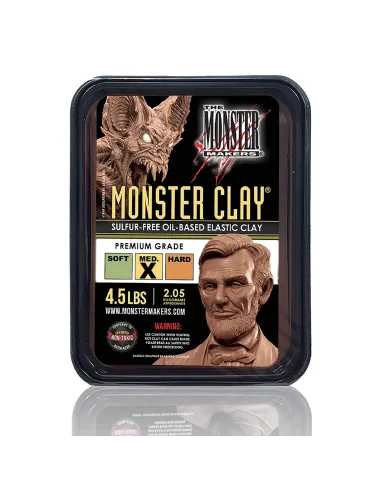
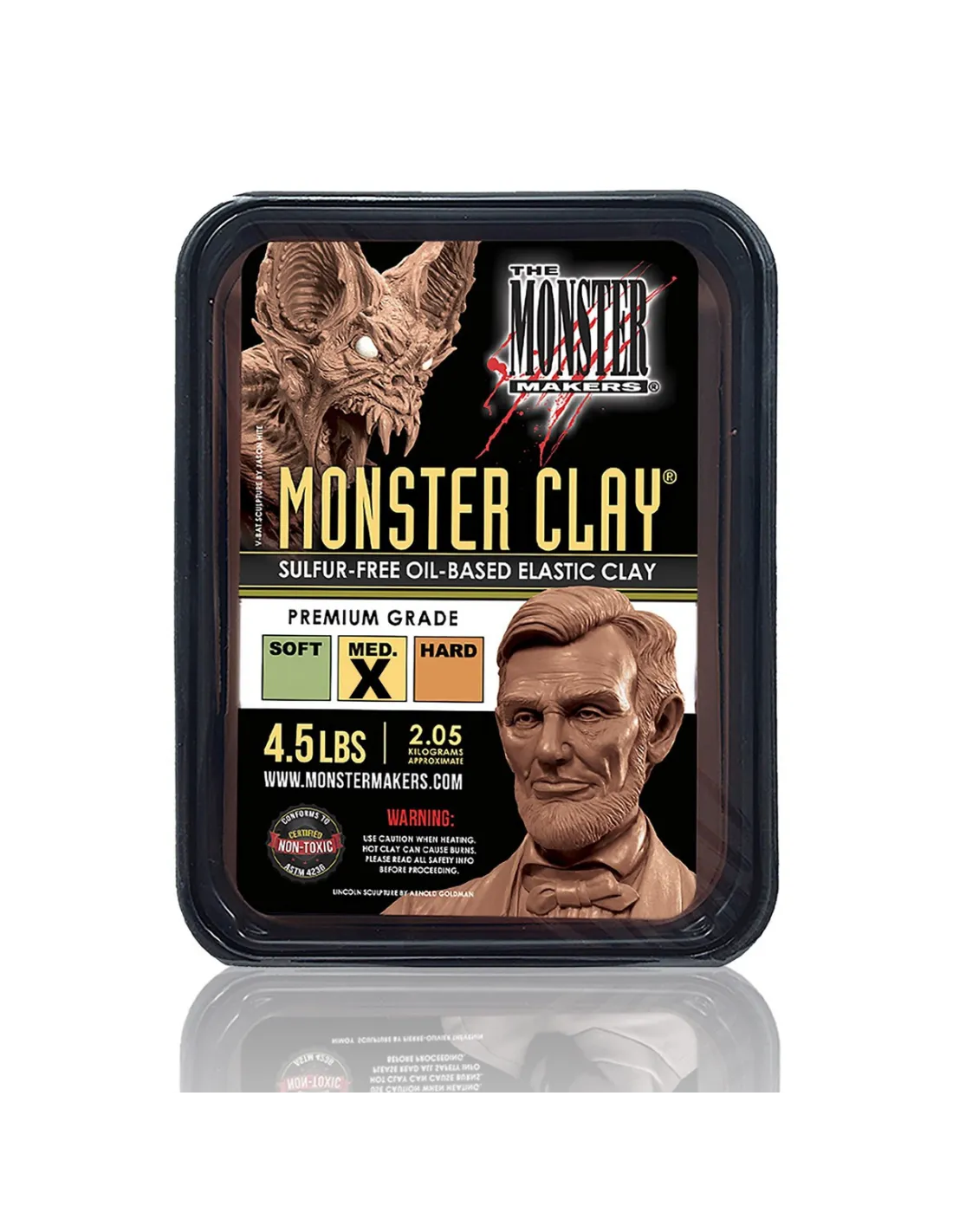
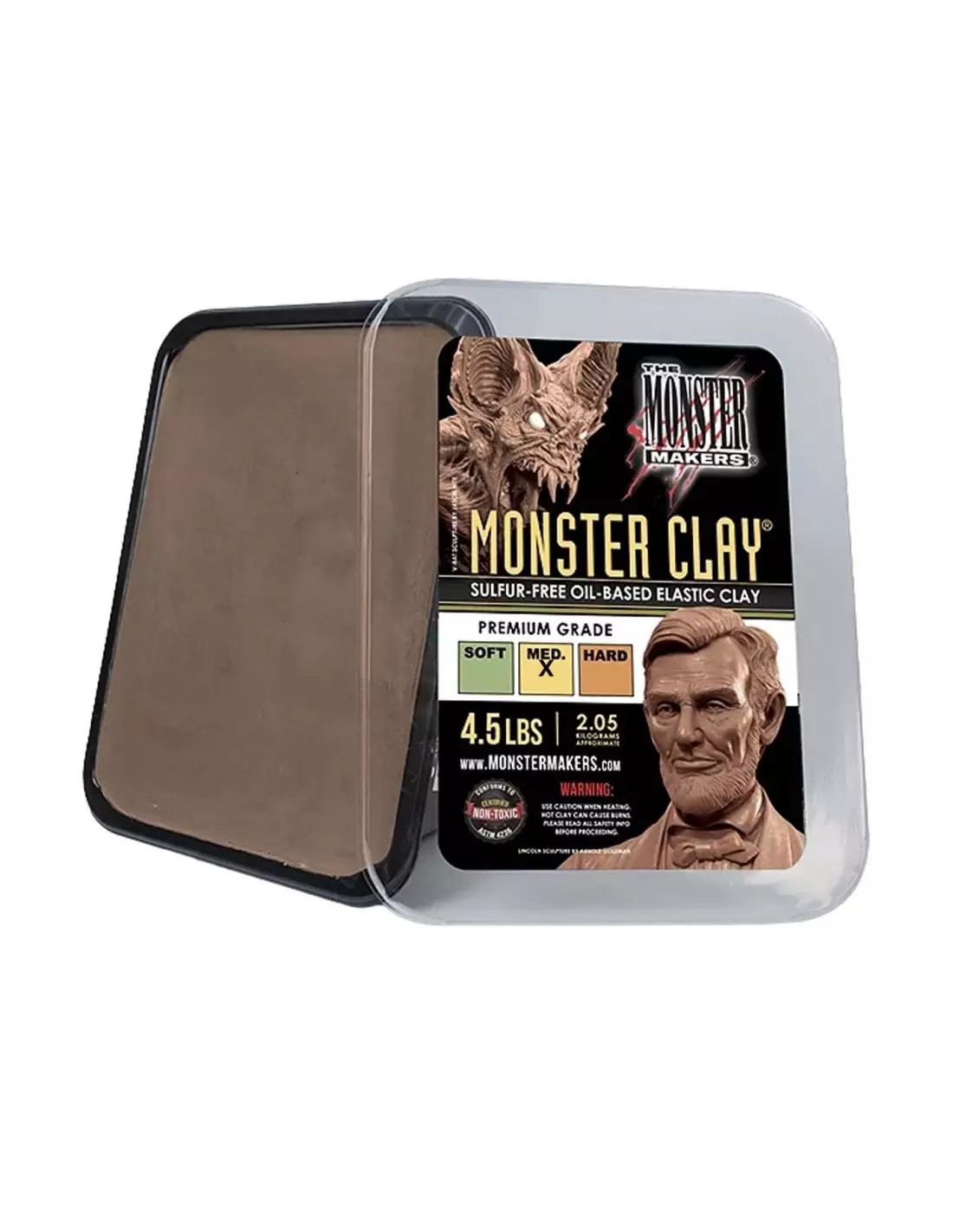
Monster Clay Medium is a professional-grade modelling clay of medium hardness, formulated with non-toxic, food-safe ingredients, sulfur-free and fully reusable. Its oil-water base gives it exceptional plasticity at room temperature and makes it fully compatible with platinum silicones, making it the go-to choice for sculptors, special effects artists and Life Casting professionals who need a reliable material from initial sketch to final mould.
Technical specifications
| Property |
Detail |
| Hardness |
Medium |
| Weight per container |
2.05 kg (4.5 lb) |
| Base |
Oil-water |
| Sulfur content |
Sulfur-free |
| Toxicity |
Non-toxic, food-safe components |
| Reusable |
Yes, indefinitely |
| Microwave-safe container |
Yes |
| Maximum oven temperature for container |
250 ºC |
| Platinum silicone compatibility |
Yes |
| State at room temperature |
Firm solid, suitable for fine detail |
| State when heated |
Pourable melt, texture similar to soft caramel |
What it's used for
Monster Clay Medium is designed for professionals and advanced hobbyists who need a versatile modelling material: firm enough at room temperature to capture fine details with tools, and fluid enough when heated to fill, correct or reuse without waste. The medium hardness balances the resistance needed for large-volume pieces with the malleability required for detail work.
- Sculpting maquettes, characters and creatures for special effects and film
- Modelling busts, heads and full-body figures
- Creating originals for mould-making with platinum silicone
- Prototyping FX prosthetics and special makeup pieces
- Life Casting and preparation of anatomical positives
- Texturing and correcting models before moulding
- Building cores and fills over anatomical armatures
- Conceptual modelling in industrial design, jewellery and animation
How to use it
- Material preparation: at room temperature Monster Clay Medium is already workable. If it is very cold or you need to soften it quickly, heat the container in the microwave in short 10–15 second intervals until you reach the desired consistency.
- Building the base volume: work the clay with your hands or over an anatomical armature to build up the main masses of the sculpture. Apply successive layers pressing firmly to avoid internal air bubbles.
- Detail modelling: use modelling tools, double-ended ball-tip tools or the 11-piece modelling tool set to carve, smooth and texture the surface.
- Melting for corrections: if you need to fill gaps or reuse leftover material, melt the clay by heating it until liquid and pour it directly onto the area to be corrected. Allow to cool before retouching.
- Surface smoothing: gently run your finger or a slightly warmed metal tool over the surface to remove tool marks and achieve smooth transitions.
- Mould preparation: make sure the sculpture is completely cool and at room temperature before applying silicone. Being sulfur-free, no prior sealer is needed when using platinum silicone.
- Material recovery: after demoulding, remove any Monster Clay residue from the piece and the mould. You can melt it again and store it in the same container for the next project.
Tips and tricks
Temperature control for each stage of work
Temperature is the main variable that controls the hardness of Monster Clay Medium. At room temperature (18–22 ºC) it is firm and retains detail; between 25 and 35 ºC it becomes soft and very malleable by hand; above 60–70 ºC it melts completely. In summer or in warm workshops, keep the piece away from direct heat sources while working on fine detail. In winter, a brief burst of heat from a heat gun or hair dryer on a low setting is enough to soften specific areas without melting the entire sculpture.
Tools and finishing techniques
Clean, slightly warmed metal tools glide better over Monster Clay than plastic ones. For skin textures or organic surfaces, press texture stamps while the clay is slightly warm. If you need a smoother finish before moulding, a clean microfibre cloth passed gently over the surface removes the last tool marks. Avoid mixing Monster Clay Medium with other mineral-oil-based clays without first checking compatibility, as they may alter the overall firmness.
Storage and reuse
Monster Clay does not dry out or permanently harden: you can store it in its original closed container for years without it losing its properties. If material collected after a project contains small impurities (dust, mould residue), melt it, filter it through a fine mesh and pour it back into the container. Avoid contaminating your stock with materials containing sulfur or latex, as these could transfer to future sculptures intended for platinum silicone moulds.
Frequently asked questions
What is the difference between the medium, soft and hard versions of this clay?
Hardness determines how much detail you can capture and how much resistance the finished piece offers. The Medium version is the most versatile: firm enough for fine detail with tools, yet workable with the heat of your hands. Softer versions are quicker to work with on large pieces; harder versions allow sharp edges and very fine detail with less risk of accidental deformation. For beginners, Medium is the most balanced option.
Can I mould directly with platinum silicone over this clay without a sealer?
Yes. Monster Clay Medium is formulated without sulfur, which is the primary inhibitor of addition-cure (platinum) silicones. You can apply platinum silicone directly onto the sculpture without any prior sealer, as long as the surface has not come into contact with other inhibiting materials such as latex, fresh epoxy, uncured urethane rubbers or sulfur-containing clays.
How do you heat it correctly to soften or melt it?
The most convenient method is the microwave: heat the container in 10–15 second intervals at medium power, checking consistency between each interval. You can also use a conventional oven at a low temperature (the container withstands up to 250 ºC, although you do not need to exceed 80–100 ºC to melt the clay). To soften only a specific area of the sculpture, a hair dryer or heat gun on a low setting is sufficient.
Is it suitable for making moulds of body parts (Life Casting)?
Monster Clay Medium is not applied directly to the skin for Life Casting, as it is a modelling material, not an impression material. Its role in Life Casting is the creation of the model or prosthetic that will be moulded afterwards. For direct skin casting, other specific materials such as alginate or skin-safe platinum silicones are used.
Can the finished sculpture be painted or have finishes applied to it?
Yes, Monster Clay Medium accepts acrylic paints, lacquers and water-based sprays for photographing or presenting the sculpture. Bear in mind that it is a thermoplastic material: if exposed to heat (intense direct sunlight, studio lights for extended periods), it may soften. For long-term display or final pieces, the recommended approach is to take a mould and produce a copy in resin or silicone.
How much material do I need to sculpt a life-size head?
For a life-size head over an armature, with an average wall thickness of 2–3 cm, one 2.05 kg container is usually sufficient if you use the appropriate armature to fill the interior volume. If the head includes the neck and part of the bust, or if you are sculpting solid without an armature, you will need two containers. Using a fillable anatomical armature significantly reduces the amount of clay needed.
Is the material reusable indefinitely?
Yes. Monster Clay does not cure or polymerise: it hardens when cooled and melts when heated in a reversible process. You can melt, model, melt again and re-model as many times as you need without the material losing its properties. This is one of its main advantages over non-thermoplastic modelling materials.
How do I clean tools and hands after working with it?
Tools are easily cleaned by warming the residue with a warm cloth or a little heat until the clay softens and can be wiped off with a chamois. For hands, Isopropyl Myristate is very effective at dissolving oily residue before washing with soap and water.