Shopping Cart


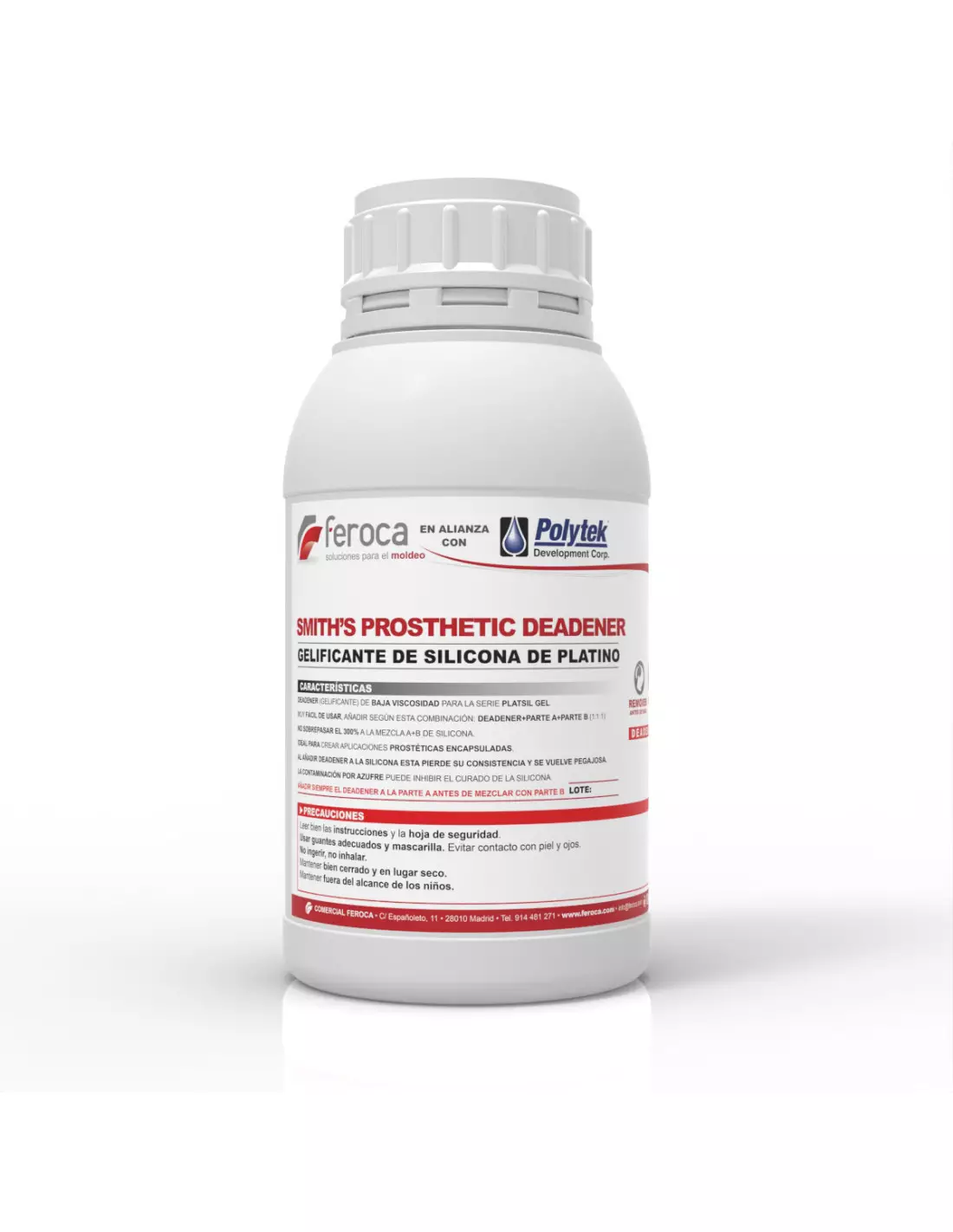
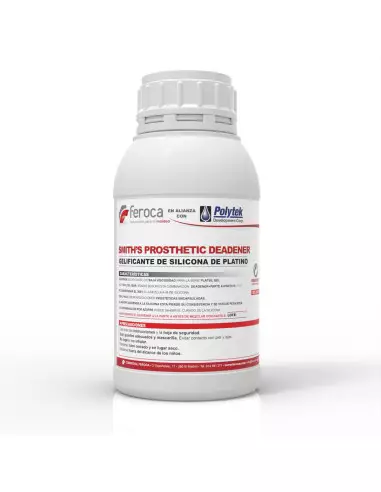
Smith's Prosthetic Deadener -Silicone Gelling Agent-
590105500
€31.35
37,93 € Tax incl.
37,93 € Tax incl.
Deadener for PlatSil Gel platinum silicones. Softens and provides gel consistency for prosthetics and animatronics.
Smith's Prosthetic Deadener is the reference deadener for PlatSil Gel range platinum silicones. By adding it in different proportions you obtain materials ranging from soft skin for animatronics to the encapsulated gel required in special effects prosthetics. It is the industry standard in character makeup and special effects studios for its predictable behaviour and direct compatibility with PlatSil silicones.
Technical specifications
| Property | Detail |
|---|---|
| Type | Deadener for platinum silicone |
| Compatibility | Platinum (addition cure) silicones, especially PlatSil Gel range |
| Base ratio (animatronic skin) | 100% by weight relative to the A+B mix |
| Base ratio (encapsulated prosthetics) | 180–200% by weight relative to the A+B mix |
| Standard indicative ratio | 50% by weight (Deadener:Part A:Part B = 1:1:1) |
| Mixing order | Always add to Part A before incorporating Part B |
| Effect on silicone | Reduces hardness, increases flexibility and rubbery feel |
What it is used for
Smith's Prosthetic Deadener is always used in combination with platinum silicones to modify their final hardness and obtain gel materials with an organic look and feel. It is indispensable in character makeup and special effects prosthetics workflows.
- Manufacturing encapsulated prosthetics for film, television and theatre
- Creating soft skins for animatronics and mechanical puppets
- Producing silicone gels for realistic skin effects
- Making facial character pieces (noses, ears, scars, wounds)
- Prototypes and tactile-effect parts in product design
- Soft tissue simulation in medical training models
How to use it
- Prepare the mould by applying a suitable release agent, such as Ferosil V 32, and allow it to evaporate completely before pouring.
- Determine the Deadener ratio according to the desired result: 50% for a standard mix (Deadener:Part A:Part B = 1:1:1), 100% for animatronic skin, 180–200% for encapsulated prosthetics gel.
- Weigh the Deadener and add it to Part A of the PlatSil silicone. Mix thoroughly until completely homogeneous before proceeding.
- Add Part B in the ratio indicated by the base silicone and mix with slow movements to avoid incorporating bubbles.
- If you need to increase viscosity without losing softness, you can add a few drops of Thixo Additive to the mix.
- Pour or apply the mix into the mould. For encapsulated prosthetics, apply a thin layer of the gel over the mould previously coated with an encapsulating material (plastic bald cap).
- Allow to cure at room temperature for the time indicated by the base silicone. The Deadener does not alter the cure time.
- Demould carefully, as the higher the Deadener ratio the more fragile and tacky the resulting material will be.
Important notice — Platinum silicone inhibition: Smith's Prosthetic Deadener is used with platinum (addition cure) silicones, which are sensitive to inhibition. Contact with sulphur, tin, sulphur-based clays, latex, cyanoacrylate adhesives, latex gloves or certain polyurethane materials can prevent full or partial curing of the silicone, leaving the surface permanently tacky. Ensure that all materials, moulds and surfaces in contact with the mix are compatible before you begin. Always perform a small-scale test if you have any doubts about the compatibility of a material.
Usage tips
Control the ratio to fine-tune final hardness
There is no single correct formula: each application requires a different level of softness. Start with a low ratio (50%) and increase in test batches until you find the exact point you need. Always record the exact weights of each component so you can reproduce the result across long productions.
Mixing order is critical
Always incorporate the Deadener into Part A before adding Part B. If you add it after mixing A+B, the cure may be affected and the result will be inconsistent. This sequence ensures homogeneous dispersion of the gelling agent throughout the silicone mass.
Manage tackiness in encapsulated prosthetics
At high Deadener ratios (180–200%), the resulting gel is very soft and tacky to the touch, making direct use without encapsulation impractical. For prosthetics, first apply a layer of encapsulating material (plastic bald cap) in the mould before pouring the gel. This creates a smooth outer layer that allows the piece to be handled and applied to the actor's skin. If you need to speed up cure time in productions with tight deadlines, you can consider using Curing Agent 81 VF following the base silicone manufacturer's instructions.
Frequently asked questions
Does the deadener alter the cure time of the silicone?
No. Smith's Prosthetic Deadener does not modify the cure time of the base platinum silicone. The curing process remains the same as indicated by the silicone manufacturer. What does change is the hardness and texture of the material once cured.
Can I use this product with any platinum silicone?
Smith's Prosthetic Deadener is specifically formulated for platinum (addition cure) silicones, and its compatibility is optimised for the PlatSil Gel range. Although it may be compatible with other platinum silicones, it is always advisable to carry out a small-scale test before using it in production with a silicone other than the one indicated.
In what order should I mix the components?
You must always add the Deadener to Part A of the silicone and mix well before incorporating Part B. This order is critical to ensure homogeneous curing and a consistent result. Reversing the order can lead to poor or uneven curing.
What ratio should I use for an encapsulated prosthetic?
For encapsulated special effects prosthetics, ratios of between 180% and 200% Deadener relative to the total weight of the silicone A+B mix are typically used. At these ratios the resulting gel is very soft and requires encapsulation to be handled and applied to skin.
Why does the silicone feel tacky after adding the deadener?
This is completely normal behaviour. The higher the Deadener ratio, the more the resulting material loses structural consistency and presents a tacky feel. This does not indicate a curing problem, but rather the nature of silicone gel. For applications where the final surface must be smooth, the gel must be encapsulated during the moulding process.
Can I add pigments or colorants to the resulting gel?
Yes. You can add pigments compatible with platinum silicones to the mix. Incorporate them together with the Deadener into Part A to facilitate homogeneous dispersion before adding Part B. Use only pigments formulated for platinum silicones to avoid inhibition issues.
How can I prevent the platinum silicone from failing to cure due to inhibition?
Make sure that all materials in contact with the mix (moulds, tools, gloves, surfaces) are free from sulphur, tin, latex and other inhibiting agents. Use nitrile gloves instead of latex, and always apply a compatible release agent to the mould. If in any doubt about a new material, carry out a small compatibility test before using it in production.
Can the viscosity of the gel be increased without losing softness?
Yes. You can add a thixotropic additive to the mix to increase its viscosity and facilitate application on vertical surfaces or detailed areas without the material running. The thixotropic additive does not modify the cure time or the final softness of the gel.
No reviews
Tap to zoom