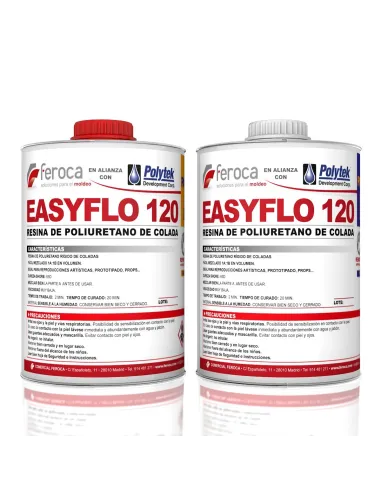
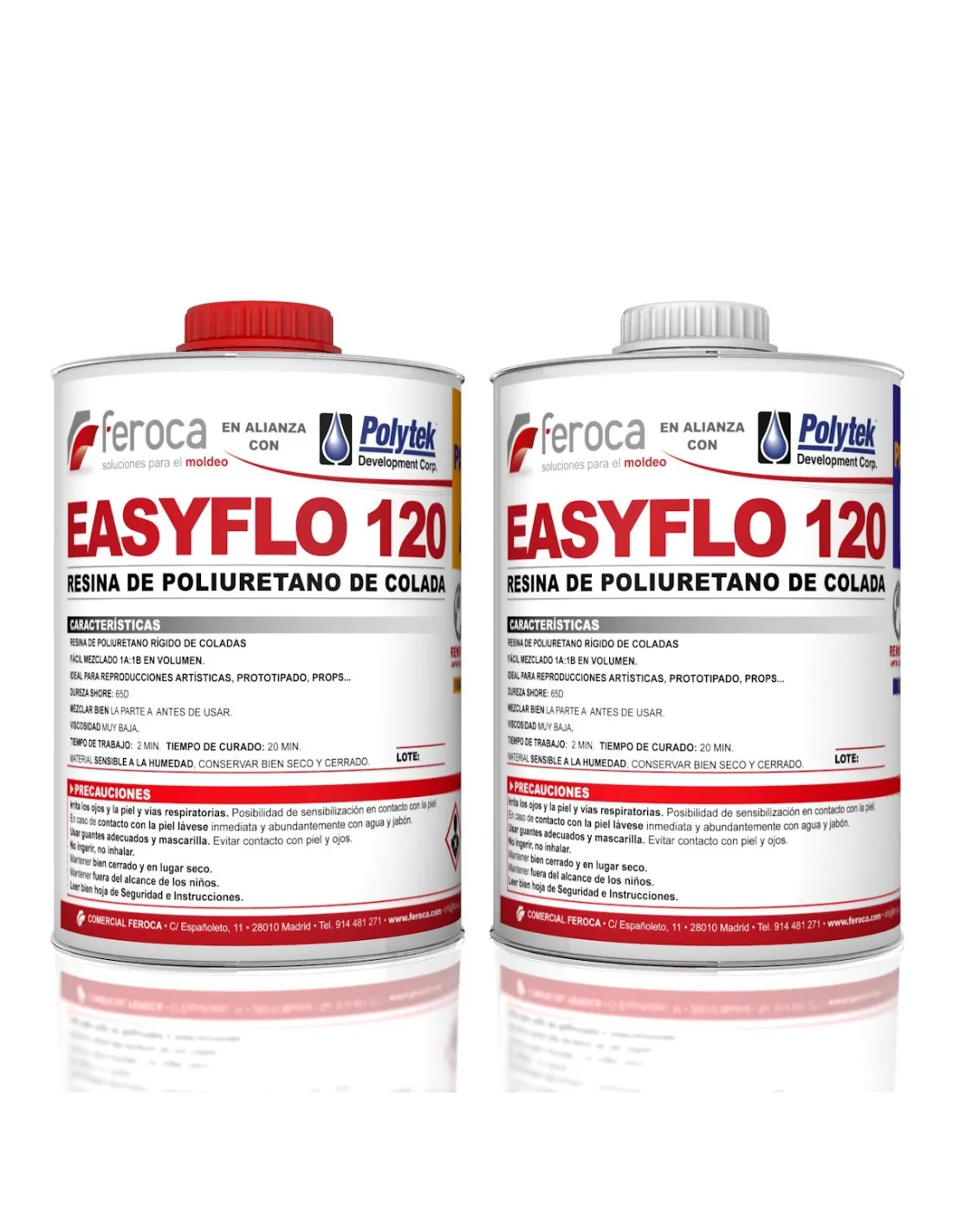
EasyFlo 120 is a low-viscosity (120 cP) semi-rigid polyurethane resin specifically designed for rotocasting processes, though it works equally well for direct casting. Its gradual cure and 1:1 by volume mix ratio make it one of the most user-friendly resins on the market for producing lightweight, impact-resistant parts with excellent detail reproduction.
Technical specifications
| Parameter |
Value |
| Type |
Semi-rigid polyurethane resin |
| Application |
Rotocasting / casting |
| Mix ratio by volume |
1A : 1B |
| Mix ratio by weight |
100A : 90B |
| Mixed viscosity |
120 cP |
| Pot life |
2.5 min |
| Cure time |
15-30 min* |
| Shore Hardness |
65D |
| Colour |
White |
| Exothermic peak |
93 °C |
| Shrinkage |
0.0065 % |
* Cure time depends on the cast mass and ambient temperature.
What it is used for
Thanks to its gradual cure and low viscosity, EasyFlo 120 is especially useful when you need hollow parts with uniform wall thickness or semi-rigid reproductions that must absorb impacts without fracturing. It is the preferred choice in special effects workshops, prop fabrication and rapid prototyping.
- Rotocasting of helmets, armour and hollow parts for cosplay and special effects
- Props and replicas for set design and film
- Semi-rigid functional prototypes
- Mechanism parts with abrasion resistance
- Casting patterns
- Bearing linings and anti-vibration pads
- Stamping parts and technical footwear
- Decorative figures and sculpture reproductions
How to use it
- Prepare the mould: make sure the mould is clean, dry and properly treated with a release agent. Silicone moulds generally do not require release agent, but it is essential for rigid moulds.
- Condition the components: bring both parts (A and B) to workshop temperature (20-25 °C). Shake component B well before use to homogenise any settled pigment.
- Measure accurately: weigh or measure the correct proportions by volume — 1:1 by volume or 100A:90B by weight. Use separate, clean containers for each part.
- Mix for 20-30 seconds: pour component B into A and mix with slow movements, scraping the sides of the container. Avoid incorporating air. If you want to pigment the resin, add the PolyColor Dyes at this stage.
- Pour or begin rotocasting: for direct casting, pour in a thin stream to reduce bubbles. For rotocasting, close the mould and begin gentle rotation immediately after pouring, distributing the mix across the inner walls before it gels.
- Keep moving until gel: in rotocasting, continue rotating until the resin stops flowing (approximately 2-3 min). After that, keep the mould closed until fully cured.
- Demould at 15-30 minutes: the part can be demoulded once the primary cure is complete. For optimal mechanical properties, allow the part to rest for 24 hours at room temperature before putting it under load.
Warning: EasyFlo 120 is a polyurethane resin. Curing can be inhibited or altered in the presence of high humidity, wet moulds or moulds contaminated with water. Always store components with lids tightly closed and in a dry place. The exothermic peak can reach 93 °C in large masses — avoid casting large volumes in closed moulds or moulds with low thermal resistance. Work in a ventilated area and use gloves and safety glasses when handling.
Usage tips
Controlling wall thickness in rotocasting
The key to rotocasting with EasyFlo 120 is consistent movement. Rotate the mould on all axes to achieve uniform distribution. If the wall comes out uneven, try slightly lowering the workshop temperature (cooler environments extend gel time slightly) or rotate more slowly so the resin flows better before curing.
Pigmentation and finishing
EasyFlo 120 is fully compatible with PolyColor Dyes, specifically formulated for polyurethane. Always add them to component A before mixing with B, and do not exceed 3-5% by weight to avoid affecting the cure. The cured part can be painted, sanded and bonded without any issues.
Moisture: the enemy of polyurethane
Polyurethane reacts with ambient moisture and generates CO2, which results in microbubbles and a porous surface. On humid days, work indoors, close the components immediately after use and, if storing an already-opened container, you can introduce a small cushion of inert gas before sealing. If your mould is made from plaster or gypsum, dry it completely in an oven before use.
Frequently asked questions
What is the difference between a semi-rigid and a rigid resin?
A semi-rigid resin like EasyFlo 120 (Shore 65D) offers some impact absorption capacity and slight flexibility at thin edges, which reduces fracturing on impact. A rigid resin such as Feropur PR55+E55 achieves greater stiffness and is better suited for structural or engineering parts where deformation is not acceptable.
Can I use it in silicone moulds without release agent?
In general, silicone moulds do not require a release agent with EasyFlo 120 thanks to the natural non-stick properties of silicone. However, in moulds with complex geometries or deep undercuts, a light coat of release agent can ease demoulding and extend the mould's service life.
How does temperature affect cure time?
The higher the ambient temperature, the faster EasyFlo 120 cures and the shorter the effective pot life. Below 18 °C the cure can slow down significantly and imperfections may appear. The ideal working range is 20-25 °C. In winter, slightly warm the components (no more than 30 °C) to maintain expected behaviour.
Can this resin be pigmented?
Yes. EasyFlo 120 is compatible with PolyColor Dyes, designed for polyurethane. Add them to component A before mixing with B and do not exceed 5% by weight to avoid compromising the cure or final mechanical properties.
Why are there bubbles in my cast part?
Bubbles in polyurethane parts have two main causes: air incorporation during mixing (mixing too vigorously or too quickly) and reaction with moisture. To minimise them, mix slowly while scraping the sides, pour in a thin stream and work with components at workshop temperature. If the problem persists, consider using a vacuum chamber to degas the mix before pouring.
How long can it be stored unopened?
With the original container sealed and stored in a dry place at temperatures between 15 and 25 °C, EasyFlo 120 retains its properties for at least 12 months. Once opened, make sure to close the lids tightly after each use to prevent moisture absorption, which particularly deteriorates component B.
Is it suitable for reproducing highly detailed parts?
Yes. The 120 cP viscosity of EasyFlo 120 is low enough for the mix to flow well and reproduce fine textures and details from the mould. For optimal detail results, make sure the mould is clean, properly treated with release agent and that no air pockets are trapped in concave areas.
Can I laminate or reinforce the part with fibreglass?
Yes, it is possible to add layers of fibreglass or reinforcement fabric during the rotocasting process to increase structural rigidity. Insert the fabric into the mould before pouring the resin or apply it while the part is still in the green state (partially cured). For more demanding composite work, also consider the specific laminating resins available in the Feroca catalogue.
How much product do I need?Calculate the exact amount before buying and avoid wasting material.
Go to the calculator →