Shopping Cart


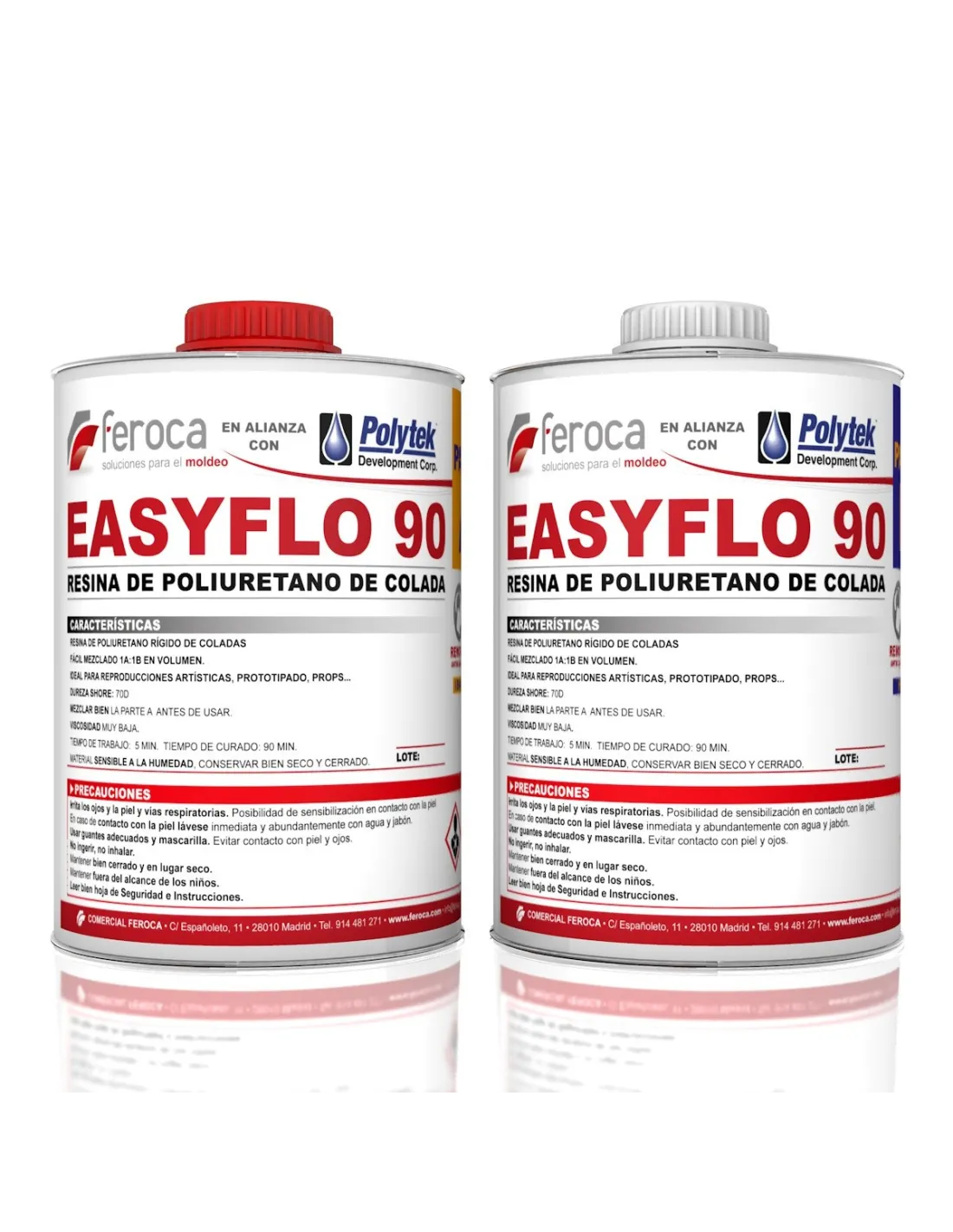
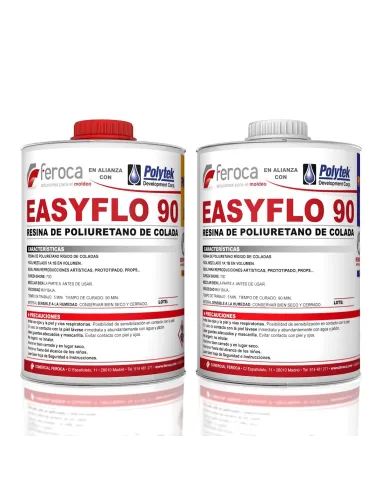
EasyFlo 90 -Slow White Polyurethane Resin-
431010101
€20.00
24,20 € Tax incl.
24,20 € Tax incl.
Low-viscosity white polyurethane resin. 1:1 mix by volume, 5 min pot life, 1-2 h cure, Shore 70D hardness.
EasyFlo 90 is a rigid polyurethane resin with an extremely low viscosity (200 cP) that produces bright white parts, virtually bubble-free and with a minimal shrinkage of 0.001%. Its extended pot life of 5 minutes and cure time of 1-2 hours make it the ideal choice when you need time to degas, pigment or work with complex geometries.
Technical specifications
| Parameter | Value |
|---|---|
| Application | Casting |
| Cured colour | Bright white |
| Shore Hardness | 70D |
| Mix ratio by volume | 1A : 1B |
| Mix ratio by weight | 100A : 90B |
| Mixed viscosity | 200 cP |
| Pot life | 5 minutes |
| Cure time (demould) | 1-2 hours |
| Exothermic peak | 80 °C |
| Shrinkage | 0.001% |
What it is used for
Thanks to its low viscosity and long cure time, EasyFlo 90 is the go-to resin when you need white, rigid, fine-detail parts without a vacuum chamber. It suits both closed-mould casting and open casting in silicone or polyurethane moulds.
- Reproduction of sculptures and mid-size artistic pieces
- Rapid prototyping of machinable or paintable parts
- Props and set dressing for special effects (FX) and film
- Parts for rotational casting
- Production of decorative figures, busts and replicas
- Manufacture of lightweight functional parts resistant to moisture and mild solvents
- Pigmenting with colorants to achieve custom shades before curing
How to use it
- Prepare the mould: make sure it is clean, dry and properly closed if it is a casting mould. Apply a release agent on porous moulds or on the first use of new moulds.
- Condition the components: bring the Part A and Part B containers to workshop temperature (between 20 and 25 °C). Stir each component separately before mixing.
- Weigh or measure: use the ratio 100A:90B by weight or 1:1 by volume. For greater accuracy, always work by weight using a digital scale.
- Mix: pour Part B into Part A and blend thoroughly for at least 30-45 seconds, scraping the sides and bottom of the container. Avoid incorporating excessive air.
- Add pigment (optional): if you wish to colour the part, add PolyColor pigments to Part A before adding Part B.
- Strain and degas (optional): the low viscosity allows bubbles to rise on their own. For highly detailed parts you can apply vacuum for 1-2 minutes before pouring.
- Pour into the mould: pour in a thin, continuous stream from the lowest point of the mould to encourage air displacement.
- Demould: after 1-2 hours the part can be demoulded. Full cure and final mechanical properties are reached at 24 hours.
Warning — polyurethane resin: polyurethane is moisture-sensitive. Always close containers after each use and store them in a dry place. Prolonged exposure to the environment can cause crystallisation of component B and the formation of bubbles in the part due to reaction with ambient moisture. Work in ventilated spaces and use nitrile gloves and safety glasses.
Usage tips
Work by weight, not by volume
Although the 1:1 volume ratio makes bench-side work easier, the higher density of component A can introduce small deviations when measuring by volume. Weighing with a digital scale (100A:90B) ensures full cure and prevents soft or sticky parts caused by stoichiometric imbalance.
Control temperature to adjust behaviour
At low temperatures (below 18 °C) viscosity increases and cure time extends considerably. If you are working in winter, pre-warm the components by placing them in warm water (30-35 °C) for 15 minutes before mixing. At higher temperatures the opposite occurs: pot life shortens, so work quickly.
Degassing without a vacuum pump
EasyFlo 90's viscosity of 200 cP is low enough for most bubbles to rise on their own during the first few minutes. To improve results without vacuum equipment: pour in a thin stream, tilt the mould slightly during filling and, if the mould allows, tap it gently on the bench after pouring to release bubbles trapped in corners.
Frequently asked questions
Is a vacuum chamber needed to get bubble-free parts?
It is not essential. EasyFlo 90 has a viscosity of only 200 cP, which allows bubbles to rise naturally before curing. For parts with very complex geometry or fine channels, a 1-2 minute degas improves results, but in most artistic and prototyping applications clean parts are achieved without vacuum.
Can I pigment the resin before mixing?
Yes. The most common approach is to add PolyColor pigments to Part A before adding Part B. This ensures the colour is distributed evenly throughout the mass. Use between 1% and 3% of the total weight for solid colours; using more may negatively affect the cure.
Which release agent should I use?
For silicone moulds a release agent is generally not needed, as the resin does not adhere to silicone. For plaster, wood, MDF or foam moulds, always apply a spray or wax release agent before pouring. For flexible polyurethane moulds it is advisable to use a release agent even on successive uses.
Can the cured part be sanded, drilled or painted?
Yes. Once fully cured (24 hours at room temperature), EasyFlo 90 produces fully machinable parts: it accepts sanding, drilling, milling and cutting. The bright white surface is also an excellent base for acrylic paints, lacquers and primers.
How long can the unopened components be stored?
In original sealed containers stored in a dry, cool place (between 15 and 25 °C), shelf life is approximately 12 months from the date of manufacture. Once opened, always close the container carefully and use it as soon as possible to avoid absorption of ambient moisture, especially in component B.
Does the resin resist outdoor exposure or water contact?
EasyFlo 90 offers good resistance to moisture and mild solvents once cured. It is not formulated for prolonged outdoor exposure: UV radiation can yellow the surface over time. For decorative exterior pieces it is recommended to apply a varnish or lacquer with UV protection.
What is the main difference from other resins in the same range?
EasyFlo 90 is the slowest-curing variant in the EasyFlo family, with a 5-minute pot life and 1-2 hours to demould. This makes it particularly suitable when you need time to degas, pigment or work with larger-volume moulds. The faster variant in the range has a pot life of 2.5 minutes and demoulds in 15-30 minutes, better suited to short production runs with a fast turnaround.
Is it suitable for rotational casting?
Yes. EasyFlo 90's low viscosity and 5-minute pot life make it compatible with the rotational casting (rotocasting) technique, in which a small amount of resin is poured into a closed mould and rotated by hand to produce hollow parts with uniform walls. The extended pot life makes it easier to coat the entire surface before gelation.
Video tutorial
EASYFLO 60 · White Polyurethane Resin
- Color
- White
- Working Time
- 5min
- Curing Time
- 1-2horas
- Shore Hardness
- 70D
- Volume Mixing Ratio
- 100A:100B
- Mixed Weight Ratio
- 100A:90B
- Application
- Casting
No reviews
Tap to zoom