Shopping Cart


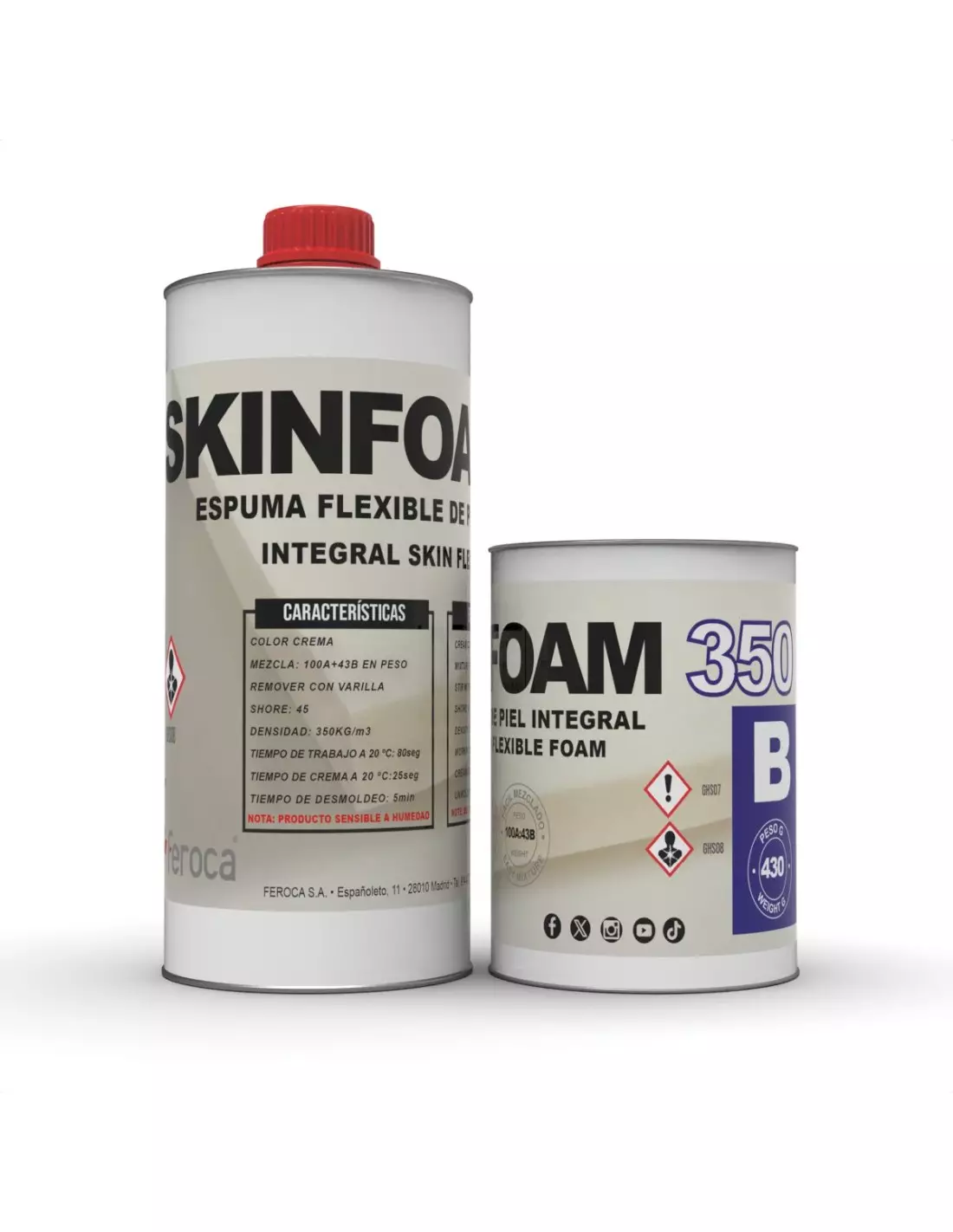
SKINFOAM 350 -Flexible Integral Skin Foam-
422353002
€21.00
25,41 € Tax incl.
25,41 € Tax incl.
Flexible integral skin polyurethane foam. Density 350 kg/m³, Shore A45, ratio 100A:43B. Ideal for props, animatronics and busts.
SKINFOAM 350 is a two-component flexible integral skin polyurethane foam: it forms a denser, more resistant outer surface while the interior remains soft and flexible. With a moulded density of 350 kg/m³ and a Shore A45 hardness, it is the go-to choice for making realistic props, hairdressing busts, scenography pieces and animattronic components that need consistency without being rigid.
Technical specifications
| Parameter | Value |
|---|---|
| Material type | Flexible integral skin polyurethane foam |
| Mix ratio (by weight) | 100A : 43B |
| Colour | Cream |
| Cream time | 25 sec |
| Working time | 80 sec |
| Demould time | 3 min |
| Shore Hardness A | 45 |
| Moulded density | 350 kg/m³ |
| Moulded density range | 300–500 kg/m³ |
| Tear resistance | 30 N/m |
| Approximate expansion | 3x initial volume |
| Blowing agents | CFC and HCFC free |
What it is used for
SKINFOAM 350 is designed for applications where a flexible part with a refined surface appearance and some resistance to continuous use is required. The integral skin generated by contact with the mould makes it especially valuable in sectors where the exterior finish is just as important as the elasticity of the core.
- Props and set dressing for film, television and theatre
- Scenography and sets with complex shapes
- Hairdressing and barbering busts: the integral skin withstands repeated pin insertions without deteriorating
- Animatronics and articulated figures requiring soft-to-the-touch parts
- Semi-rigid cosplay pieces (armour, shoulders, chest pieces)
- Furniture components: armrests, chair and stool padding
- Automotive parts: trims, grips, gear shift knobs
- Prototypes and models with a finish similar to the final product
How to use it
- Prepare the mould making sure it is clean and dry. Apply a suitable Release agent over the entire inner surface to facilitate demoulding.
- Weigh the components in separate containers following the ratio of 100 parts of component A to 43 parts of component B, always by weight.
- Mix both components vigorously and evenly for about 20–25 seconds. Make sure to scrape the sides and bottom of the container thoroughly.
- Pour the mixture into the mould within the first 80 seconds (working time). At approximately 25 seconds the cream phase begins and the foam starts to expand.
- Close the mould if working in a closed system. The foam expands up to three times its initial volume, so calculate the amount to pour carefully to avoid overloading the mould.
- Wait at least 3 minutes before demoulding. If the part has complex geometry, increase the cure time to avoid deformation.
- Leave the demoulded part to rest at room temperature for at least an additional 30 minutes to complete the cure and stabilise its shape.
Important notice — Exothermic and moisture-sensitive product: Component B (isocyanate) reacts with moisture in the air and may generate additional CO₂ that alters the expansion. Always keep containers tightly closed when not in use. Work in well-ventilated spaces. The foaming process is exothermic: do not use moulds made of materials that cannot withstand moderate heat. Wear nitrile gloves and eye protection during mixing and pouring.
Usage tips
Controlling the final density
The density of the finished part depends directly on the amount of mixture poured into the mould relative to its volume. If you fill the mould completely and close it, you will obtain higher densities within the 300–500 kg/m³ range, with a thicker and more defined skin. If you allow the foam to expand freely in an open mould, the density decreases and the skin is thinner. Adjust the amount poured according to the result you need.
Temperature and reaction time
Ambient temperature directly affects working and cream times. Above 25 °C times shorten and the foam rises faster; below 18 °C the process slows down and an uneven surface may result. The optimum is to work between 20 and 25 °C with the components at room temperature. In a cold workshop, slightly pre-warm the containers (no more than 30 °C) to restore normal reactivity.
Moulds and release agents
SKINFOAM 350 faithfully reproduces mould detail thanks to its integral skin. For the best surface finish, use silicone or resin moulds with a well-treated surface. Always apply Release agent before each casting, even in silicone moulds, to facilitate demoulding without damaging the outer skin of the part. If you need to paint or finish the part, lightly sand the skin with fine-grit sandpaper to improve adhesion of flexible paints.
Frequently asked questions
How much does this foam expand?
SKINFOAM 350 expands up to three times its initial volume (3x). This is a relatively contained expansion compared to lower-density foams, making it easier to control the final shape and allowing work with closed moulds without excessive overpour.
What is the difference between an integral skin foam and a conventional foam?
In an integral skin foam, the area in contact with the mould forms a denser, more compact and touch-resistant outer layer, while the inner core remains soft and porous. The result is a part with a "leather-like" surface finish and cushioning inside, without the need for additional coatings. Conventional foams have a uniform cellular structure throughout their cross-section.
Can the surface of the part be painted or finished?
Yes. The integral skin of SKINFOAM 350 accepts flexible polyurethane or flexible acrylic paints. To improve adhesion, lightly sand the surface with fine-grit sandpaper (180–220) and remove dust before applying the finish. Avoid rigid or enamel paints that may crack when the part flexes.
What type of mould is most suitable for this foam?
Silicone moulds are the most recommended because they do not require Release agent for every casting (though it is still recommended), they reproduce detail accurately and are easy to demould. Rigid resin or polyurethane moulds also work well with a good Release agent. Avoid unsealed porous material moulds, as the foam may adhere and ruin the part.
Is it flexible once cured or does it become rigid?
SKINFOAM 350 is a flexible foam. With a Shore A45 hardness and a density of 350 kg/m³, the finished part has a firm feel to the touch but yields to pressure and recovers its shape. It is not rigid: it can be bent, compressed and handled without breaking, although it offers more resistance than a low-density foam.
Can it be used in an open mould or only in a closed mould?
It can be used in both open and closed moulds, depending on the desired result. In an open mould the foam rises freely and the top surface is rough and porous (no integral skin on that face). In a closed mould all surfaces in contact with the mould form skin, and the part has greater density and a better finish on all sides. For busts, props and professionally finished parts, a closed mould is recommended.
How much time is there to pour the mixture after combining the components?
The working time is 80 seconds from when you start mixing. At approximately 25 seconds the cream phase begins (the mixture starts to turn opaque and rise). You must have the mould ready and prepared before mixing, and pour quickly to make use of all the available time before the expansion becomes uncontrollable outside the mould.
Is there a risk of the foam sticking to the mould?
Polyurethane tends to adhere to untreated surfaces, especially resins and metals. Always apply a suitable Release agent before each casting, even if the mould is silicone. For new moulds, apply two or three coats of Release agent allowing each to dry before the next to create an effective barrier.
Video tutorial
SkinFoam 350 Black · Flexible Integral Skin Polyurethane ·
- Color
- Cream
- Working Time
- 80seg
- Curing Time
- 3min
- Shore Hardness
- A45
- Mixed Weight Ratio
- 100A:43B
No reviews
Tap to zoom