Shopping Cart


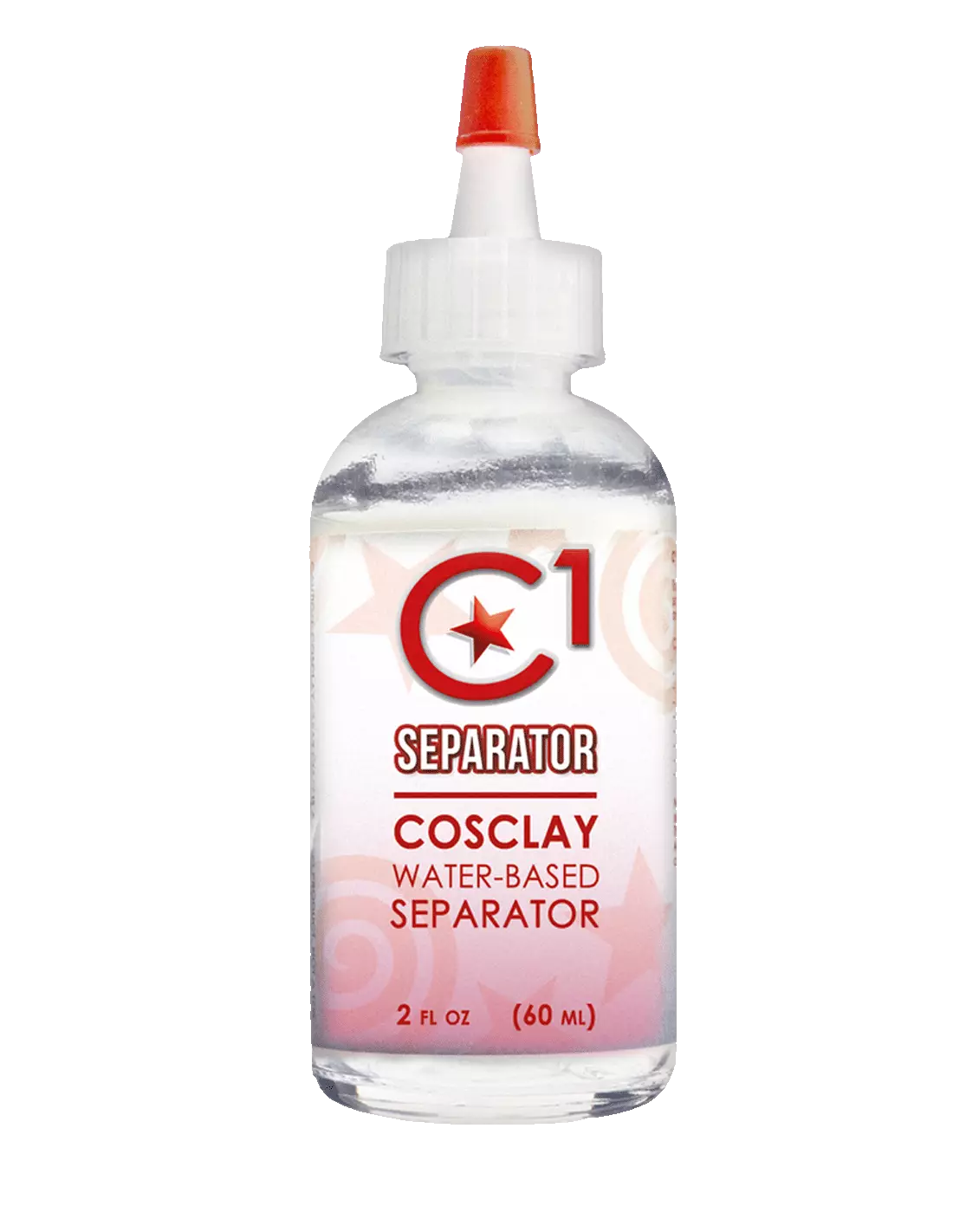
CosClay Separator C1
204361001
€12.00
14,52 € Tax incl.
14,52 € Tax incl.
CosClay Separator C1, water-based non-toxic release agent, 60 ml. Barrier between cured and raw clay, bakeable at 135 °C for 30 min.
CosClay Separator C1 is a water-based, non-toxic liquid release agent specifically formulated for CosClay flexible polymer clay. It creates a barrier film between already-cured clay surfaces and raw clay, allowing both to be baked in contact without fusing together. It is the essential solution for anyone making articulated dolls, modular pieces, or any work that requires separating components after baking.
Technical specifications
| Feature | Value |
|---|---|
| Format | Liquid |
| Base | Water |
| Toxicity | Non-toxic |
| Content | 60 ml |
| Baking temperature | 135 °C (275 °F) |
| Baking time | 30 minutes |
| Cleanup | With water |
| Main compatibility | Cured CosClay over raw CosClay |
What it is used for
Without a separator, two layers of polymer clay in contact inside the oven will fuse together permanently. Separator C1 prevents exactly that: a thin brush application on the cured surface is enough to create a clean barrier that allows pieces to be separated once cool, without damaging either one. It is the go-to product for making artist dolls and articulated prototypes with CosClay Sculpt Medium Firm Gray.
- Making articulated dolls: ball joints, sockets and pivot joints that must move freely after baking.
- Creating CosClay cured molds to reproduce shapes with raw clay without risk of adhesion.
- Modular prototypes where several pieces are baked in contact but must be demolded afterwards.
- Duplication of sculptural details over cured originals without layer fusion.
- Production of series of pieces where the same cured CosClay negative is reused.
- Any layering technique in polymer clay that requires independence between layers after curing.
How to use it
- Make sure the cured surface you are going to work on is clean, dry and free of grease residue.
- Gently shake the bottle before use to homogenise the product.
- Apply a thin, even coat of Separator C1 onto the cured surface using a soft brush or your fingers.
- Allow to dry completely until the surface loses its wet sheen (a few minutes at room temperature).
- Sculpt or place raw clay directly onto the treated area.
- Place in the oven at 135 °C (275 °F) for 30 minutes, following the CosClay curing instructions.
- Allow to cool completely before separating the pieces. Do not force separation while still warm.
- If any separator residue remains on the pieces, clean them with water and a soft cloth.
Tips for use
Thin coat, not thick
A single thin coat is sufficient. Applying too much separator can create a visible film on the cured surface or slightly alter the texture of the raw clay placed on top. If you see the product pooling, remove the excess with the brush before leaving it to dry.
Wait for it to dry before sculpting on top
This is the most common mistake: working on the separator while it is still wet. If the film has not dried fully, the raw clay may partially absorb it and lose its effect. Wait until the surface has a matte, dry-to-the-touch finish. In cold or humid environments, it may take a couple of minutes longer than usual.
Compatibility and storage
Separator C1 is formulated for use with CosClay, although it may work as a temporary barrier with other polymer clays. Close the bottle tightly after each use to prevent the product from thickening due to water evaporation. Store at room temperature, away from direct heat and sunlight. If the product has thickened, do not add water: first check whether it is still functional by applying a test coat.
Frequently asked questions
Can I use any release agent with polymer clay?
Not all release agents are compatible with polymer clay. Many solvent-based or oil-based release agents can degrade the clay or interfere with curing. Separator C1 is specifically formulated for CosClay: water-based, non-toxic and designed to withstand the baking cycle at 135 °C without altering the clay's properties.
Does it only work between clay pieces of the same material?
It is optimised for the combination of cured CosClay and raw CosClay, which is the most common situation in doll making and articulated prototype production. It may work as a barrier between other polymer clays, but if you are working with different materials it is advisable to do a prior test on a small area.
Should it be applied before or after sculpting?
Always before. Apply it to the already-cured surface, let it dry, and then sculpt the raw clay on top. Applying it over raw clay does not have the same effect because the film does not adhere correctly to an uncured surface.
Can it be baked immediately after applying without waiting?
It is not recommended. Separator C1 needs to dry before baking. If you place the piece in the oven with the separator still wet, the residual water may generate steam and affect the surface finish of the clay. Always wait until the film is completely dry to the touch.
How many applications does a 60 ml bottle last?
It depends on the size of the surfaces treated, but since it is applied in very thin coats, a 60 ml bottle covers a large number of work sessions. When making standard-size articulated dolls, one bottle covers several dozen joints.
Does it affect the finish or colour of the clay?
Once dry and after baking, Separator C1 does not visibly alter the colour or finish of CosClay pieces. If applied in excess it may leave a slight film, but with a thin coat the result is clean. Surfaces can be painted or finished as normal once separated.
Is it necessary for working with flexible polymer clay?
It depends on the work. If you are baking independent pieces that are not in contact with each other, you do not need it. But as soon as you work with joints, molds made from the clay itself, or any technique where two CosClay surfaces come into contact inside the oven, Separator C1 is essential. Without it, the pieces fuse together irreversibly.
Is it compatible with other polymer clays such as Super Sculpey?
Separator C1 is developed for CosClay. If you work with Super Sculpey Beige or Super Sculpey Firm Gray, these clays have different curing temperatures and times, so it is advisable to verify compatibility with a prior test before using it on a final piece.
No reviews
Tap to zoom