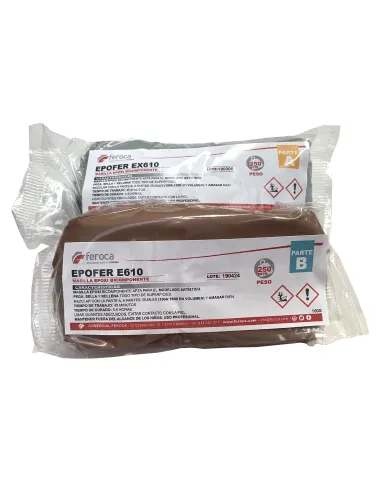
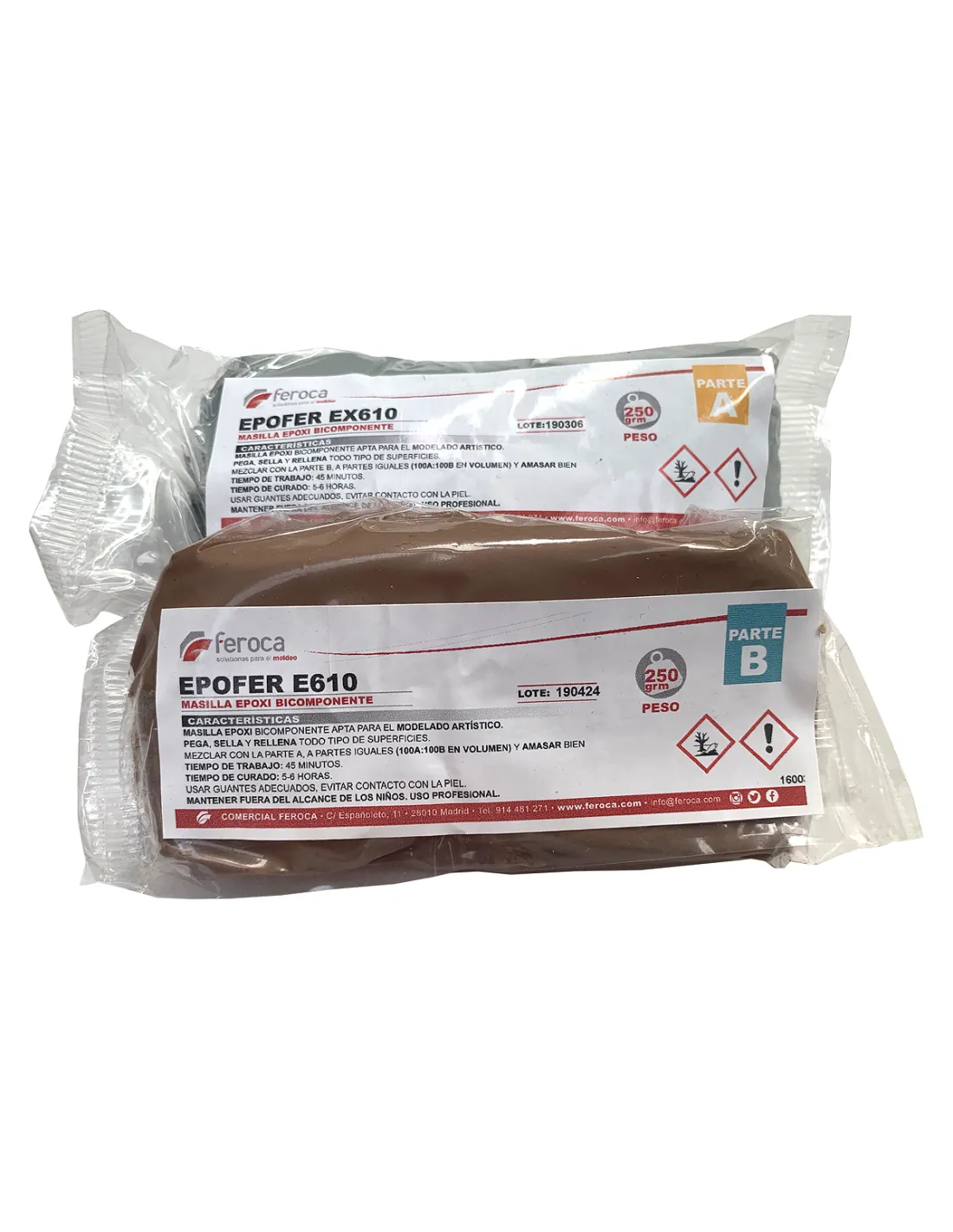
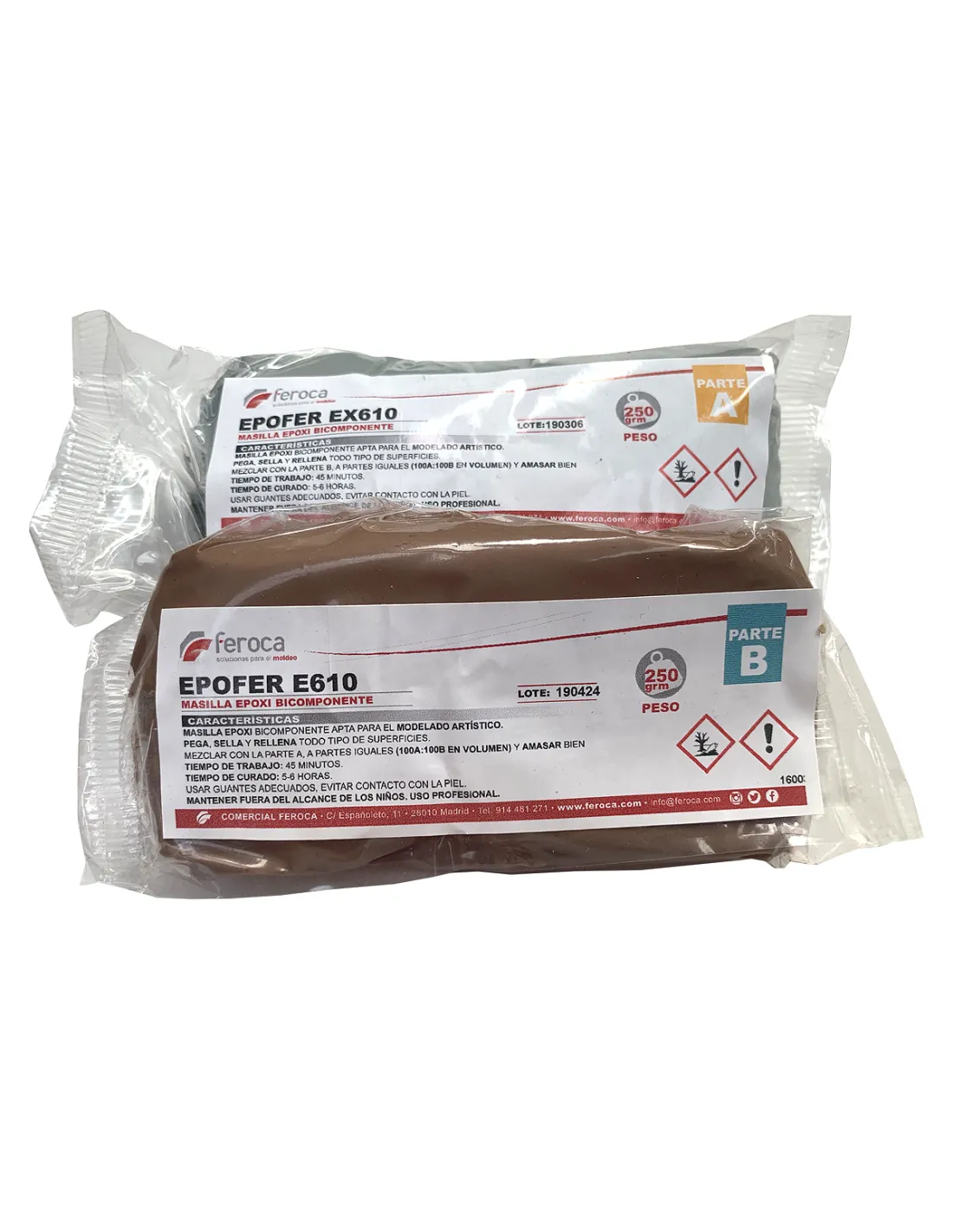
Masilla Epoxica 610 is a two-part epoxy putty with a 1:1 mix ratio that combines high chemical resistance with excellent mechanical properties. It is hand-kneaded in equal parts and bonds to a wide variety of substrates, including metal, wood, concrete and expanded polystyrene. Its ability to cure even underwater makes it a unique solution for repairs in difficult conditions, and once cured it can be sanded, drilled and painted without issue.
Technical specifications
| Parameter |
Value |
| Type |
Two-part epoxy putty |
| Mix ratio by weight |
100A : 100B |
| Mix ratio by volume |
100A : 100B |
| Mixing method |
Hand kneading |
| Cures underwater |
Yes |
| Post-processing |
Sandable, drillable, paintable |
| Available formats |
500 g kit (250 g part A + 250 g part B) / 5 kg kit |
What it's used for
Masilla Epoxica 610 is an extremely versatile workshop tool. Its ability to bond to very different substrates and its ease of hand modelling make it a go-to material for both industrial professionals and artists and sculptors looking for a hand-workable material with a permanent finish.
- Sculpture and direct modelling: creating shapes, details and volumes that are permanent once cured
- Repair and sealing of metal surfaces, pipes and structures, even in the presence of moisture or when submerged
- Filling cracks, joints and gaps in concrete, wood and laminates
- Structural adhesive for bonding pieces of expanded polystyrene, wood, metal and plastics
- Prototypes and scale models where a hand-workable material with subsequent finishing is required
- Reinforcement and sealing in composite and laminate work
- Base or support for sculptures that will later be moulded with silicone
How to use it
- Prepare the surface: clean the substrate thoroughly, removing dust, grease and rust. For metal, prior sanding noticeably improves adhesion. You can use Isopropyl Alcohol 99.9% for quick degreasing.
- Cut or separate equal portions: extract the same amount of part A (white or one colour) and part B (another colour) according to the 1:1 ratio by weight and volume.
- Knead by hand: mix both parts by kneading them with your fingers (wear nitrile gloves) until you obtain a uniform colour with no streaks. This indicates the mixture is homogeneous.
- Apply and model: apply the putty to the surface and shape it with your fingers or with modelling tools. Work within the pot life time, before it starts to harden.
- Wait for cure: allow the material to cure for the indicated time before handling. If working underwater, make sure the putty is pressed firmly against the substrate.
- Post-process: once cured, sand, drill or paint as required by the project. Silicone kidney tools are useful for smoothing the surface during modelling.
Important notice: Masilla Epoxica 610 contains epoxy resin. Always work with nitrile gloves and in a well-ventilated space. Avoid prolonged skin contact, as the uncured components can be irritating and sensitising. If you plan to use this putty as an original for platinum (addition cure) silicone moulds, bear in mind that incompletely cured epoxy can inhibit silicone cure: make sure the putty is fully cured and clean before applying silicone over it.
Tips and tricks
Controlling working time
Workshop temperature directly affects pot life. At high temperatures the putty hardens faster, reducing modelling time. If you need more time for complex pieces, work in a cooler environment or prepare smaller portions sequentially. Do not knead more material than you can apply within the available working time.
Detail modelling
To achieve smooth surfaces during modelling, lightly dampen your fingers or tools with water: the putty will not stick and allows smoother control. A modelling tool set or silicone kidney tools greatly assist with detail work and smoothing. If working over an existing professional oil-based clay sculpture, bear in mind that the epoxy bonds well to it but not the other way around.
Preparing difficult surfaces
On porous surfaces such as concrete or highly absorbent wood, apply a small amount of putty by rubbing with pressure so it penetrates the pores before adding more material. On rusted metal, aggressive prior sanding is essential. For expanded polystyrene, the putty bonds directly without the need for additional primer and does not attack it.
Frequently asked questions
How do I know the mix is done correctly?
When the two parts of Masilla Epoxica 610 are correctly mixed, the result is a completely uniform colour with no streaks or patches of the individual component colours. If you can see streaks, keep kneading until they disappear. An incomplete mix results in uncured zones or areas with reduced mechanical properties.
How long do I have to model before it hardens?
Working time depends on ambient temperature. At standard workshop temperature (20–23 °C) you have several minutes to model before the putty begins to harden noticeably. In warm conditions, that time is reduced. If you need more time, work with small portions and keep them cool until the moment of use.
Does it really cure underwater?
Yes. Masilla Epoxica 610 is formulated to polymerise even in direct contact with water, making it especially useful for repairs on pipes, tanks, boat hulls and structures in damp environments. The key is to press the putty firmly against the substrate to ensure contact and adhesion before curing begins.
Can it be painted once cured?
Yes. Once Masilla Epoxica 610 has fully cured, it accepts water-based paints, enamels, lacquers and epoxy-based paints. For best results, sand the surface beforehand with medium-grit sandpaper to create micro-roughness that improves paint adhesion.
What materials can it be applied to?
Masilla Epoxica 610 bonds to a wide variety of substrates: steel, iron, aluminium, copper and other metals; wood and wood-based materials; concrete and construction materials; expanded polystyrene without attacking it; and most rigid plastics. On very smooth or release-coated surfaces, adhesion may be lower, so sanding or surface preparation is recommended before application.
Can it be used as a base for silicone moulding?
Yes, but with precautions. Masilla Epoxica 610 can be used as an original for silicone moulds as long as it is completely cured. Uncured epoxy can inhibit the cure of platinum (addition cure) silicones. Make sure the putty has cured fully, clean it thoroughly and apply a sealer or Release agent if the surface is very porous before pouring the silicone.
Is it necessary to wear gloves?
Yes, it is essential. The uncured components of Masilla Epoxica 610 are irritating and can cause skin sensitisation with repeated exposure. Always wear nitrile gloves (not latex) during mixing and application. Work in a well-ventilated space and avoid contact with eyes and mucous membranes.
How much material do I need for a medium-sized repair or sculpture?
For spot repairs or small pieces, the 500 g kit is usually sufficient. For larger projects, such as medium-sized sculptures or extensive repairs, the 5 kg kit offers better value for money. Bear in mind that the putty has a high density, so an apparently small volume weighs quite a lot.