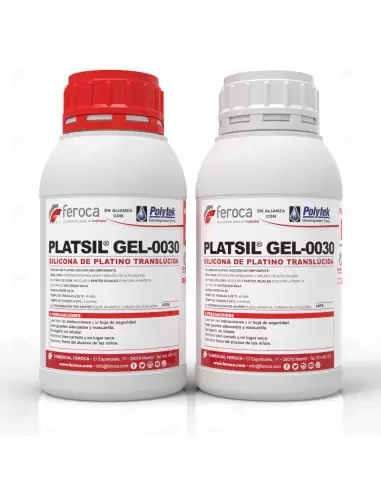
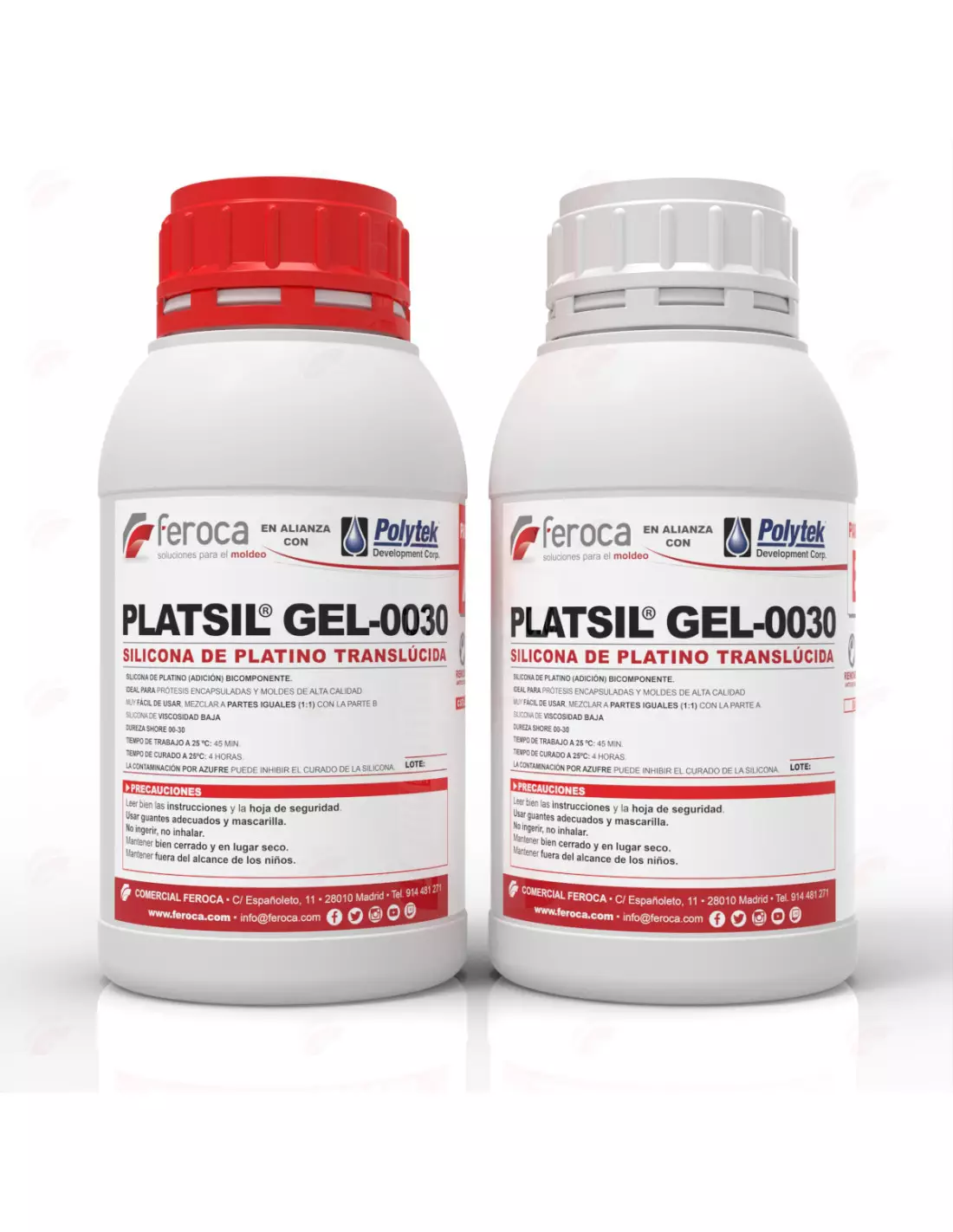
PlatSil Gel-0030 is a two-part platinum (addition) silicone with an extraordinarily low Shore Hardness (Shore 00-30), translucent and easy to mix in equal parts by weight or volume. Developed by Polytek, it is an established reference in special effects, prosthetics and animatronics thanks to its predictable behaviour, high detail fidelity and soft-to-the-touch finish.
Technical Specifications
Parameter
Value
Type
Platinum (addition) silicone
Colour
Translucent
Shore Hardness
00-30
Mix ratio by weight
100A : 100B
Mix ratio by volume
100A : 100B
Mixed viscosity
6,200 cP
Working time at 25 °C
45 min
Cure time at 25 °C
4–5 hours
Shrinkage
Negligible
Specific volume
26 in³/lb
What It Is Used For
A Shore Hardness of 00-30 places PlatSil Gel-0030 at the softest end of the platinum silicone range, making it especially suitable when the finished piece must replicate the texture and flexibility of human skin or soft tissue. It is the standard choice among special effects professionals and anaplastologists.
Masks and skins for special effects in film and television
Animatronics: soft coverings over mechanical structures
Medical simulation and anatomical phantoms
Reborn baby and hyper-realistic doll reproduction
Flexible moulds for complex geometry parts with undercuts
How to Use It
Prepare the original surface: ensure the model is clean, dry and free from inhibiting contaminants (sulphur, latex, tin). Apply a release agent if necessary.
Weigh or measure the components: mix component A and component B in a 1:1 ratio by weight or volume. Use a precision scale for best results.
Mix thoroughly: stir slowly for at least 3 minutes, scraping the sides and bottom of the container, until a uniform and homogeneous colour is achieved.
Degas (recommended): place the mix in a vacuum chamber for 1–2 minutes to remove air bubbles before pouring.
Pour or apply: place the silicone into the mould or onto the original in a thin stream from the lowest point. You have 45 minutes of working time at 25 °C. If working on prosthetics, you can add silicone pigments before pouring to achieve the desired skin tone.
Allow to cure: keep the piece at room temperature for 4–5 hours without moving it. Do not expose to elevated temperatures during the first hours unless you need to accelerate the process in a controlled manner.
Demould: once cured, the silicone releases easily thanks to its negligible shrinkage. Remove carefully to preserve detail.
Warning: platinum silicone inhibition PlatSil Gel-0030 is an addition-cure (platinum) silicone. Certain materials inhibit its cure, leaving the surface sticky or uncured. Avoid contact with:
Sulphur-containing clays and plasticines (the most common in sculpture)
Natural latex
Tin (condensation) silicones
Freshly cast or not fully cured polyester resins
Uncured epoxy compounds
Urethane rubber
Vaseline and some paints
Vinyl and surfaces containing plasticised PVC
If in doubt, always carry out an inhibition test: apply a small amount of mixed silicone to the material being tested and check the cure after 24 hours before proceeding with the full piece.
Usage Tips
Working with pigments and additives
PlatSil Gel-0030 is translucent, allowing precise pigmentation to replicate skin tones. Use silicone-specific pigments or Key-Pigments for FX: add them to component A before mixing with component B for even distribution. For surface texture effects, you can also incorporate Flocking. If you need encapsulated ultra-soft pieces (prosthetics with feathered edges), combine the silicone with deadener at approximately 180–200% relative to the total mixed silicone.
Use with encapsulant and in professional prosthetics
In prosthetic applications, the edges of the piece should be as thin as possible to blend with the skin. Use an encapsulant (Key-Cap Plastic) over the outer edge so that it can be blended with make-up. Apply a release agent between silicones when working with counter-moulds, as platinum silicone does not self-release onto another platinum silicone without a barrier.
Temperature and cure times
The higher the ambient temperature, the shorter the working and cure times. At 20 °C the working time is noticeably longer; at 30 °C it is shorter. Always work in a controlled environment to reproduce the stated times. If you need a faster-curing version with the same Shore 00-30, see PlatSil Gel-00, which cures in 30 minutes but with a working time of only 6 minutes. For casting from the original (Life Cast), consider using KEY-FORM, specifically formulated for skin contact.
Frequently Asked Questions
What materials inhibit the cure of a platinum silicone?
Platinum silicones like PlatSil Gel-0030 are sensitive to several contaminants that block the catalyst and cause the surface to remain sticky or uncured. The main inhibitors are: sulphur-containing clays and plasticines, natural latex, tin (condensation) silicones, uncured polyester and epoxy resins, urethane rubbers, Vaseline, plasticised vinyl and some paints. If in any doubt, always carry out a small cure test on the material before working with the full piece.
Can I use a tin silicone mould to cast platinum silicone inside it?
No. Platinum silicone does not cure in contact with tin silicone: it is inhibited and remains sticky. If your mould is made from condensation silicone, you will not be able to pour PlatSil Gel-0030 directly into it. You will need a mould made from platinum silicone or a compatible rigid material (resin, plaster, etc.).
Is a vacuum chamber necessary when working with this silicone?
It is not essential, but it is strongly recommended for applications requiring high detail fidelity or professional-quality finishes, such as prosthetics and reborn babies. The 6,200 cP viscosity of PlatSil Gel-0030 allows pouring in a thin stream to minimise bubbles, but prior degassing guarantees a pore-free result. The 45-minute working time provides sufficient margin to complete the vacuum process before pouring.
Can pigment be added to this silicone to replicate skin tone?
Yes. Being translucent, PlatSil Gel-0030 takes pigmentation very well. Use only pigments formulated for silicone or Key-Pigments for FX. Never use acrylic or water-based pigments, as they can inhibit the cure. Add the pigment to component A, mix well and then incorporate component B.
How long should you wait before demoulding?
PlatSil Gel-0030 completes its cure in 4–5 hours at 25 °C. Demoulding earlier may deform the piece or leave marks. If the ambient temperature is below 20 °C, extend the waiting time. The cure can be easily verified: if the silicone is not sticky to the touch at its thickest point, it is ready to demould.
What is the difference between this silicone and others with the same Shore but different working times?
Within the PlatSil range, Gel-00 has the same Shore Hardness of 00-30 but a working time of only 6 minutes and a cure time of 30 minutes, making it suitable for fast castings but very demanding in terms of handling. PlatSil Gel-0030 offers 45 minutes of working time, ideal when you need time to pigment, degas and position the material at a comfortable pace. Choose according to your workshop workflow.
Can this silicone be used directly on skin for a Life Cast?
PlatSil Gel-0030 is not specifically formulated for application on living skin. For Life Casting (direct impression taken from the body), KEY-FORM is available — a platinum silicone formulated and tested for safe skin contact. Once the mould has been obtained, you can cast PlatSil Gel-0030 inside it to produce the final prosthetic.
Can it be used with deadener to make even softer prosthetics?
Yes. Deadener is an additive that further softens the already very soft PlatSil Gel-0030 silicone. For encapsulated prosthetic applications, the typical ratio is between 180 and 200% of deadener relative to the total mixed silicone (1A:1B). This produces an almost gelatinous silicone that very convincingly replicates the texture of soft tissue.
How much product do I need?Calculate the exact amount before buying and avoid wasting material.
Cookies on this site are used to personalise content and ads to deliver social media features and to analyse traffic. We also share information about your use of the site with our social media partners for advertising, personalisation and web analytics.. More information.