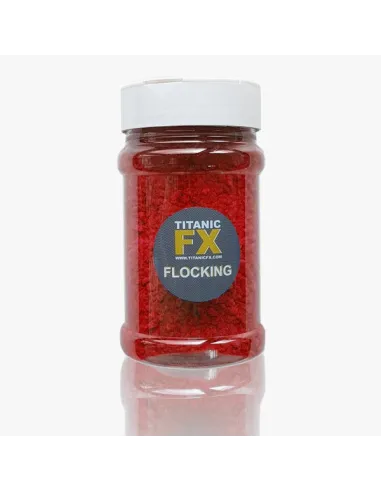
Titanic FX Flocking Red 100 ml is a coloured microfibre pigment used to tint gelatine and silicone prosthetics for special effects makeup and character work. Unlike paste or liquid pigments, the fibres are microscopic and stay suspended within the mix without settling, so the colour does not read as a flat layer but with a translucent depth very close to that of real skin. Red is the foundation of any vascular look: in minimal doses it mimics subcutaneous capillaries and the natural flush of the dermis, and blended with the other colours in the range it lets you build custom flesh and skin tones. Distributed in Spain by Feroca.
Technical specifications
| Parameter |
Value |
| Brand |
Titanic FX |
| Colour |
Red |
| Type |
Flocking microfibres for pigmentation |
| Volume |
100 ml |
| Compatibility |
Gelatine and silicone |
| Application |
By hand or with a flocking machine |
| Packaging |
Airtight tub with dual-speed dispensing cap |
| Main use |
SFX prosthetics, character makeup and props |
What it is used for
Flocking is the standard way to stop a prosthetic from looking like a piece of tinted material and start looking like living tissue. Red is the colour in the range that does most of that work:
- Pigmenting gelatine prosthetics for theatre, film and television character work
- Colouring silicone pieces: facial appliances, ears, noses, bald caps and body prosthetics
- Simulating capillaries and subcutaneous vascularity in thin-skin areas such as eyelids, temples, ears and knuckles
- Base for building realistic flesh and skin tones when mixed with other flocking colours
- Localised redness for wound, burn, irritation and fresh scar effects
- Colouring props and silicone parts for cosplay, animatronics and creature modelling
How to use it
- Use very little: flocking goes a very long way. Start with a tiny pinch, about the size of a pinhead, per batch of mix. Adding more is far easier than correcting an overload.
- Add it to the mix before curing: stir the fibres into the melted gelatine or into the silicone component until they are evenly distributed, with no lumps or clusters.
- Test the tone on a sample: pour a small test piece and let it cure before making the final one. Colour always looks different in the liquid mix than in the cured, translucent piece.
- Adjust the colour blend: combine red with other shades in the range until you reach the skin tone you need, bearing in mind the performer's or character's complexion.
- You can also apply it dry: work the fibres onto the surface by hand or spread them with a flocking machine when you want a surface effect rather than an internal tint.
- Close the tub properly: the airtight dual-speed cap lets you dispense gradually and keeps the fibres dry and loose between uses.
Tips
Less is more
Overloading is the most common mistake. A prosthetic with too much red flocking looks opaque and artificially pink, and loses exactly the translucency you were after. Real skin is subtle: in most jobs the correct amount is one you can barely see in the mix, but which appears as soon as the piece cures and light passes through it.
Concentrate red where skin is thin
Vascularity is not uniform across the body. If you are making pieces zone by zone, push the red in eyelids, ears, nostril wings, knuckles and elbows, and pull it back in the forehead, cheeks and thicker-skinned areas. That tonal variation between pieces is one of the details that most helps a set of prosthetics read as continuous skin.
Write your ratios down
Once you find the blend that works for a character, note the quantities. Shoots and theatre runs need replacement pieces made over weeks, and matching a tone without a written reference is very hard. Keep the cured test sample alongside the note.
Work away from draughts
These are very light, airborne fibres. Handle them away from fans or draughts, over a surface that is easy to clean, and avoid opening the tub abruptly: they scatter easily and red stains on contact with damp fingers.
Frequently asked questions
How much flocking should I add to the mix?
Far less than you would expect. As a starting point, a tiny pinch per batch of gelatine or silicone, then build up through small tests. Flocking yields much more than a paste pigment, so a 100 ml tub covers a very large number of pieces. Always judge colour on a cured sample, never on the liquid mix.
Does it work with both gelatine and silicone?
Yes, it works in both materials. Stir it into melted gelatine before pouring, or into the silicone component before mixing catalyst and base. With silicone, disperse the fibres thoroughly before adding the catalyst so you do not spend working time stirring once the reaction has started.
Why use flocking instead of a normal pigment?
Because the result is different. A liquid or paste pigment tints the whole mass evenly and produces a flat colour. Flocking fibres remain suspended as separate particles inside a translucent material, reproducing the irregular, deep look of real skin, with specks of colour that become visible up close. It is the difference between a piece that looks painted and one that looks like tissue.
Does it settle at the bottom of the mould?
No. It is a very light filler that stays in suspension while curing, so colour is distributed evenly throughout the piece instead of concentrating at the bottom. That is one of its main advantages over heavier fillers.
Can I mix it with other colours in the range?
That is exactly how it is normally used. Real skin tones are never a single colour: they are built by combining red with yellows, greens, blues and whites in very small proportions. Red provides the vascular component and the others correct the tone towards the result you need for each character.
Can it be applied with a flocking machine?
Yes. As well as mixing it into the material, it can be applied dry by hand or with a flocking machine when the effect you want is on the surface rather than an internal tint.
Where can I buy this product?
Titanic FX Flocking is available from Feroca, the manufacturer's distributor in Spain, with shipping throughout Spain and Portugal.