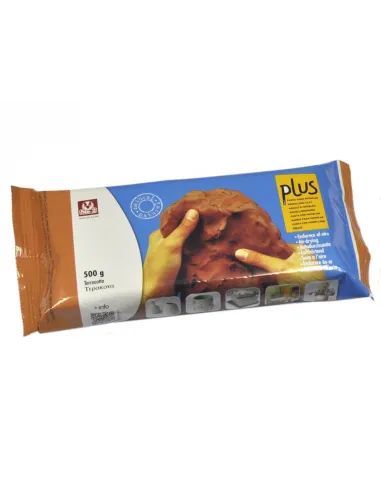
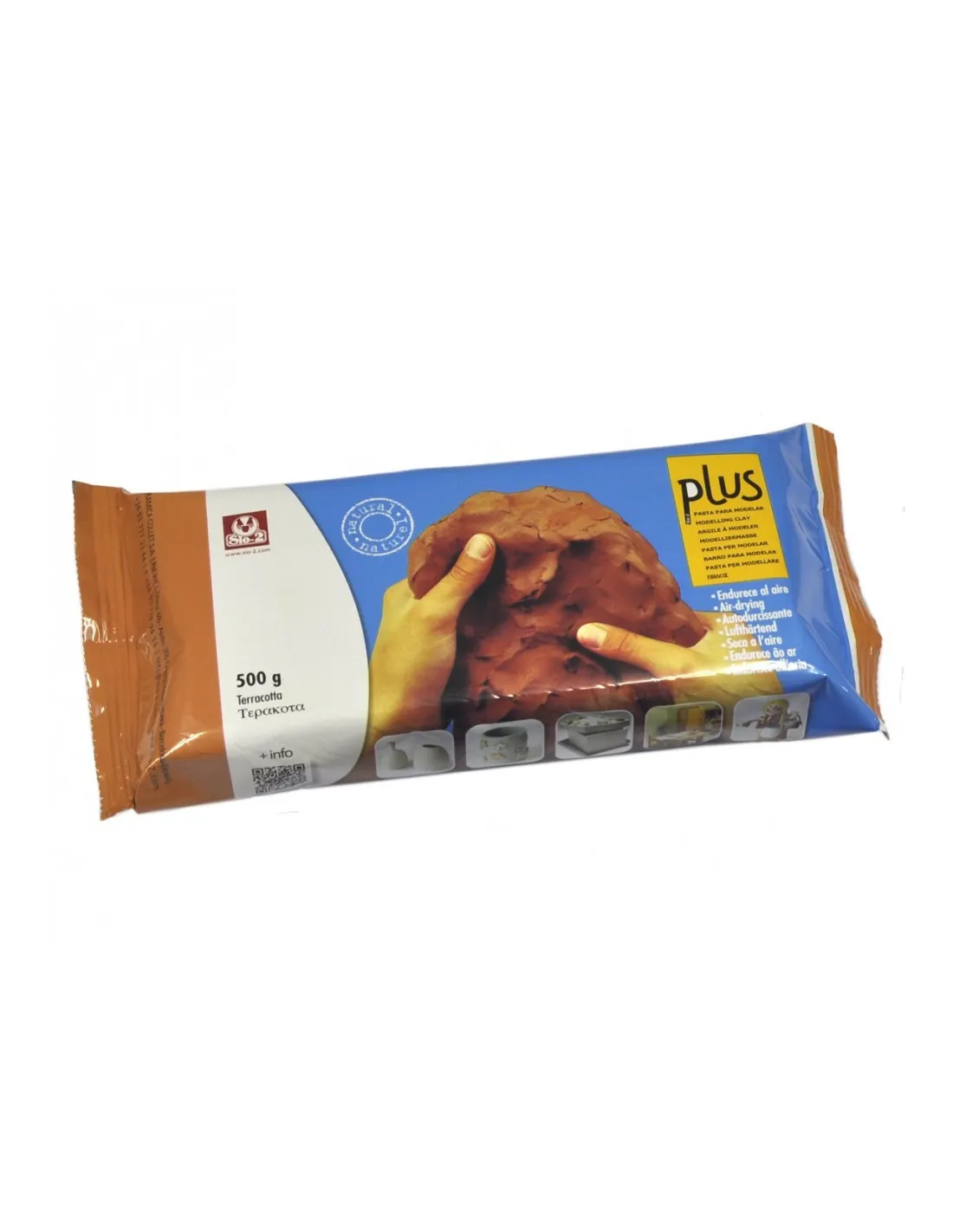
Sio-2 PLUS Terracotta Clay is a high-plasticity natural clay that air-dries without the need for a kiln or firing, reaching a hardness comparable to fired ceramics. Its natural terracotta colour, the presence of cellulose fibres that prevent cracking during drying, and its easy water-based cleanup make it a reliable choice for professional workshops and schools as well as creative use at home from age 3.
Technical specifications
Feature
Detail
Material type
Natural clay with cellulose fibres
Colour
Terracotta (natural colour)
Hardening
Air-dry, no firing required
Final hardness
Similar to fired ceramics
Available formats
500 g, 1 kg, 1.5 kg, 5 kg, 10 kg
Finish after drying
Paintable, varnishable, sandable, carvable and drillable
Cleanup
With water (hands, clothing and surfaces)
Odour
Odourless
Standards
EN-71 (Europe) / AP non-toxic seal (USA)
Minimum recommended age
From 3 years
Shelf life in original packaging
Minimum 2 years
What it's used for
It is a versatile clay covering a wide range of uses, from art education to decorative piece production and manual prototyping. Its terracotta colour provides a visually warm finish even before painting, making it especially interesting for decorative and sculptural pieces.
Hand modelling of figures, sculptures and scale models
Throwing on a potter's wheel
Creating fine details and reliefs on decorative pieces
Plastic arts workshops in schools and art centres
Making pieces to be painted, varnished or decorated afterwards
Prototyping and modelling shapes for later reproduction in silicone moulds
Supervised creative activities for children (from age 3)
Volume production for workshops thanks to the large 5 and 10 kg formats
How to use it
Open the packaging and take out the amount of clay you need. Close the rest tightly to preserve moisture.
If the clay is slightly dry on the surface, briefly knead it with slightly damp hands until it regains uniform plasticity.
Model with your hands or with modelling tools and loop tools to achieve fine details or hollow forms.
To join pieces or add volume, use a little water or very wet clay (slip) as an adhesive at the joints.
Leave the piece to air-dry at room temperature on a non-porous surface or rack, turning it periodically for even drying. Large pieces may take several days.
Once completely dry and hard, you can sand the surface with fine-grit sandpaper, drill it or carve it as needed.
Apply acrylic paint, tempera, oil paint or any varnish over the dry piece to colour or protect the finish.
Usage tips
Storing and reviving the clay
The key to keeping Sio-2 PLUS Terracotta in perfect condition is to prevent it from drying out before use. Always store the unused block in its original tightly closed packaging, or wrap it in cling film. If the clay has lost some moisture and become brittle, you can revive it by wrapping it in a damp cloth for several hours, or by placing small fragments in a sealed bag with a few drops of water and leaving it to rest until it rehydrates.
Crack-free drying for large pieces
The cellulose fibres in the Sio-2 PLUS formula minimise the appearance of cracks, but with large or thick-walled pieces it is advisable to take additional precautions. Model with uniform wall thickness — ideally hollow on the inside — to facilitate moisture evaporation. Cover the piece with a slightly damp cloth during the first 24 hours to slow initial drying and reduce internal stress. Drying too quickly in very warm or draughty environments can generate cracks even with this clay.
Finishes and painting
The terracotta colour of the clay already provides a very pleasing final look without any need for painting. If you want to colour the piece, wait until it is completely dry and hard throughout — not just on the surface — before applying any paint or varnish. Acrylic paints are the most common choice for their ease of use and quick drying. If you plan to apply several coats or want a very smooth finish, a light sanding with fine-grit paper beforehand noticeably improves adhesion. For outdoor decorative pieces, apply a waterproofing varnish: air-dried clay is not inherently waterproof.
Frequently asked questions
Does this clay need to be fired in a kiln to harden?
No. Sio-2 PLUS Terracotta Clay hardens completely in the air at room temperature, with no need for a ceramic kiln or any kind of firing. Once dry, it reaches a hardness comparable to fired ceramics.
How long does it take to dry?
It depends on the thickness of the piece and the ambient conditions. Small, thin pieces can be completely hard in 24–48 hours. Large or thick-walled pieces may need several days. To speed up the process you can place the piece in a warm, well-ventilated spot, although drying too quickly can cause cracking.
Can a young child use it safely?
Yes. Sio-2 PLUS Terracotta meets the European EN-71 toy safety standard and carries the AP non-toxic product seal in accordance with US regulations. It is recommended from age 3. It also cleans easily from hands, clothing and surfaces with just water, with no special products needed.
Can it be used as a master model for making a silicone mould?
Yes, but with one important consideration: if you want to use a platinum (addition-cure) silicone to make the mould, make sure the piece is completely dry and apply a coat of sealer or lacquer before pouring the silicone, as residual moisture and certain clay components can interfere with curing. With condensation silicones such as EASYL 3520, compatibility is direct and more straightforward.
What paints or varnishes can be applied to the dry piece?
Any type of paint or varnish is compatible: acrylics, temperas, oils, enamels or water-based paints. Acrylics are the most practical for general use. If the piece will be exposed to moisture or outdoor conditions, apply a waterproofing varnish as the final coat, as air-dried clay is not inherently waterproof.
What is the difference between the white and the terracotta colour?
Both are the same Sio-2 PLUS formula with identical modelling and drying properties. The only difference is the natural colour of the clay. The white version is ideal when painting with light or pastel colours, as the base tone does not show through. The terracotta provides a warm, natural finish without any need to paint, making it well suited to decorative or sculptural pieces.
What happens if the clay dries out and hardens inside the packaging?
If the packaging has not been properly sealed and the clay has lost moisture, you can try to revive it by rehydrating it slowly. Break the block into fragments, place them in an airtight bag with a few drops of water and leave to rest for 24–48 hours. Then knead it until it recovers its original texture. The shelf life in closed packaging is at least two years from the manufacturing date.
Can it be thrown on a potter's wheel?
Yes. Sio-2 PLUS Terracotta has sufficient plasticity to be worked on a potter's wheel as well as by hand modelling. It is an interesting option for ceramics workshops that want to dispense with the firing process.
Soft Shore A 20 condensation silicone for casting moulds. 100:5 mix ratio by weight, 20 min working time, 4–5 h cure. Ideal for resins, plaster and wax.
Cookies on this site are used to personalise content and ads to deliver social media features and to analyse traffic. We also share information about your use of the site with our social media partners for advertising, personalisation and web analytics.. More information.