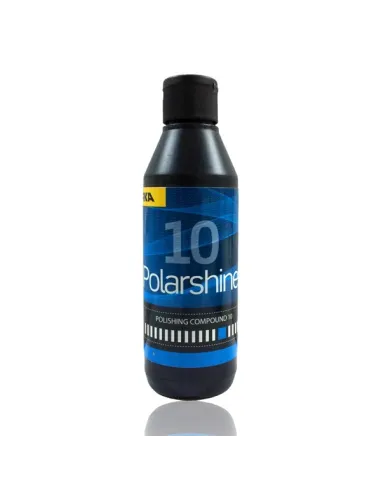
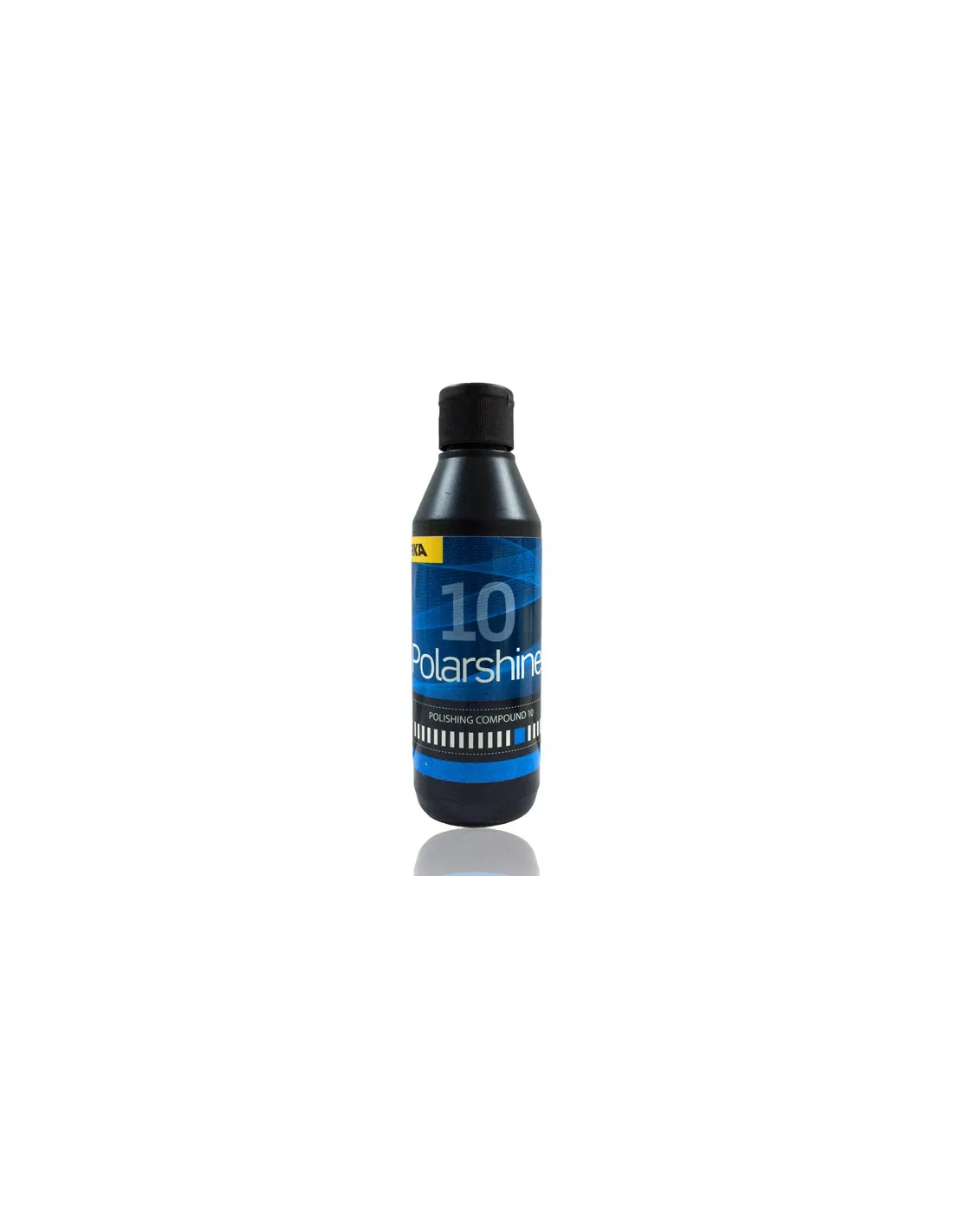
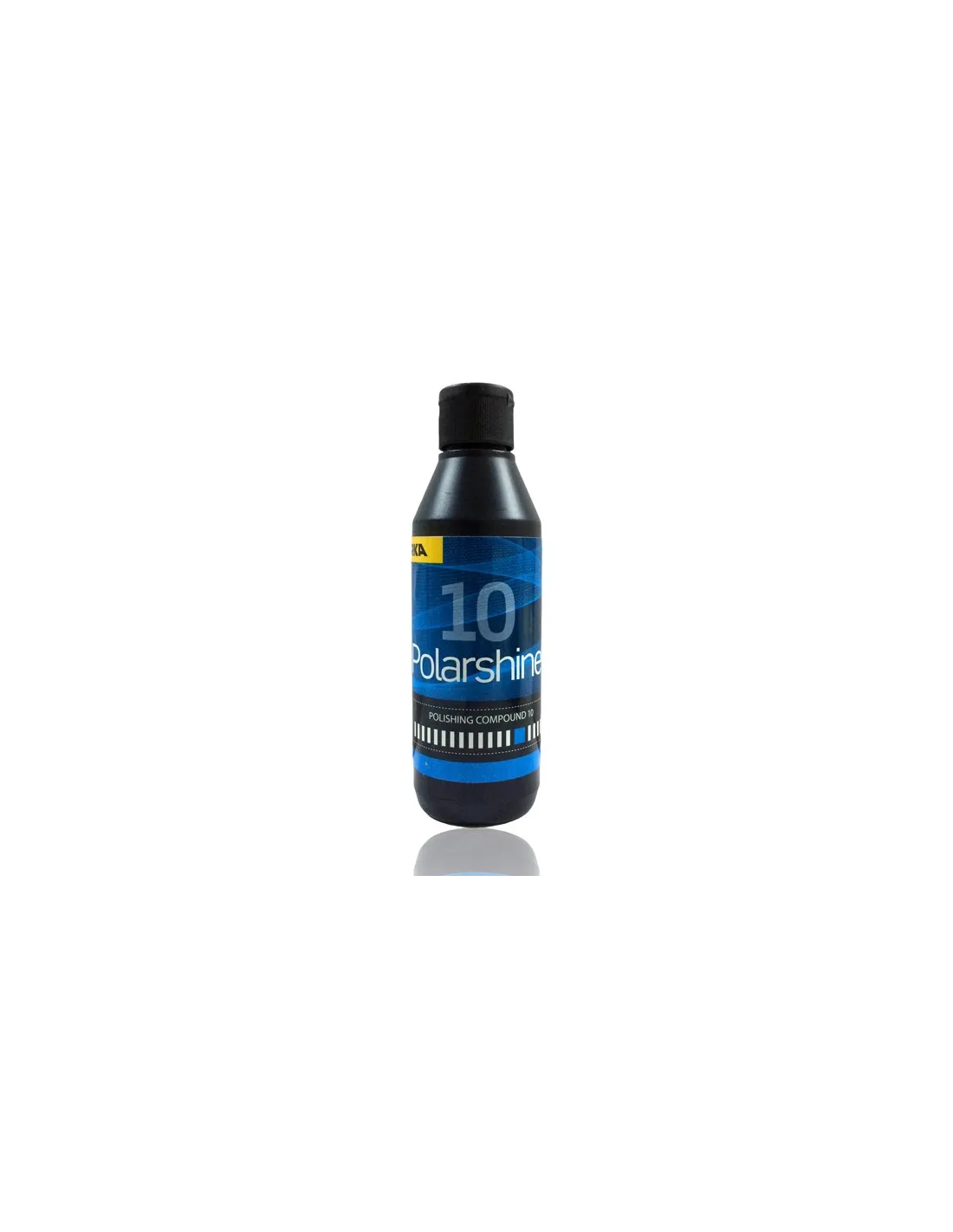
PolarShine 10 is a medium-grain polishing compound designed to permanently remove sanding marks from paint and varnish systems. Silicone-free, it keeps surface temperature under control during the process and is compatible with both manual and machine application.
Technical specifications
| Parameter | Value |
|---|
| Abrasive type | Medium grain |
| Silicone content | Silicone-free |
| Application method | Manual or machine |
| Compatibility | All paint and varnish systems |
| Format | 250 ml |
What it is used for
PolarShine 10 is designed for the finishing stage in composite lamination work, bodywork repairs, lacquered carbon fibre parts and any painted or varnished surface that requires the removal of fine scratches or sanding marks. Being silicone-free, it does not interfere with repaints or the adhesion of subsequent coats.
- Removal of fine sanding marks on lacquered composite parts.
- Polishing of carbon fibre finishes with varnish or gel coat.
- Correction of surface scratches on automotive paint.
- Polishing of parts made with epoxy resins after the finishing phase.
- Surface preparation before applying protective waxes.
- Final finish on lamination work with Epofer Laminate 401 once the part has been lacquered.
How to use it
- Make sure the surface is clean, dry and free of dust or grease.
- If the part has been sanded, finish with a fine grit (P1500 or higher) before applying the compound.
- Apply a small amount of PolarShine 10 directly onto the foam applicator or polishing cloth.
- Work in small areas using circular or linear movements, either by hand or with an orbital/rotary polisher at medium-low speed.
- Maintain constant pressure and prevent the compound from drying out excessively on the surface.
- Remove residues with a clean microfibre cloth.
- Repeat the process if visible marks remain. For very superficial marks, you can move directly to a finer compound.
Usage tips
Speed and temperature
Work at moderate speed with the polisher. Excessive speed generates heat that can damage the varnish or lacquer coat, especially on thin composite parts. PolarShine 10 is formulated to keep temperature low, but the operator must also control the contact time on each area.
If sanding marks are deep or come from coarse grits (P800 or lower), start with PolarShine 35 (coarse grain compound) and finish with PolarShine 10 for the fine finish. This two-step workflow gives better results than trying to correct deep marks directly with a fine abrasive.
Silicone-free: advantage for repaints
Being silicone-free, PolarShine 10 leaves no residues that cause adhesion problems if the part is to be repainted or if an additional varnish coat is applied. Clean the surface with a clean cloth before any subsequent application regardless.
Frequently asked questions
Can I use this compound directly on carbon fibre without varnish?
It is not recommended. PolarShine 10 is designed to act on paint, varnish or lacquer coats. Applying it directly on uncoated carbon fibre can damage the surface fibres. If your carbon fibre part has no varnish, first apply a protection coat compatible with the laminate, such as the one you can achieve with Epofer Laminate 401, and once cured and sanded, use the compound.
Can it be used to polish clear epoxy resin?
Yes, as long as the resin is fully cured and has been previously sanded with fine sandpaper. PolarShine 10 removes sanding marks and restores transparency and gloss to the epoxy surface. For best results, finish sanding with P1500 grit or higher before applying the compound.
What is the difference between this compound and a coarse-grain one?
PolarShine 10 has a medium grain, suitable for fine sanding marks and surface scratches. PolarShine 35 has a coarse grain and is designed to correct more pronounced defects or low-grit sanding marks. The usual approach is to use the coarse compound first and finish with the medium-fine to achieve maximum gloss.
Is it necessary to use a release agent before polishing a part?
No. The Release agent is applied before the moulding process, not during the polishing phase. If you use ACMOS 82-2405 as a release agent in the mould, make sure the demoulded part is clean of any residue before sanding and polishing with PolarShine 10.
Can it be applied by hand without a polisher?
Yes. PolarShine 10 is compatible with manual application using a cloth or foam applicator. For small areas or parts with complex geometry it is even the most practical option. Results will be equally good, although it requires more effort and time than with an orbital polisher.
How much product do I need for a medium-sized part?
It depends on the condition of the surface and the technique used. For a medium-sized composite part (for example, a bonnet or side panel), a 250 ml container is usually sufficient for several polishing sessions. Always apply in small amounts: it is more efficient and avoids wasting product.
Does it leave white residues in joints or edges of the part?
Like any polishing compound, PolarShine 10 can accumulate in edges, recesses or joints. Remove the excess with a dry microfibre cloth before it dries. For hard-to-reach areas, a soft natural-bristle brush makes cleaning easier without damaging the finish.
How much product do I need?Calculate the exact amount before buying and avoid wasting material.
Go to the calculator →