Shopping Cart


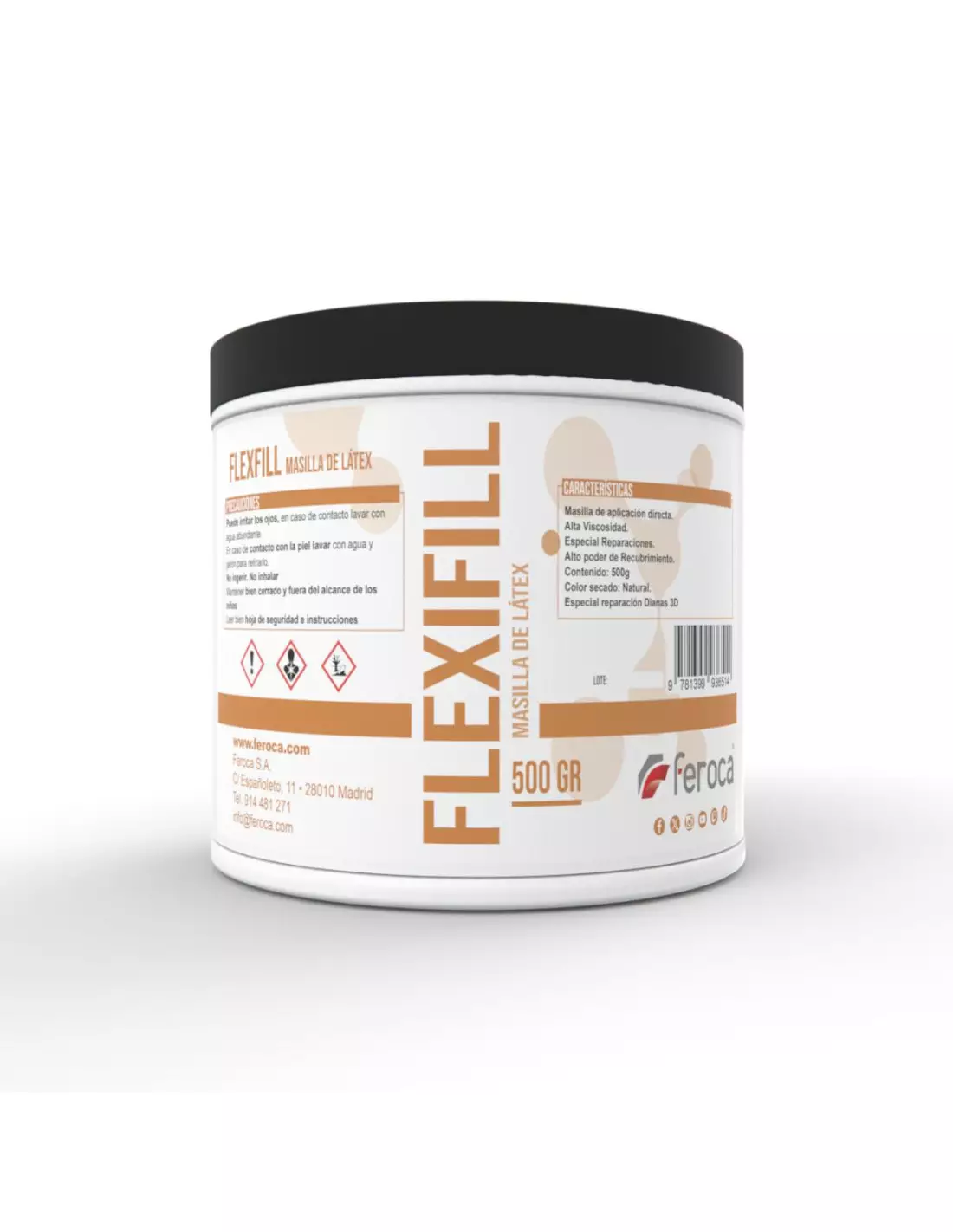
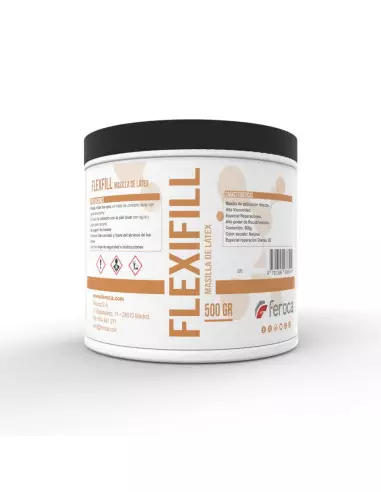
FLEXIFILL - Latex Putty
204450005
€10.00
12,10 € Tax incl.
12,10 € Tax incl.
High-viscosity latex filler with outstanding covering power. Ideal for repairing 3D archery targets, scenography and sculpture. 500 g, natural colour.
FLEXIFILL is a high-viscosity, paste-textured latex filler formulated for direct application on flexible or rigid surfaces. Its outstanding covering power and adhesive properties make it the go-to solution for quick repairs on 3D archery targets, scenography, theme park sets and sculpture. It comes in a ready-to-use 500 g format — no mixing or prior preparation required.
Technical specifications
| Parameter | Value |
|---|---|
| Product type | Single-component latex filler |
| Format | 500 g |
| Dry colour | Natural |
| Viscosity | High (paste texture) |
| Application | Direct, no mixing |
| Drying acceleration | Heat source (heat gun, oven) |
| Base | Latex with adhesive and filler additives |
What it is used for
FLEXIFILL is designed for any job that requires filling, sealing or coating surfaces with a flexible and durable material. Thanks to its density and adhesion, it covers imperfections, cracks and perforations in a single generous application. It is especially effective for:
- Repairing 3D archery targets: fills projectile holes in a durable and flexible way
- Restoring sculptures and latex pieces deteriorated by use or time
- Building and maintaining sets for theatrical and film scenography
- Repairing and reinforcing theme park and attraction elements
- Sealing seams and joints on latex or foam pieces
- Finishing and texturing surfaces in special effects and character makeup
How to use it
- Clean the surface to be repaired: remove dust, grease or loose debris. If the area is wet, dry it before applying.
- Open the container and, if the filler has been sitting, stir well with a spatula until you get a uniform texture.
- Apply FLEXIFILL directly to the area to be treated using a spatula, palette knife or gloved fingers, covering the entire damaged surface thoroughly.
- Apply in generous layers if the fill is deep. In thick areas it is preferable to apply in two or three passes to ensure complete curing.
- Leave to dry in air or apply heat with a heat gun or oven to speed up the process up to 10 times.
- Once dry, the filler remains flexible with a natural colour. If you need to colour it, you can paint it with Mask Paint, a paint specifically formulated for latex.
- Close the container tightly after each use to prevent the filler from drying out.
Usage tips
Drying control
At room temperature and with thick layers, drying time can be long. Use a heat gun or a low-power oven and keep the heat flow moving to prevent the surface from forming a skin before the interior cures. In cold environments (below 15 °C) applying heat is virtually essential to achieve a correct and lasting cure.
Repairing 3D archery targets
To fill projectile holes, press the filler directly into the hole using gloved fingers or a narrow spatula to make sure it reaches the bottom. Then apply a surface layer to bring it level with the rest of the target. After drying, the repaired area recovers its original flexibility and withstands new impacts.
Painting and finishing
The natural colour of dry latex is suitable for many jobs, but if you need to match the tone with the rest of the piece, use Mask Paint, a paint specifically formulated to adhere to latex without cracking or peeling with flexion.
Frequently asked questions
How long does a thick layer take to dry?
In open air at room temperature (20–25 °C), a very thick layer can take several hours. Applying heat with a heat gun reduces the time approximately 10 times. At low temperatures, heat is especially recommended to ensure complete curing.
Can it be applied over foam or EVA?
Yes. FLEXIFILL adheres well to flexible foam, EVA and similar porous materials. On very porous surfaces it can be useful to apply a first diluted coat (adding a few drops of water) to prime the substrate before applying the filler at full density.
Can it be thinned for use as a primer or thin coat?
Yes, a small amount of water can be added to reduce viscosity and achieve thinner layers. However, FLEXIFILL is designed as a filling and thick-coating filler, not as a thin-coat latex. For thin coating work, brush-on latex products are more suitable.
Can the filler be coloured before application?
Yes, latex-compatible pigments can be incorporated directly into the filler before applying. You can also paint it once dry with Mask Paint, which is formulated to flex together with the latex without cracking.
How many repairs can be made from a 500 g container?
It depends on the size and depth of the holes to be repaired. On 3D archery targets with standard arrow impacts, a 500 g container can cover dozens of repairs. For sets or sculptures with large areas, yield varies depending on the thickness of the layer applied.
Is it water-resistant once dry?
Cured latex has acceptable resistance to ambient moisture and splashes. However, for pieces that will be in prolonged contact with water or continuously exposed to the elements, it is recommended to apply a compatible paint or sealer coat to increase durability.
How do you clean the tools after use?
While the filler is still fresh, clean spatulas and tools with warm water. Once dry, the latex forms an elastic film that can be removed mechanically. Avoid leaving dried residue accumulated on the rim of the container so the lid closes properly.
Can it be used outdoors?
Yes, FLEXIFILL is suitable for outdoor use under normal conditions. 3D archery targets are typically used outdoors and the filler withstands temperature changes and weather exposure during the season. For permanent outdoor installations, a protective paint finish improves the lifespan of the repair.
No reviews
Tap to zoom