Shopping Cart


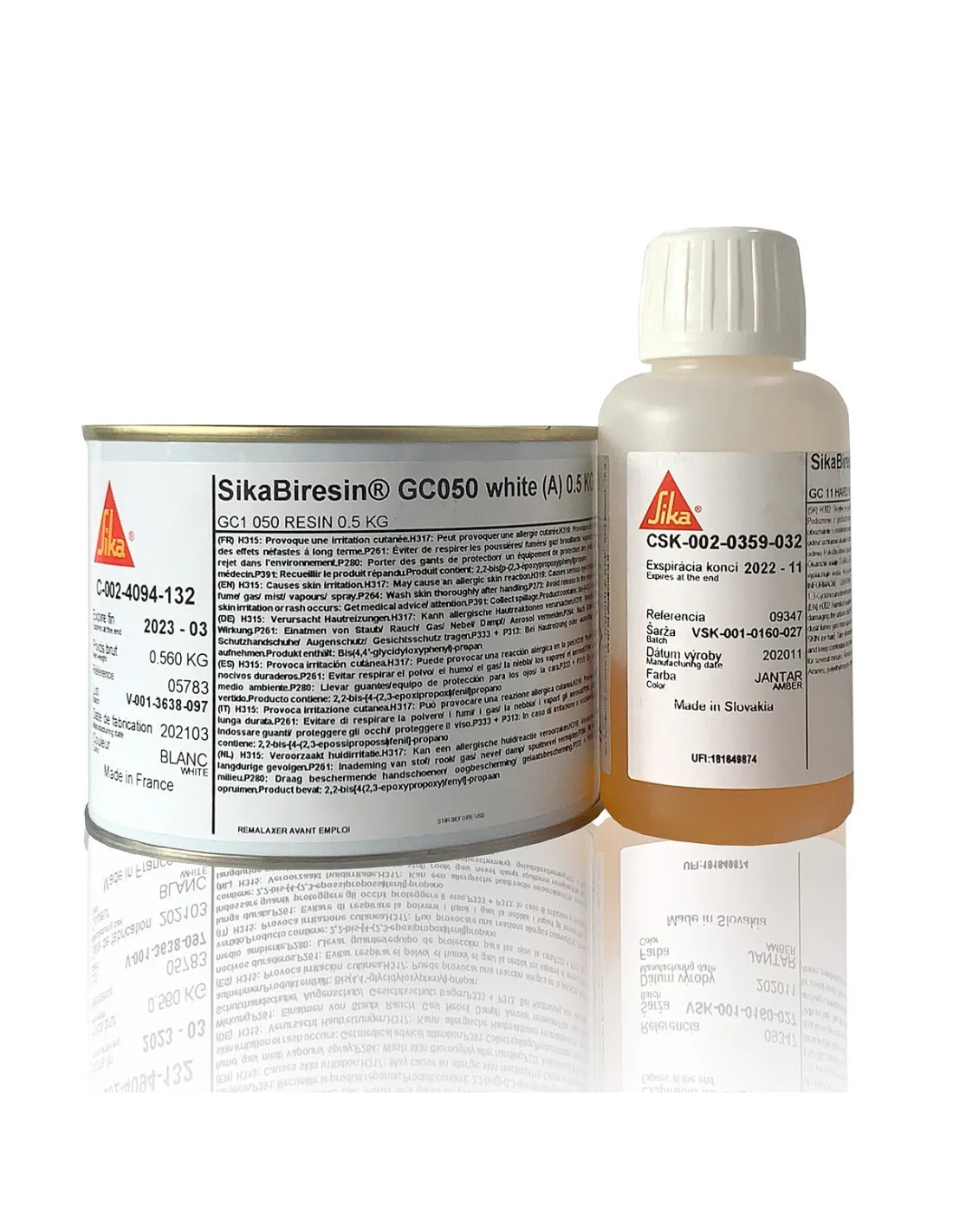
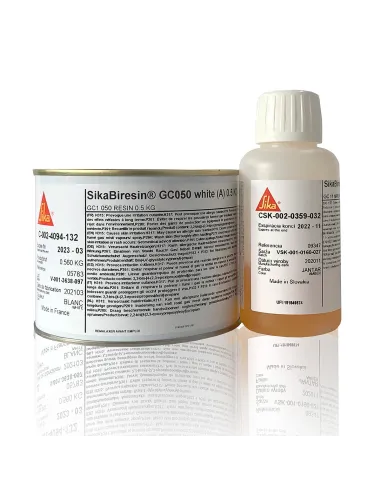
SikaBiresin GC1 050 -Gel Coat Epoxy-
407205001
€31.50
38,12 € Tax incl.
38,12 € Tax incl.
White thixotropic epoxy gel coat, 100A:10B ratio, 20-30 min working time, Shore 88D hardness. Ideal for precision and FX moulds.
SikaBiresin GC1 050 is a white thixotropic epoxy gel coat formulated to be applied as a surface layer on demanding moulds. Its high hardness (Shore 88D), exceptional abrasion resistance and dimensional stability make it the first-choice coat for FX moulds, precision tools and industrial tooling. It adheres without sagging on vertical surfaces and bonds perfectly with subsequent fibreglass lamination.
Technical specifications
| Parameter | Value |
|---|---|
| Type | Thixotropic epoxy gel coat |
| Colour | White |
| Mix ratio (by weight) | 100A : 10B |
| Working time | 20-30 min |
| Cure / demould time | 24 hours |
| Shore Hardness | 88D |
| Flexural strength | 72 MPa |
| Density | 1.57 g/cm³ |
What it is used for
SikaBiresin GC1 050 acts as a sacrificial and finishing layer on the active face of the mould, protecting the inner laminate and providing a high-quality surface to the produced parts. Its most common applications are:
- FX moulds for casting silicone and other casting materials
- Vacuum forming and thermoforming moulds
- Low-pressure injection moulds
- Precision tools and composite tooling
- Patterns and model plates for casting
- Repair and recovery of damaged mould surfaces
- First layer in fibreglass laminates where a fine surface finish is required
How to use it
- Prepare the surface. Make sure the model or mould is clean, dry and free of dust. Apply a paste release agent (34D) in several thin coats, allowing each to dry before the next; this ensures a clean demould without damaging the gel coat layer.
- Weigh the components. Mix part A and part B in a 100:10 ratio by weight. Use a precision scale; errors in the ratio directly affect the cure and final hardness.
- Add fillers if needed. If you want to incorporate dry fillers (e.g. to adjust colour or density), mix them into part A first until fully homogeneous before adding part B.
- Mix part A + part B. Stir slowly and continuously with a spatula or mixer for at least 2-3 minutes, scraping the sides and bottom of the container thoroughly. Incomplete mixing produces uncured areas.
- Apply the gel coat. Using a short-bristle brush or airless spray gun, apply a uniform layer of 0.5-1 mm over the surface. The thixotropic nature of the material prevents sagging on vertical surfaces or complex geometries.
- Wait for the tacky stage. When the gel coat has gelled but is still slightly tacky to the touch (the "green" stage), it is ready for lamination. Do not wait for it to cure completely, or the bond with the subsequent laminate will be weaker.
- Laminate fibreglass. Apply the laminating epoxy resin over the gel coat while it is in the green stage and continue building the mould. For areas requiring filling or dimensional adjustment, use epoxy filler 610 once the laminate has cured.
- Final cure. Allow the assembly to cure at room temperature for 24 hours before demoulding. A post-cure in an oven at moderate temperature improves the final mechanical properties.
Important notice — Platinum silicone inhibition: If you intend to use this mould to cast addition-cure silicones (platinum), be aware that freshly cured epoxy can inhibit the silicone cure in the contact area. Always apply a suitable release agent and, if possible, carry out a small cure test in a limited area before the final casting. Other materials that also inhibit platinum silicones include: latex, sulphur-based clays, freshly cured polyester and unsealed surfaces with contaminants.
Usage tips
Temperature and workshop conditions
The ideal working temperature is between 18 °C and 25 °C. Below 15 °C the gel coat may not cure correctly or the gelation time may be significantly extended. Above 30 °C the working time is notably reduced; in summer or in warm workshops, mix in smaller batches to prevent the material from gelling before you finish the application.
Layer thickness control
Always apply in a single layer of 0.5 to 1 mm. Thinner layers may be porous or cure poorly; thicker layers accumulate heat during the exotherm and can generate internal stress or cracking. If greater thickness is needed, apply a second coat once the first has gelled but not fully cured.
Storage and shelf life
Store the components in a cool, dry place away from direct sunlight, with containers tightly closed. Under optimal conditions (between 15 °C and 25 °C, without sudden temperature changes or high humidity) the estimated shelf life is approximately 6 months from the date of manufacture. Do not store the mixed material: always work in batches that can be applied within the 20-30 minute working time.
Frequently asked questions
What is the difference between an epoxy gel coat and a standard laminating epoxy resin?
A gel coat is an epoxy resin with a thixotropic filler that gives it a paste-like consistency. This allows it to stay where it is applied without sagging and to act as a hard, wear-resistant surface layer. SikaBiresin GC1 050 is specifically formulated for this purpose: its Shore 88D hardness and 72 MPa flexural strength make it ideal as a first layer in demanding moulds. Conventional laminating resins have lower viscosity and are optimised for wetting fibre, not for providing a surface finish.
Can I apply it directly onto a 3D-printed or plaster model?
Yes, but the surface must be perfectly sealed and have release agent applied before using SikaBiresin GC1 050. Porous models (plaster, gypsum, MDF) absorb the gel coat and make demoulding difficult; apply a suitable epoxy sealer and several coats of release agent 34D before the first gel coat layer. On FDM prints with visible layer lines, sand first to achieve the most uniform surface possible.
Can it be used in moulds intended for casting silicone?
Yes, SikaBiresin GC1 050 is commonly used to make rigid moulds into which silicone is poured. Bear in mind that if you use platinum (addition-cure) silicones, the cured epoxy can inhibit the cure in the contact area. Always apply release agent between the mould and the silicone, and carry out a small test before making the full casting.
How long do I have to work with the material once mixed?
The working time of SikaBiresin GC1 050 is 20 to 30 minutes at room temperature (around 20-23 °C). At higher temperatures the time is reduced. Only prepare the amount you can apply comfortably within that window: once the material starts to gel it cannot be worked further, and forcing it can introduce bubbles or cause a deficient cure.
Can I add pigments or fillers to change the colour?
Yes. SikaBiresin GC1 050 accepts dry fillers and epoxy-compatible pigments. Always add the filler or pigment to part A and mix until fully homogeneous before incorporating part B. Adding the pigment directly to the final mixture can result in uneven dispersion and affect the effective mix ratio.
Is an oven post-cure necessary?
It is not essential. At room temperature after 24 hours the material is cured and ready to demould with very good mechanical properties. However, an oven post-cure at moderate temperature (consult the official Sika technical data sheet for the exact cycle) improves the final thermal and mechanical resistance, which may be relevant for moulds subjected to high temperatures or intensive use cycles.
How long can it be stored unopened?
Under suitable storage conditions (cool, dry place, no direct sunlight or sudden temperature changes, between 15 °C and 25 °C) the estimated shelf life is around 6 months from the date of manufacture. Once the container has been opened, close it tightly after each use to prevent moisture absorption, especially in part B (hardener).
Can a damaged area of the mould be repaired with this same gel coat?
Yes. For localised repairs, clean and sand the affected area down to sound material, remove the dust and apply a new coat of SikaBiresin GC1 050. If the damage extends to the laminate, fill first with epoxy filler 610 and apply the gel coat as a finishing layer once the filler has cured.
- Color
- White
- Working Time
- 20-30min
- Curing Time
- 24horas
- Shore Hardness
- 88D
- Mixed Weight Ratio
- 100A:10B
- Type
- Gel Coat
No reviews
Tap to zoom