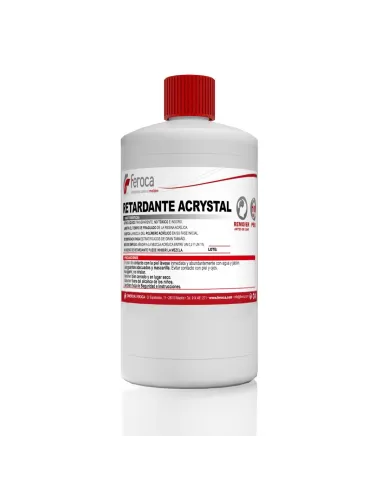
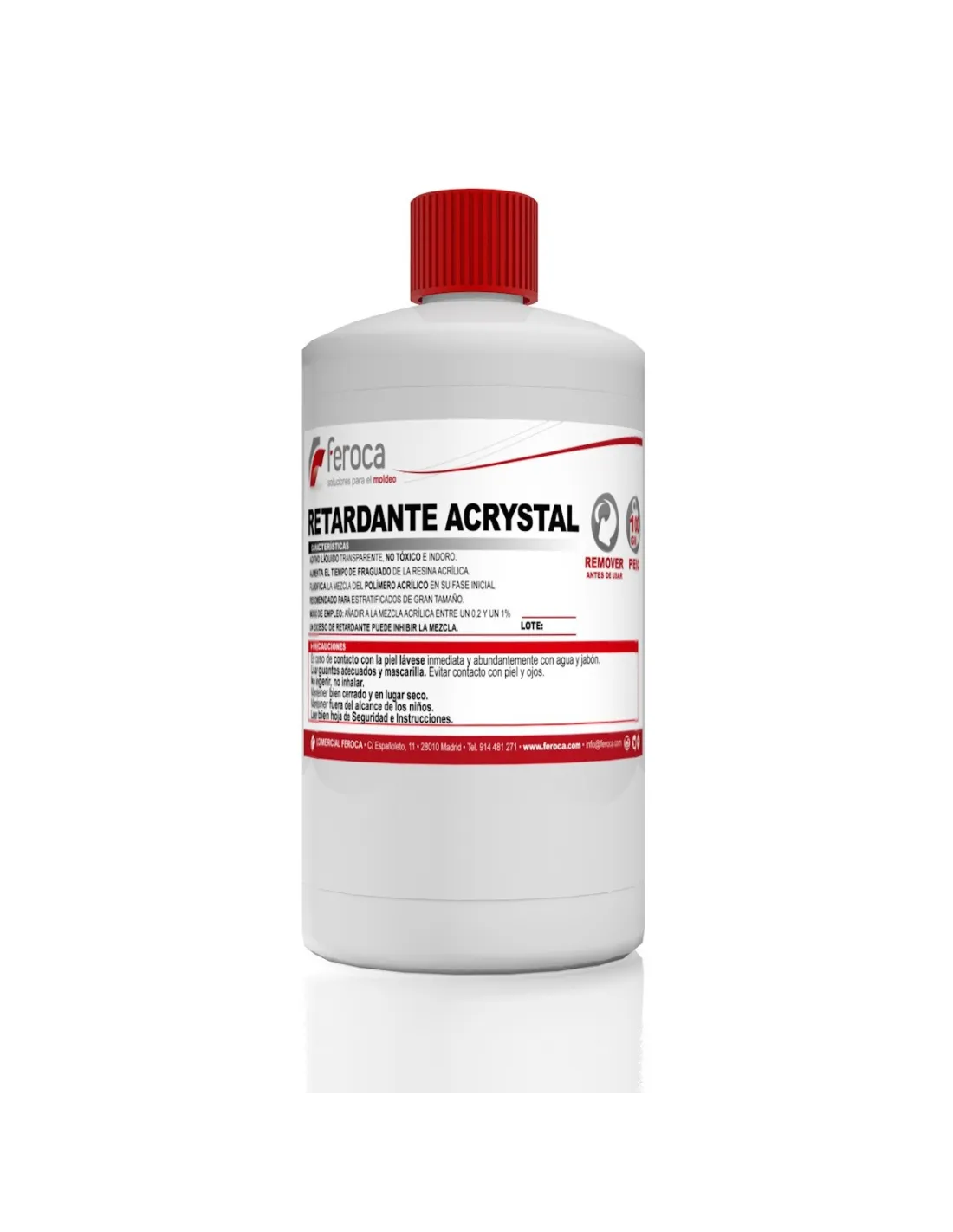
The Acrystal Retarder is a clear, non-toxic, odourless liquid additive that extends the setting time of acrylic resins. It fluidifies the mix during its initial phase, giving you more working time without compromising the final result. It is especially useful for large laminates or in high-temperature conditions where setting accelerates.
Technical specifications
| Parameter |
Value |
| Type |
Liquid retarding additive |
| Appearance |
Clear liquid |
| Toxicity |
Non-toxic |
| Odour |
Odourless |
| Recommended dose |
0.2% – 1% of the total mix weight |
| Maximum dose |
1% of the total mix weight |
| Compatibility |
Acrylic resins (Acrystal, Jesmonite) |
What it is used for
This retarder is designed for professionals and advanced users working with Acrystal Prima, Jesmonite AC100 or other acrylic resins who need more handling time. Typical use cases:
- Large-surface laminates where lamination time is long
- Complex castings with fine detail that require more positioning time
- Working in warm environments where setting naturally accelerates
- Mixes with fillers or pigments that slow down incorporation and need more mixing time
- Projects with Jesmonite pigments where a very uniform colour distribution is required
- Layered applications with Jesmonite AC730 Flex Metal where more gel coat application time is needed
How to use it
- Prepare and weigh the components of your acrylic resin according to the manufacturer's instructions.
- Calculate the retarder dose: between 0.2% and 1% of the total mix weight (polymer + liquid). Always start with the minimum dose.
- Add the retarder to the liquid component of the resin before incorporating the powder or polymer. Mix briefly to homogenise.
- Add the powder polymer to the already-retarded liquid and mix with slow, steady movements to avoid bubbles.
- Work the mix as normal. You will have a noticeably longer working time than without the additive.
- If you are also using the Tixotropante Acrystal for vertical applications, add it during this mixing phase as well.
- Pour or apply the mix into the mould or onto the surface and allow to set according to the time indicated for the resin used.
Warning: Exceeding 1% retarder can permanently inhibit setting, leaving the mix uncured. Always weigh accurately and do not exceed the maximum recommended dose.
Usage tips
Adjust the dose according to ambient temperature
In summer or with workshop temperatures above 22–25 °C, the setting of acrylic resins accelerates significantly. Under those conditions you can approach the 1% mark. In winter or at low temperatures, setting is already slower on its own; stay at 0.2–0.3% or skip the retarder altogether. Always use a workshop thermometer to have real control over conditions.
Weigh it — don't estimate by eye
The difference between 0.2% and 1% can be a fraction of a gram in small mixes. A precision scale (0.01 g resolution) is essential for using this additive safely. Even a slight excess can slow setting more than desired; exceeding the maximum can ruin the piece entirely.
Combine with the thixotropic agent only if necessary
If your project requires applying the resin on vertical or inclined surfaces, you can use the Tixotropante Acrystal together with the retarder in the same mix. However, adding several additives at once requires greater precision in weighing. Always carry out a small-scale test before tackling the final piece.
Frequently asked questions
How much retarder should I add if it's my first time using it?
Always start with the minimum dose: 0.2% of the total mix weight. This lets you evaluate the effect without risk of inhibition. If you need more working time, increase gradually up to 1% in successive tests.
Can it affect the final finish of the piece?
When used within the recommended range (0.2–1%), the Acrystal Retarder does not alter the mechanical properties or the surface appearance of the cured resin. It only modifies the setting time.
Can it be used for both castings and laminates?
Yes. It is equally valid for mould castings and fabric laminates. It is in large laminates where its usefulness is most noticeable, as it allows the fabric to be thoroughly saturated before the resin begins to gel.
Is it compatible with all acrylic resins?
The Acrystal Retarder is formulated for water-based acrylic resins such as Acrystal Prima and Jesmonite AC100. It is not suitable for polyester, epoxy or polyurethane resins.
What happens if I exceed the maximum dose?
Exceeding 1% can irreversibly inhibit curing, leaving the mix sticky or uncured. If this happens, the piece cannot be salvaged and must be redone. This is why precise weighing is essential.
Can I add it together with other additives such as the thixotropic agent?
Yes, it is possible to combine the Acrystal Retarder with the Tixotropante Acrystal in the same mix. Always carry out a prior small-scale test to verify the behaviour before applying it to the final piece.
How should it be stored correctly?
Store the retarder in its original tightly closed container, in a cool, dry place away from heat sources and direct sunlight. Being a non-toxic, odourless product, it requires no special storage conditions beyond the usual ones for workshop additives.
At what point in the process is the retarder added?
It is added to the liquid component of the resin before incorporating the powder or polymer. Mixing it first with the liquid ensures uniform distribution throughout the mass and prevents lumps or unretarded areas.
How much product do I need?Calculate the exact amount before buying and avoid wasting material.
Go to the calculator →