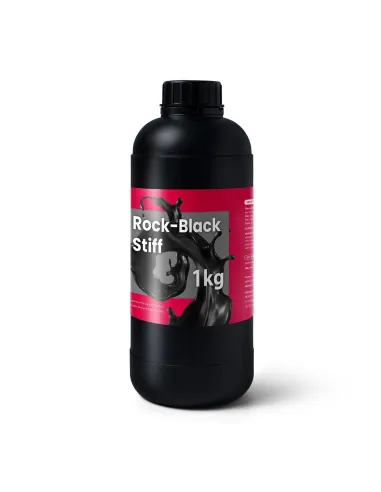
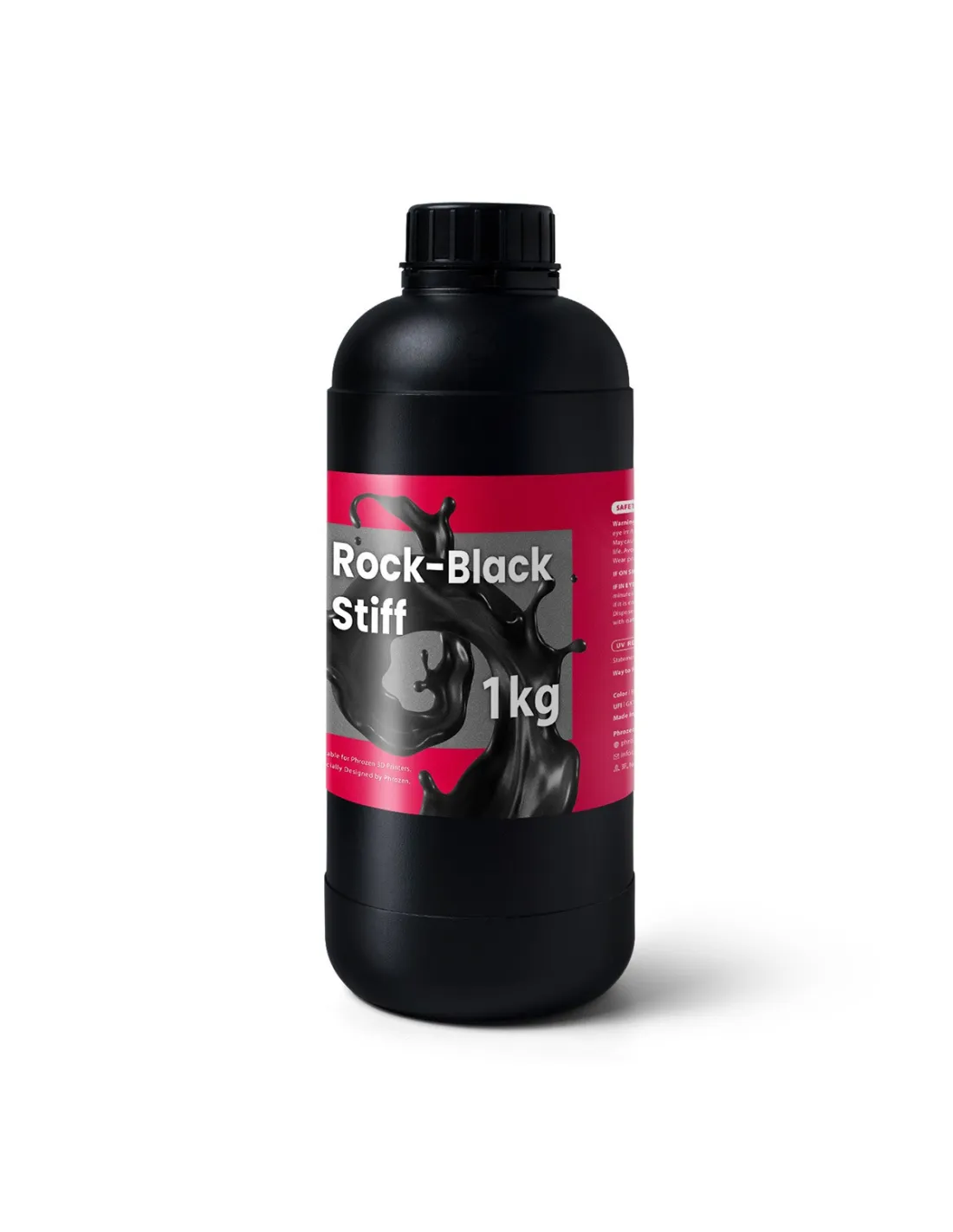
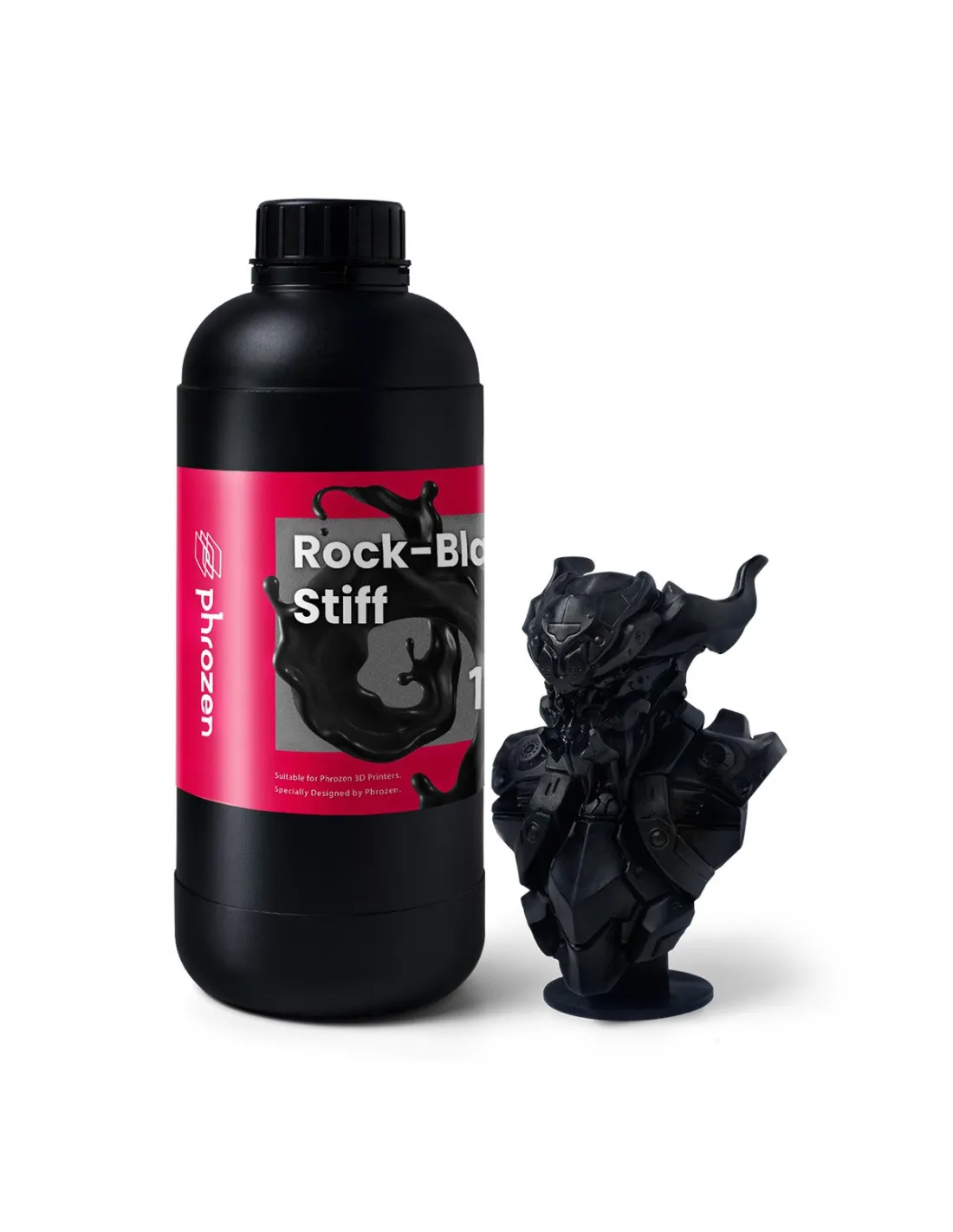
Phrozen Rock-Black Stiff is a photopolymer resin for UV-curing 3D printers (LCD/MSLA) formulated for parts that demand high rigidity, low shrinkage and sustained thermal resistance up to 97 °C. With a hardness of 81 Shore D and an intense black finish, it is the go-to option when a prototype or final part must withstand demanding mechanical and thermal conditions without deforming.
Technical specifications
Parameter
Value
Contents
1 kg per bottle
Color
Intense black
Density
1.1 g/cm³
Viscosity
70–170 cps
Surface hardness
81 Shore D
Tensile strength (UTS)
30 MPa
Tensile modulus
419 MPa
Elongation at break (EAB)
4 %
Notched impact resistance (Izod)
2.68 J/m
Thermal resistance
Up to 97 °C
Type
High strength
Compatible technology
LCD / MSLA (UV photocuring)
What it is used for
Phrozen Rock-Black Stiff is designed for professionals and technicians who need printed parts with predictable mechanical behaviour and high dimensional tolerance. Its extreme rigidity and heat resistance make it suitable for a wide range of engineering and manufacturing applications:
Functional engineering prototypes that must withstand real mechanical loads
Internal structural components of products or mechanisms
Parts that operate close to heat sources (up to 97 °C)
Master moulds for low-pressure moulding or thermoforming
Technical housings, brackets and clamps
Automotive, electronics and robotics parts requiring high surface hardness
Short-run workshop tooling
How to use it
Shake the bottle thoroughly before pouring the resin into the printer vat. Components may settle during storage.
Configure the print parameters according to the profile recommended by Phrozen for your printer model and desired layer thickness. Start with the official profiles and adjust to suit your machine.
Print the part. During printing, ensure the workspace is adequately ventilated, as photopolymer resins emit vapours during the process.
Remove the part from the build plate carefully. Use nitrile gloves and safety glasses.
Wash the part in isopropyl alcohol 99.9 % to remove uncured liquid resin. Two successive baths (one pre-wash and one final wash) improve the result.
Dry the part thoroughly before post-curing to avoid surface stains or bubbles.
Post-cure the part under UV light (curing station or UV box) for the time indicated by the manufacturer. This step is critical to achieve the maximum mechanical and thermal properties specified (81 Shore D, 97 °C).
Finish or post-process the part as required: sanding, priming, painting or light machining.
Warning: Phrozen Rock-Black Stiff is an uncured photopolymer resin that may cause skin irritation and sensitisation. Always work with nitrile gloves (not latex), safety glasses and in well-ventilated areas. Avoid contact with skin and eyes. Uncured liquid resin is harmful to the aquatic environment: do not pour it down the drain. Cure resin waste under UV light before disposing of it in accordance with local regulations.
Usage tips
Full post-curing: key to thermal properties
The thermal resistance specifications (97 °C) and hardness (81 Shore D) are only achieved with proper post-curing. Under-curing produces brittle parts or parts with lower heat resistance. If you do not have a UV station, you can use a DIY box with 405 nm UV LED strips, although times will be longer. Always check that the part no longer has any tacky areas before considering it fully cured.
Efficient washing with isopropyl alcohol
Use two containers of isopropyl alcohol 99.9 %: the first removes the bulk of the uncured resin, the second gives a clean finish. Replace the first container when the liquid becomes heavily saturated (intense yellow tint). Gently agitate the part in the alcohol rather than leaving it to soak for long periods, as rigid resins can absorb moisture and lose surface properties with excessive exposure.
Resin storage and shelf life
Store the bottle tightly closed, in a cool, dark place (between 15 and 25 °C), away from direct sunlight and heat sources. Ambient UV light can initiate partial curing of the resin in the vat if the printer is left exposed. If you are storing leftover resin from the vat, filter it before returning it to the bottle to remove any cured particles. Always shake before use, regardless of storage time.
Frequently asked questions
Is it suitable for printing functional parts that will be subjected to mechanical loads?
Yes. Phrozen Rock-Black Stiff is specifically formulated for engineering parts that require high rigidity (tensile modulus of 419 MPa) and surface hardness (81 Shore D). However, its elongation at break is low (4 %), so it is not suitable for parts that need flexibility or strong impact absorption. For high impact loads, it is advisable to evaluate a design that distributes stresses.
What is the maximum working temperature it can withstand?
Phrozen Rock-Black Stiff withstands up to 97 °C under continuous use conditions, provided the part is correctly post-cured. Above that temperature, deformation may occur. If your application exceeds that threshold occasionally or continuously, you will need to evaluate resins with higher thermal resistance.
Which printers is it compatible with?
It is compatible with LCD/MSLA 3D printers that work with UV photocuring resins (typical wavelength: 405 nm). Phrozen provides its own print profiles for its printer models. For other brands, use those profiles as a reference and adjust exposure times according to your screen power and chosen layer thickness.
How are freshly printed parts cleaned?
The recommended method is washing in isopropyl alcohol 99.9 %. Use two successive baths and dry the part thoroughly before UV post-curing. Always wear nitrile gloves when handling uncured parts.
Can it be sanded, drilled or machined once cured?
Yes. Once fully post-cured, Phrozen Rock-Black Stiff accepts light mechanical post-processing operations: sanding, drilling, milling or tapping. Its high hardness (81 Shore D) makes machining relatively straightforward with conventional tools. For more demanding machining operations, work at low speed and avoid generating excessive localised heat to prevent weakening the part.
Can the printed part be painted or primed?
Yes. Phrozen Rock-Black Stiff accepts conventional primer and paint once cured and sanded. Since the base colour is intense black, if you need light colours over it, first apply a white or light grey primer. Clean the surface thoroughly before painting to remove any traces of isopropyl alcohol or grease.
How long can the resin be stored unopened?
Under correct storage conditions (dark place, temperature between 15 and 25 °C, away from direct sunlight), the resin retains its properties for the period indicated by the manufacturer on the packaging. Once opened, close the bottle tightly and shake before each use. If you notice lumps or partial curing inside the bottle, the resin is no longer suitable for use.
How does it differ from other Phrozen resins in the catalogue?
Phrozen's catalogue at Feroca includes different formulations depending on the application. Phrozen Water-Washable Model Gray washes with water and is intended for general modelling. ABS-Like Matte Gray offers behaviour closer to ABS with slightly greater toughness. Aqua-Gray 4K is optimised for high-resolution printers and fine finishing. Rock-Black Stiff is the highest rigidity and thermal resistance option in the group, aimed at engineering parts.
Video tutorial
How to do the printing test for Sonic Mighty 4K - Phrozen LCD 3D Printer
Cookies on this site are used to personalise content and ads to deliver social media features and to analyse traffic. We also share information about your use of the site with our social media partners for advertising, personalisation and web analytics.. More information.