Shopping Cart


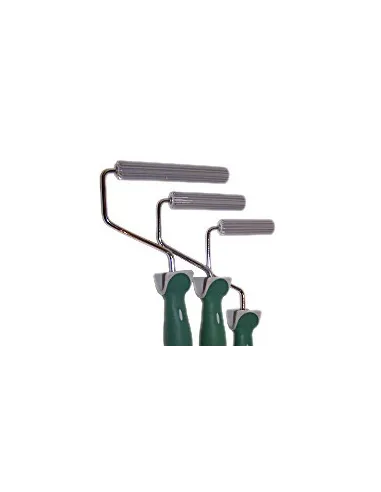
Metal Deaerator Roller -Laminates-
305082207
€8.00
9,68 € Tax incl.
9,68 € Tax incl.
Metal de-airing roller for laminates. Horizontal grooves that eliminate trapped air and excess resin. Price per unit.
The metal de-airing roller is the essential tool for achieving bubble-free and void-free laminates. Its horizontal grooves work the fresh resin mechanically, displacing trapped air between fibre layers and expelling excess resin with each pass. The result is a more compact, homogeneous laminate with a better fibre/resin ratio.
Technical specifications
| Feature | Detail |
|---|---|
| Material | Metal (steel) |
| Groove type | Horizontal |
| Main function | De-airing and removal of excess resin in laminates |
| Compatibility | Polyester resins, epoxy resins, gel coat |
| Price | Per unit |
What it is used for
This roller is designed specifically for the hand laminating process with fibreglass, carbon fibre or other technical fibres. It allows each reinforcement layer to be worked efficiently, ensuring correct impregnation and a defect-free laminate.
- De-airing fibreglass laminates with polyester resin or epoxy resin
- Removal of excess resin from each layer of woven fabric or mat
- Consolidation of fibre against the mould to prevent delamination
- Repair work on composite parts (bodywork, boats, tanks)
- Laminates using surface veil for quality finishes
- Part manufacturing in composites workshops and special effects
How to use it
- Prepare the clean mould and apply the gel coat or the first resin layer according to the process.
- Place the first fibre layer (mat, woven fabric or veil) onto the impregnated or dry surface, depending on the technique.
- Apply resin onto the fibre using a laminating brush, distributing it evenly.
- Pass the metal de-airing roller with firm pressure and movements in different directions to saturate the fibre and expel trapped air.
- The horizontal grooves of the roller channel excess resin away from the working area, preventing build-up.
- Repeat the operation on each fibre layer you add to the laminate.
- Clean the roller with acetone or a suitable solvent immediately after use, before the resin cures.
Usage tips
Correct rolling technique
Do not apply too much pressure in a single direction. Work the roller in crossed passes (horizontal, vertical, diagonal) to ensure that air moves from the interior towards the edges. On corners and radii, reduce the rolling speed and press the roller down gradually to avoid lifting the fibre.
Cleaning and maintenance
Polyester and epoxy resins cure quickly on metal. Clean the roller with acetone (for polyester) or with the solvent specified by the epoxy resin manufacturer after each use. If the resin has already cured on the roller, it may be difficult to remove without damaging the tool. Store the roller in a dry place to prevent metal oxidation.
Combination with other tools
For best results, combine the de-airing roller with a laminating brush for the initial impregnation of the fibre. The roller acts during the consolidation phase, while the brush is more effective for the initial distribution of resin. If you are working with surface veil, use the roller with extra care to avoid displacing this delicate layer.
Frequently asked questions
What is a de-airing roller used for in laminates?
A de-airing roller removes air bubbles trapped between fibre and resin layers during hand laminating. The metal de-airing roller with horizontal grooves also expels excess resin, which improves the fibre/resin ratio and the mechanical strength of the finished part.
When should I use the roller during the laminating process?
Use the roller immediately after impregnating each fibre layer with resin, while it is still fresh and fluid. If you wait too long and the resin starts to gel, the roller will not be able to move the material and you could drag or tear the fibre.
Does this roller work with epoxy resin as well as polyester?
Yes. The metal de-airing roller is compatible with polyester resins such as Ferpol 100 BSX15 and with epoxy resins such as Epofer Laminate 401. The metal does not react with either of these resins. Always clean the tool with the appropriate solvent for each system.
How do you clean the roller after use?
Clean the roller with acetone immediately after use, before the resin cures. For epoxy resins, use the solvent recommended by the manufacturer. If the resin has cured on the roller, the cleaning process is much more complicated and may require mechanical sanding or replacement of the part.
What types of fibre are compatible with this roller?
The roller works with any type of fibre used in hand laminating: fibreglass mat, fibreglass woven fabric, surface veil, carbon fabrics and natural fibres. For more delicate fibres such as surface veil, apply less pressure to avoid displacing the layer.
Is it necessary to use a Release agent before laminating?
Yes, whenever you intend to demould the part it is essential to apply a Release agent to the mould before you start. Without a Release agent, the resin can permanently bond to the mould and ruin both the part and the mould. Feroca stocks several types of Release agent depending on the resin system and the mould material.
Can I use the roller to apply gel coat?
It is not the most suitable tool for applying gel coat. gel coat is best applied with a spray gun or a brush, depending on the desired thickness and finish. The de-airing roller is optimised for the laminating phase, not for the gel coat layer.
What catalyst ratio should I use for polyester laminating resin?
For polyester resins such as Ferpol 100 BSX15, the typical catalyst (MEKP) ratio is approximately 1.5% by weight, with a range of 1 to 2% depending on ambient temperature. Always weigh both components and mix until you obtain a homogeneous liquid before applying.
No reviews
Tap to zoom