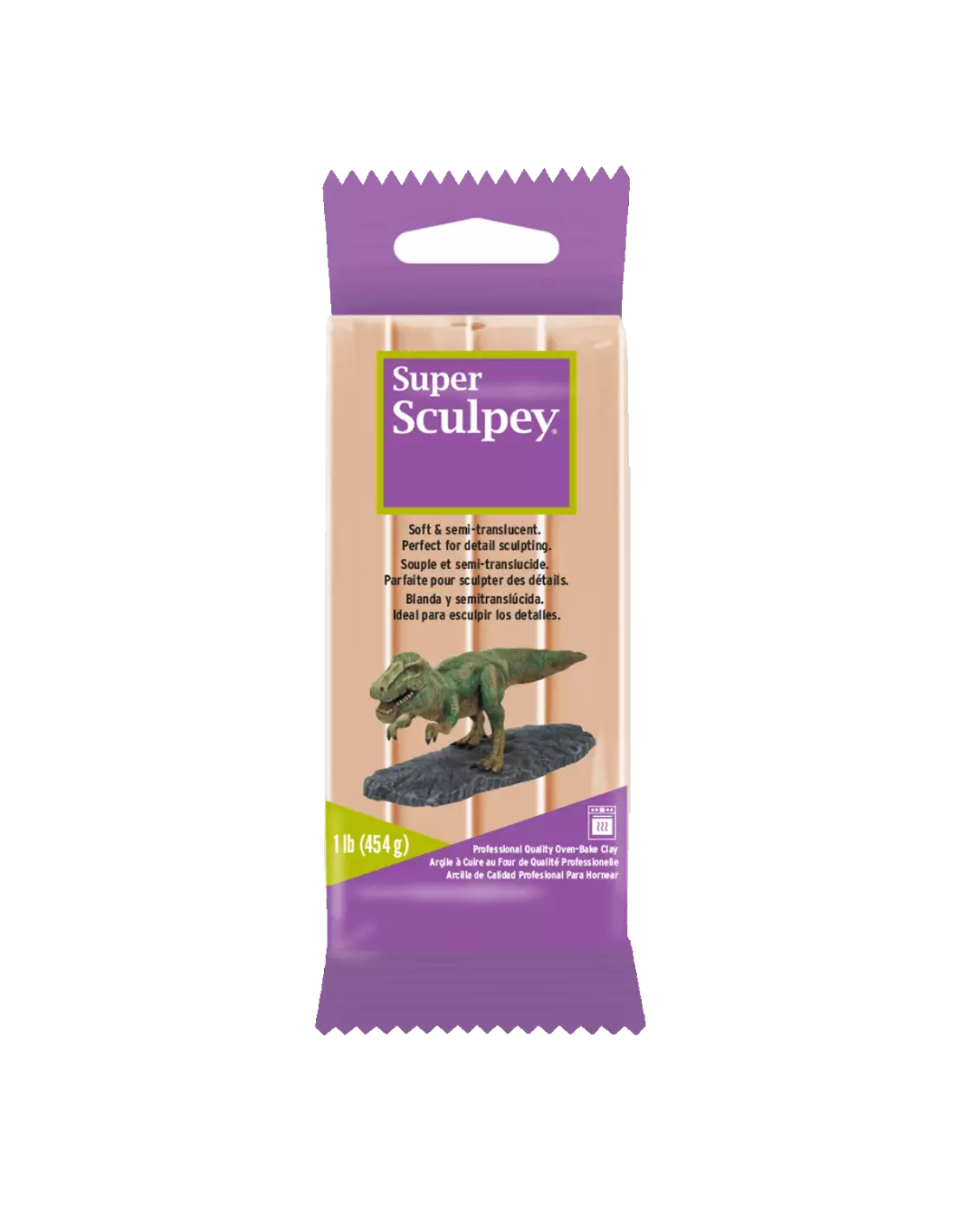
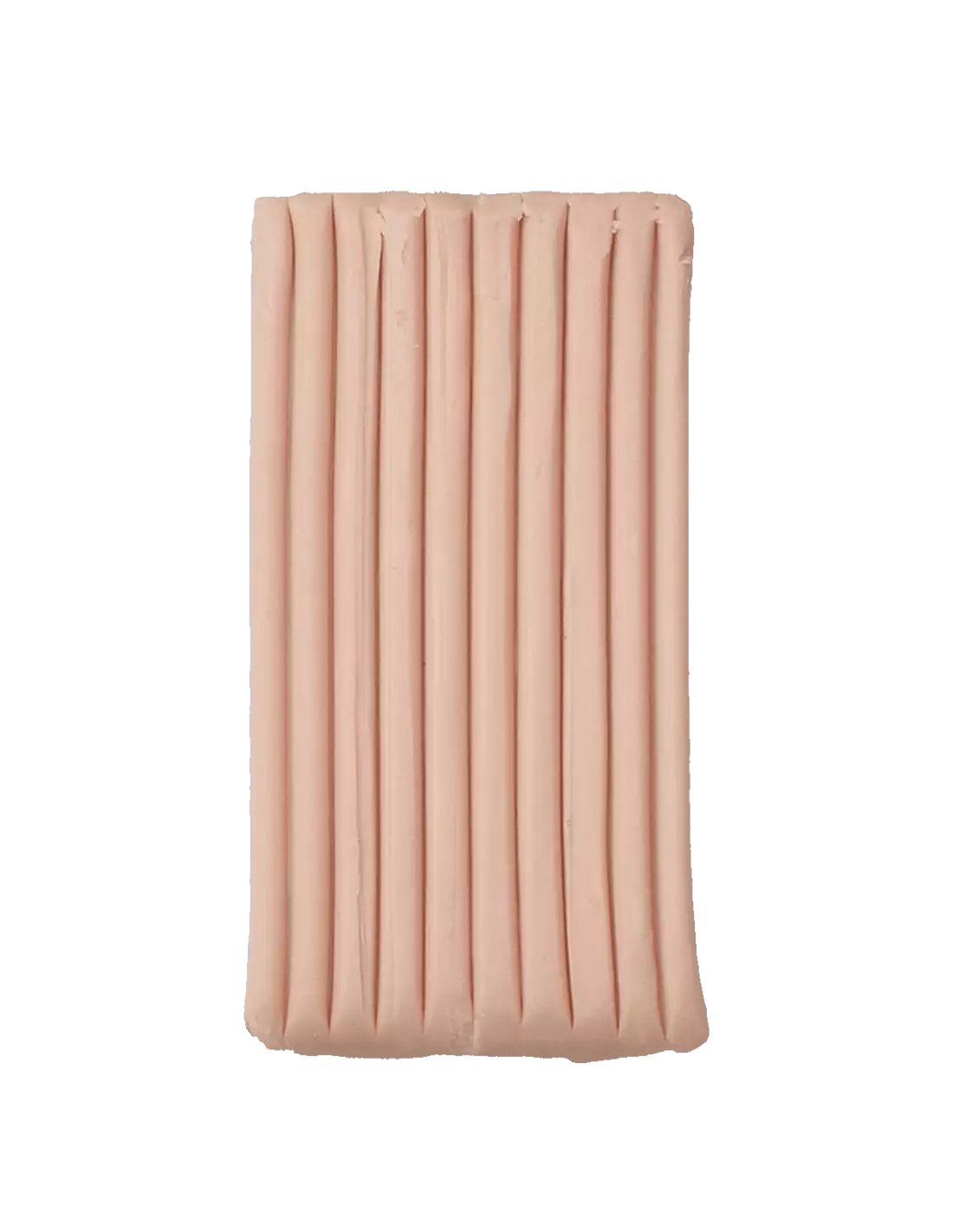
Super Sculpey Beige is the reference polymer clay for professional sculpture and fine detail prototyping. Its translucent flesh tone makes it the go-to choice for figure sculptors, special effects workshops and prototype designers. It doesn't harden in air, so you work at your own pace and bake the piece when it's finished.
Technical specifications
| Format | 454 g (1 lb) |
|---|
| Colour | Translucent flesh (beige) |
|---|
| Baking temperature | 130 °C (275 °F) |
|---|
| Baking time | 15 min per 6 mm of thickness |
|---|
| Curing | Oven-cure — does not harden in air |
|---|
| Finish after baking | Semi-translucent, ceramic-like |
|---|
| Toxicity | Non-toxic |
|---|
What it's used for
Super Sculpey Beige is formulated for fine detail sculpture. Its medium consistency — neither too soft nor too rigid — allows you to work skin textures, wrinkles and facial features with great precision. It is the most widely used clay in special effects workshops, stop-motion animation and the design of collectible figures and toys.
- Sculpture of articulated figures, busts and characters
- Prototypes for silicone or resin moulds
- Anatomical modelling and human skin replicas
- Detailed scale models and miniatures
- Special effects: prosthetics, mechanical heads, creatures
- Artistic and decorative sculpture
- Masters for resin or latex production runs
How to use it
- Condition the clay: work it with your hands for a few minutes until it is pliable and smooth. In cold environments, warm it briefly with your palms or a hair dryer on a low setting.
- Sculpt your piece: use modelling tools to work the fine details. You can add and remove material at any point before baking.
- Blend with other clays if you need firmness variations: mix with Super Sculpey Firm Gray to achieve a harder consistency and greater detail retention.
- Prepare the oven: preheat a domestic oven to 130 °C (275 °F). Use an oven thermometer if you have any doubts about the calibration of your appliance.
- Bake the piece: allow 15 minutes per 6 mm of thickness. Place the sculpture on a non-stick surface or baking paper.
- Allow to cool: remove from the oven and leave to cool to room temperature before handling the piece. Do not force cooling with cold water.
- Final finishing: once cool, you can sand, paint, glue with cyanoacrylate adhesive or use the piece as a master for mould making.
Usage tips
Temperature and consistency
The consistency of Super Sculpey Beige varies with ambient temperature. In summer or in warm workshops it can feel somewhat soft; in that case, refrigerate it for a few minutes before sculpting. In winter, work it with your hands for longer before you start. If you need a firmer clay for very high-detail pieces, blend it with Super Sculpey Firm Gray: mixing the two lets you adjust the hardness to your preference.
Safe and even baking
Never exceed 135 °C: above that temperature the clay can burn, darken and release fumes. If your sculpture has areas of very different thickness (for example, a thin finger and a thick torso), protect the thinner parts with aluminium foil during the last few minutes of baking to prevent them from burning before the thicker sections are fully cured. Baking can be done in multiple stages: bake already-finished parts and continue sculpting over them.
As a master for moulds
Super Sculpey Beige is a very common material as an original for making silicone moulds. Bear in mind that polymer clays may contain traces of sulphur that inhibit the cure of platinum silicones. Before pouring a platinum silicone over a baked piece, always seal the surface with lacquer or shellac and allow it to cure completely. Alternatively, use condensation (tin) silicones, which have no inhibition issues with this material.
Frequently asked questions
Can it be baked in a regular kitchen oven?
Yes. Super Sculpey Beige is baked in any standard domestic oven at 130 °C. It is recommended to use a standalone oven thermometer to make sure the temperature is correct, as many domestic ovens are not well calibrated. Do not use a microwave.
What happens if the clay burns in the oven?
If you exceed 135 °C or leave it in too long, the clay darkens, becomes brittle and may release smoke. Ventilate the space well if this happens. To avoid it, always use an oven thermometer and monitor baking times according to the thickness of the piece.
Can I use this clay as a master for making a silicone mould?
Yes, it is one of its most common uses. If you are using a platinum silicone, first seal the baked surface with lacquer or shellac to avoid potential inhibition issues. With condensation (tin) silicones this step is not necessary.
Can it be painted after baking?
Yes. Once baked and cool, Super Sculpey Beige accepts acrylic paints, enamels and lacquers. Its semi-translucent finish is particularly valued for skin replicas, as it allows for a natural appearance. You can sand it, drill it and glue parts with cyanoacrylate adhesive.
How long can I work the clay before baking it?
Indefinitely. Super Sculpey Beige does not dry in air, so you can leave an unfinished sculpture for days, weeks or months without it hardening. Store it wrapped in cling film or in a sealed bag to prevent dust build-up.
Is it suitable for children?
Super Sculpey Beige is non-toxic, but it is intended as a professional or semi-professional material. If used with minors, it should always be done under adult supervision, especially during the baking process.
Can I mix it with other polymer clays?
Yes. You can mix Super Sculpey Beige with Super Sculpey Firm Gray to achieve a harder consistency and greater detail retention. It is also compatible with other polymer clays from the same family. For flexible sculpture, you can explore Cosclay, which retains some flexibility after baking.
What tools are recommended for working with this clay?
Standard sculpture tools: needles, spatulas, loops and sticks. The 11-piece modelling tool set from Feroca is a great starting point. You can also use a scalpel, wooden sticks or second-hand dental tools for very fine detail work.