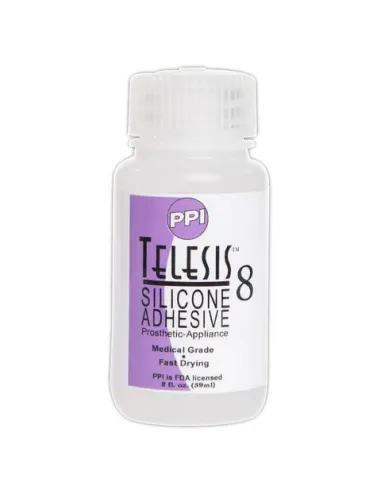
Telesis 8 is the most widely used medical-grade silicone adhesive in the special effects and prosthetic make-up industry. Pressure-sensitive, it delivers an extraordinarily strong and long-lasting bond without damaging silicone or latex prosthetics. Combined with Telesis 8 Thinner, working time can be adjusted to suit each application.
Technical specifications
| Property |
Detail |
| Adhesive type |
Pressure-sensitive silicone (PSA) |
| Grade |
Medical |
| Compatible substrates |
Platinum silicone, latex, skin |
| Compatible accelerator |
Telesis 8 Thinner / Telesis 9 Thinner |
| Recommended remover |
Telesis Silicone Remover |
| Damages silicone or latex prosthetics |
No |
| Main application |
Prosthetic make-up, special effects |
What it is used for
Telesis 8 is designed specifically to bond silicone and latex prosthetics to skin with maximum safety and hold. Its medical-grade formulation makes it ideal for applications in high-movement areas where other adhesives fail.
- Bonding platinum silicone prosthetics (noses, ears, chins, scars)
- Adhering latex appliances to skin
- Adhesion in problem areas such as the eye contour, corners of the mouth and forehead
- Prosthetic make-up for film, television and theatre
- Professional FX make-up and high-demand special effects
- Securing wig lace and postiche facial hair
How to use it
- Clean and degrease the skin in the application area to ensure maximum adhesion.
- Apply a thin layer of Telesis 8 to the silicone or latex prosthetic using a spatula or brush.
- Allow the adhesive to dry until it is translucent and slightly tacky to the touch (contact technique).
- To speed up drying, prime the skin with Telesis 8 Thinner before placing the prosthetic.
- Press the prosthetic firmly onto the skin and hold pressure for a few seconds until the adhesive is set.
- If you need a slower-drying version for complex areas, consider Telesis 8S (Slow).
- To remove the prosthetic, apply Telesis Silicone Remover to the edges and allow it to work before carefully peeling away.
Usage tips
Drying time control
The drying time of Telesis 8 can be easily adjusted to suit the needs of the shoot or session. Applying Telesis 8 Thinner or Telesis 9 Thinner as a primer on the skin reduces cure time to just a few moments once the two surfaces make contact. If you need more working time for large-surface prosthetics, go directly for Telesis 8S (Slow). For ultra-fast on-set applications, Telesis 8F (Fast) is the ideal alternative.
Compatibility with encapsulants
Telesis 8 works perfectly on prosthetics made with encapsulants such as Key-Cap Plastic. The encapsulant layer not only protects the prosthetic but also improves the adhesion surface of Telesis 8 by creating a more receptive substrate. Make sure the prosthetic is fully cured and clean before applying the adhesive.
Storage and preservation
Always keep the container tightly closed after each use to prevent evaporation of the carrier solvent. Store in a cool, dry place away from heat sources. If the adhesive thickens over time, its consistency can be adjusted with small amounts of Thinner. Do not expose to extreme temperatures during transport or storage.
Frequently asked questions
Can this adhesive be used directly on skin?
Yes. Telesis 8 is a medical-grade adhesive formulated specifically for skin contact. It is routinely used by FX make-up, film and theatre professionals to bond prosthetics directly to the face and body, including sensitive areas such as the eye contour and mouth.
How is this type of silicone adhesive removed from skin?
The recommended method is Telesis Silicone Remover, a fast-acting solvent with an odourless, non-oily formula that incorporates vitamins D and E and Aloe Vera. Applied to the edges of the prosthetic, it dissolves Telesis 8 without damaging the silicone or latex prosthetic or wig lace.
What is the difference between the various versions of this adhesive?
Telesis 8 is the standard version, with a balanced drying time suited to most applications. Telesis 8F (Fast) offers faster drying for on-set situations with limited time. Telesis 8S (Slow) extends working time, ideal for large or complex prosthetics. All share the same medical-grade silicone chemical base.
Does this adhesive damage platinum silicone prosthetics?
No. Telesis 8 is specifically formulated not to damage or degrade platinum silicone or latex prosthetics. This is one of the reasons it is the reference adhesive in the professional special effects industry.
How can drying time be accelerated?
The most effective method is to prime the skin with Telesis 8 Thinner before placing the prosthetic. When the adhesive applied to the prosthetic contacts the primed skin, cure time is drastically reduced, resulting in an immediate and firm bond.
Can this adhesive be used with encapsulated prosthetics?
Yes. Telesis 8 is fully compatible with prosthetics encapsulated with products such as Key-Cap Plastic. The encapsulant layer provides a clean, receptive surface that facilitates adhesion. Make sure the encapsulant is completely dry and clean before applying the adhesive.
What other adhesives can complement this one in an FX make-up kit?
For a complete FX make-up kit, PROTAC Acrylic Adhesive is a widely used acrylic-based alternative for latex foam appliances and other porous substrates. Each adhesive has its optimal field of application: Telesis 8 for silicone and latex, PROTAC for porous materials and lighter applications.
Is it necessary to encapsulate the prosthetic before bonding?
It is not essential, but encapsulating the prosthetic notably improves the final result with platinum silicone. The encapsulant creates a thin, strong edge that facilitates adhesion, conceals the margins and protects the prosthetic. If you make silicone prosthetics without an encapsulant, Telesis 8 also bonds directly to cured silicone.